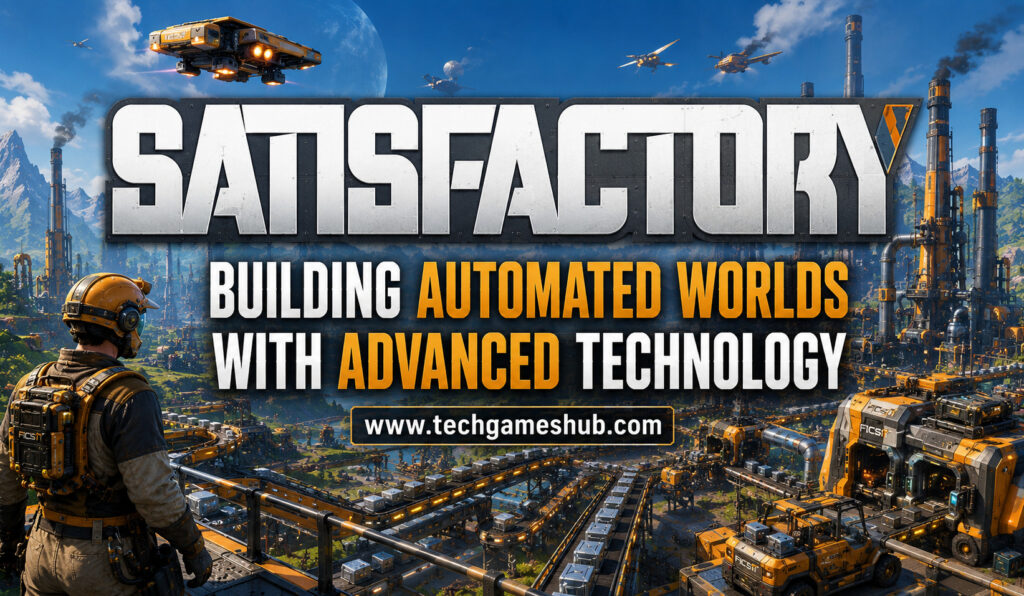
Satisfactory turns industrial automation into a first-person exploration and construction experience. Instead of simply managing a factory from above, players physically move through their industrial world, gather resources, construct production lines, explore unfamiliar landscapes, and gradually transform a natural environment into a highly automated manufacturing network.
Technology is at the heart of this progression. Players begin with relatively simple equipment and production methods before unlocking increasingly advanced machines, transportation systems, power infrastructure, and automation tools. As the factory grows, the game becomes less about collecting individual resources and more about designing interconnected systems.
This combination of exploration, construction, logistics, and technology gives Satisfactory a distinctive approach to factory simulation.
What Makes Satisfactory Different?
Factory-building games often focus primarily on production efficiency. Satisfactory adds another dimension by placing the player directly inside the world.
Players can walk through factories, inspect machines, build infrastructure, explore landscapes, and watch production systems operate from a first-person perspective.
This makes automation feel physical.
A conveyor belt is not simply a line on a management screen. It is an actual structure running through the environment. Production buildings occupy physical space, power lines connect different areas, and transportation systems can stretch across enormous distances.
The factory becomes part of the world rather than a separate management interface.
Starting With Basic Technology
The early stages of Satisfactory introduce players to the fundamentals of industrial production.
Players gather raw materials and use basic machines to process them into more useful components. As production requirements become more complicated, manual work becomes increasingly inefficient.
This creates a natural reason to automate.
Instead of collecting every resource personally, players construct machines that perform repetitive tasks. Over time, simple production chains become interconnected industrial systems.
The progression is satisfying because players can see the physical impact of every technological improvement.
Automation Transforms the Landscape
One of the most visually interesting aspects of Satisfactory is how much the factory can change its surroundings.
A natural landscape can gradually become filled with conveyor belts, machines, pipelines, power infrastructure, storage facilities, railways, and other industrial structures.
The environment becomes a reflection of technological progress.
At the beginning, the world may look untouched. Later, the same area can resemble a massive industrial complex.
This transformation creates a strong sense of accomplishment because players can physically see how far their technological systems have developed.
Resource Extraction Drives Expansion
Automation begins with resources.
Players must locate deposits and determine how to extract and transport materials efficiently. As factories become larger, nearby resources may no longer be enough.
This encourages expansion into new areas.
A resource deposit located far from the main factory can create an entirely new engineering problem. Players may need to construct long conveyor lines, pipelines, power connections, or transportation networks.
The world therefore becomes part of the logistics challenge.
Exploration is not separate from factory building. Discovering resources directly determines where the industrial network can expand.
Advanced Technology Creates New Possibilities
Satisfactory uses technological progression to gradually introduce more sophisticated production methods.
Players unlock improved machines, transportation options, energy systems, and manufacturing capabilities. These technologies make larger and more complicated factories possible.
However, every advancement also increases the complexity of the production network.
Producing a new component may require several intermediate materials. Those materials may require different machines, resources, and power sources.
As a result, technological progress creates a continuous cycle of expansion.
New technology allows players to produce more, but producing more requires better infrastructure.
Conveyor Belts Become the Factory’s Circulatory System
Conveyor belts are one of the most recognizable features of Satisfactory.
They connect machines and allow resources to move automatically between different stages of production.
A well-designed conveyor network can make a factory operate smoothly without constant player intervention.
But as factories expand, logistics become increasingly complicated.
Players must think about belt capacity, routing, intersections, production speed, storage, and distances.
A factory can have excellent machines and still perform poorly if materials cannot reach them efficiently.
This makes logistics one of the most important parts of the game.
Power Is Essential to Automation
Automation depends on reliable energy.
Every major expansion can increase power requirements, forcing players to develop larger and more sophisticated energy systems.
This creates another layer of technological planning.
Players need to ensure that power generation can support their factories while also allowing room for future growth.
A sudden increase in production can place additional pressure on the energy network. Expanding power infrastructure therefore becomes an essential part of long-term planning.
Technology is not only about producing more goods. It is also about creating the infrastructure needed to support that production.
Factories Become Engineering Projects
As production becomes more advanced, a Satisfactory factory can begin to resemble a genuine engineering project.
Players need to understand how different machines interact and how materials move through the system.
A production chain may begin with raw ore and pass through several stages before producing a final component.
Each stage depends on the previous one.
If one machine produces materials too slowly, it can create a bottleneck. If transportation cannot keep up with production, resources may accumulate in one area while another machine remains idle.
Solving these problems requires observation, planning, and experimentation.
Designing Factories in Three Dimensions
Satisfactory’s first-person perspective adds another unique challenge: factories exist in three-dimensional space.
Players can build vertically, create elevated conveyor systems, construct platforms, and organize machines across multiple levels.
This creates opportunities for compact designs.
Instead of spreading everything across a flat area, players can build upward and use vertical space to organize production.
The three-dimensional building system also gives players considerable creative freedom. A factory can be designed purely for efficiency or shaped into an impressive industrial structure.
Exploration Supports Technological Progress
Satisfactory is not entirely about sitting inside a factory.
The world contains large natural environments that players can explore. These areas can contain useful resources, unusual locations, and opportunities for expansion.
Exploration can therefore lead directly to technological progress.
Finding a new resource can unlock new production possibilities. Discovering a better location can make it easier to construct a remote manufacturing facility.
The game continuously connects exploration with industrial development.
Automation Reduces Repetition
One of the most satisfying parts of Satisfactory is watching automated systems take over repetitive tasks.
At the beginning, players may personally collect and process materials. Later, machines can perform these activities continuously.
This allows players to focus on larger objectives.
Instead of spending time gathering basic resources, they can design a new production line, explore the map, expand the power network, or optimize an existing factory.
Automation therefore changes the player’s role over time.
The player starts as a worker and gradually becomes an industrial architect.
Efficiency Versus Creativity
Satisfactory gives players a constant choice between efficiency and creativity.
A highly optimized factory might use compact layouts and carefully calculated production ratios.
Another player may prioritize appearance, creating enormous buildings, organized walkways, decorative structures, and visually impressive transportation networks.
Both approaches can be rewarding.
This flexibility makes the game appealing to different types of players. Those who enjoy engineering can focus on optimization, while creative builders can treat the factory as a massive construction project.
Technology Creates a Sense of Scale
One of Satisfactory’s biggest strengths is the sense of technological scale it can create.
A small automated setup can eventually develop into a huge industrial network covering large sections of the game world.
Long conveyor systems connect remote resource locations. Trains transport materials between facilities. Power networks support massive production operations.
The player can physically walk through these systems and see them working.
That sense of scale makes technological progression feel tangible.
The Future of Automated Worlds
Satisfactory demonstrates how automation can become a form of world-building.
Players are not merely producing items. They are constructing infrastructure that changes how they interact with the environment.
Future factory games could push this idea even further with smarter logistics, adaptive machines, dynamic economies, advanced robotics, and AI-controlled production systems.
Factories could potentially respond automatically to changing resource availability or demand, creating even more complex industrial simulations.
The combination of artificial intelligence and automation could also allow non-player systems to build, optimize, and manage parts of an industrial world.
Conclusion
Satisfactory shows how advanced technology can transform a game world into a massive automated ecosystem. Players begin by collecting resources and building simple machines, but gradually develop complex production networks involving conveyors, power systems, transportation, and advanced manufacturing.
What makes the experience unique is the physical connection between technology and the environment. Factories occupy real space, transportation systems cross the landscape, and industrial expansion visibly changes the world.
Automation is therefore not just a tool for saving time. It becomes the central way players express progress, solve problems, and reshape their surroundings.
By combining first-person exploration with factory construction and technological progression, Satisfactory turns industrial automation into an immersive open-world experience where every machine can become part of a much larger technological system.