
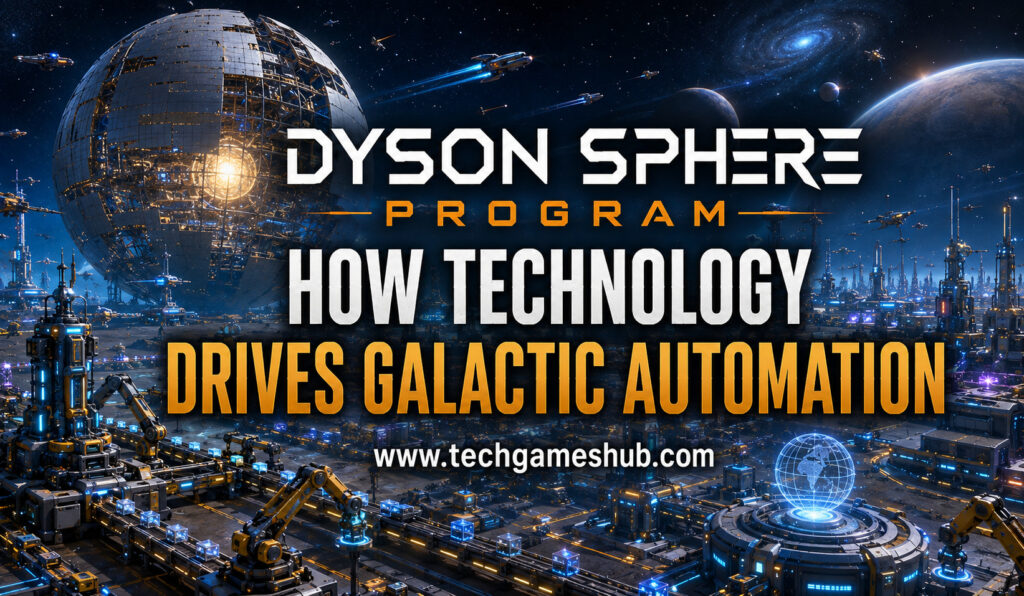
Dyson Sphere Program takes factory automation beyond a single planet and turns it into a challenge of managing an entire interstellar production network. Instead of building one industrial complex, players gradually develop automated factories across multiple planets, connect them through transportation systems, research advanced technologies, and eventually work toward constructing a Dyson sphere capable of harvesting enormous amounts of stellar energy.
The game’s central idea is simple but ambitious: technology allows a civilization to automate production on a galactic scale.
Every stage of progression introduces a new technological challenge. Players begin with basic resource collection and gradually move toward planetary logistics, interstellar transportation, advanced manufacturing, energy management, and large-scale space construction.
This progression makes technology more than a background theme. It is the system that drives the entire gameplay experience.
From One Planet to an Entire Galaxy
Dyson Sphere Program begins with relatively modest industrial objectives. Players establish production facilities, collect resources, research technologies, and build automated manufacturing systems.
However, the scale quickly expands.
As factories become more advanced, players can move beyond their starting planet and establish operations elsewhere. Different planets can provide access to different resources, creating a reason to expand the production network.
Eventually, the player’s factory is no longer a single location. It becomes an interconnected industrial system spread across multiple worlds.
This transformation is one of the game’s most impressive features.
Automation Is the Foundation
Automation is at the heart of Dyson Sphere Program.
Players construct mining machines, smelters, assemblers, storage systems, logistics facilities, and other production structures. These machines work together to transform raw resources into increasingly sophisticated components.
The goal is not simply to build more machines. It is to create production chains that operate efficiently with minimal manual intervention.
A basic resource may pass through several stages before becoming a component used in advanced research or space infrastructure.
This creates a constant engineering challenge: every new technological requirement can demand a new automated production system.
Technology Creates New Production Problems
One of the most interesting aspects of Dyson Sphere Program is that technological progress does not simply make the game easier.
New technologies often create more complicated production requirements.
Unlocking an advanced component might require several intermediate materials. Those materials may depend on resources from different planets, which can then require new transportation systems.
As a result, technological progress expands the player’s industrial responsibilities.
A new technology may solve one limitation while creating several new logistical problems.
This keeps the gameplay focused on continuous optimization.
Research Drives Expansion
Research is an essential part of technological progression.
Players invest resources into unlocking new capabilities, and each research milestone can introduce more sophisticated machines, transportation systems, energy technologies, or construction options.
Research therefore acts as a bridge between the current factory and its future capabilities.
The player is constantly deciding what technology will be most useful next.
Should production capacity be increased? Should transportation be improved? Should energy systems be upgraded? Should the player invest in technology that enables interstellar expansion?
These decisions make technological planning an important part of the strategy.
Planetary Factories Create Specialization
Once players begin operating across multiple planets, specialization becomes increasingly valuable.
One planet might focus on mining raw materials, while another could process those materials into refined components. A third world might specialize in advanced manufacturing.
This approach resembles a real industrial network.
Instead of forcing every planet to produce everything, players can create specialized production centers and connect them through logistics systems.
This makes the galaxy itself part of the factory.
Each planet becomes another potential component in a larger production chain.
Logistics Connect the Galaxy
A massive industrial network cannot function without transportation.
Dyson Sphere Program uses logistics systems to move resources and products between different locations. As the factory expands, transportation becomes a major strategic consideration.
Players need to think about where resources originate, where they are needed, and how efficiently they can be moved.
A production facility on one planet may depend on materials generated hundreds of millions of kilometers away.
This creates challenges involving transportation capacity, storage, production rates, and demand.
The logistics network becomes the circulatory system of the player’s industrial civilization.
Interstellar Transportation Changes the Scale
Interstellar transportation is one of the major technological milestones in the game.
Once players can move materials between planets and star systems, the limitations of a single world become much less important.
A resource shortage on one planet can potentially be solved by importing materials from another.
This changes the way players think about factory design.
Instead of asking how to make a planet self-sufficient, they can ask how multiple worlds can cooperate as one industrial network.
That shift is central to the game’s galactic automation concept.
Energy Becomes a Major Concern
Large-scale automation requires enormous amounts of energy.
Power generation is therefore closely connected to technological progression.
As factories expand, players must develop increasingly capable energy infrastructure to keep production running.
This becomes particularly important when constructing the Dyson sphere.
The sphere represents the ultimate expression of the game’s technological progression: converting the energy of a star into a resource for a civilization built around automated production.
The concept gives the entire factory-building journey a clear technological direction.
Building a Dyson Sphere
The Dyson sphere is not simply a late-game construction project. It represents the culmination of the game’s central idea.
A civilization begins with limited resources on a single planet and gradually develops the technology needed to exploit an entire star system.
Players construct components and infrastructure that eventually contribute to a massive structure surrounding or harvesting energy from a star.
The scale of this project creates a powerful sense of progression.
What begins as a small automated factory can eventually become a technological network operating across multiple star systems.
The Challenge of Scaling Production
Scaling is one of the most important challenges in Dyson Sphere Program.
A production line that works at a small scale may become inadequate once demand increases.
Players need to expand mining, processing, manufacturing, storage, transportation, and energy production simultaneously.
This can lead to increasingly complicated factories.
The challenge is not merely producing more. It is maintaining balance across the entire system.
If one component is produced too slowly, the shortage can affect several other production chains.
This creates a continuous optimization puzzle.
Technology Changes How Players Think
Dyson Sphere Program encourages players to gradually shift their perspective.
Early gameplay focuses on individual machines and local production.
Later, players begin thinking about planetary systems.
Eventually, the entire galaxy becomes a production network.
This change in perspective is one of the game’s greatest strengths.
Technology effectively expands the player’s strategic viewpoint. As new capabilities become available, players must think at larger scales.
The game turns technological advancement into a change in how players understand their own factory.
Automation and Player Creativity
Although the game is highly focused on efficiency, players still have considerable creative freedom.
Factories can be organized in different ways. Production facilities can be arranged according to personal preferences, while planetary specialization can be designed around different strategies.
Some players may prioritize maximum throughput. Others may focus on compact layouts or visually impressive industrial complexes.
The systems provide the framework, but players decide how to construct their galactic civilization.
This combination of technical planning and creativity gives automation a personal dimension.
Why Galactic Automation Is So Engaging
The appeal of Dyson Sphere Program comes from its sense of continuous growth.
A player might begin by automating a simple resource, then build a production chain, expand to another planet, establish interstellar logistics, and eventually construct a massive stellar energy project.
Each stage builds upon the previous one.
There is always another bottleneck to solve, another technology to unlock, or another production network to improve.
This creates a gameplay loop where progress constantly creates new objectives.
The Future of Large-Scale Automation Games
Dyson Sphere Program demonstrates how factory simulation can move beyond traditional industrial settings.
Future automation games could incorporate more advanced artificial intelligence, dynamic economies, simulated civilizations, autonomous logistics, procedural galaxies, and adaptive production systems.
Instead of simply managing factories, players might eventually manage entire technological societies whose production networks respond dynamically to changing conditions.
The combination of automation and AI could make these systems even more complex, allowing virtual industries to behave more like living economic networks.
Conclusion
Dyson Sphere Program demonstrates how technology can transform factory automation from a local activity into a galactic-scale strategy.
Players begin with basic machines and limited resources, but technological progression gradually unlocks larger production systems, planetary specialization, interstellar logistics, and advanced energy infrastructure.
The ultimate goal of constructing a Dyson sphere gives meaning to this progression. Every mining operation, production line, transportation route, and research project contributes to a much larger technological ambition.
What makes the game compelling is that automation never feels like a single feature. It connects almost every part of the experience.
By combining factory building, scientific research, logistics, energy management, planetary expansion, and interstellar engineering, Dyson Sphere Program shows how technology can become the driving force behind an entire gameplay universe.