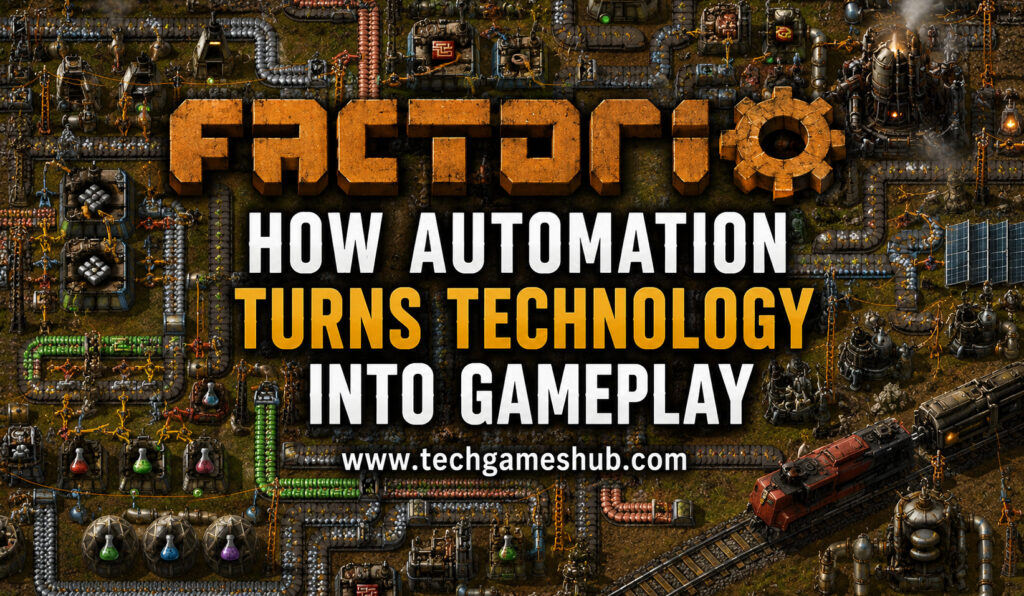
Factorio is a game built around a deceptively simple idea: create machines that make other machines, automate production, and gradually transform a small industrial operation into a massive technological factory. What makes the game especially compelling is that automation is not merely a convenience. It is the central gameplay mechanic.
Instead of treating technology as something that exists in the background, Factorio turns research, machinery, logistics, electricity, resource extraction, and production into interactive systems. Every technological improvement creates new possibilities while also introducing new challenges.
The result is a game where players constantly ask one question: How can I make this system work better?
Automation Is the Core of Factorio
Many strategy and simulation games include automation as a supporting feature. Factorio takes the opposite approach.
Automation is the foundation of almost everything players do.
At the beginning, players may manually collect resources and craft basic items. This approach works for a short time, but as production requirements increase, manual work quickly becomes inefficient.
The solution is to build machines that perform repetitive tasks automatically.
Mining machines extract resources, furnaces process materials, assemblers create products, and transport systems move items between production stages.
Once these systems begin operating together, the factory starts to function almost like a living industrial organism.
From Manual Crafting to Industrial Production
Factorio’s progression is designed to make manual work increasingly impractical.
Early production may involve a small number of machines. Players can easily monitor what is happening and make adjustments by hand.
Eventually, however, factories become too large to manage individually.
This creates a natural motivation for automation.
Players begin designing production lines rather than simply crafting individual items. Instead of asking how to make one product, they need to understand everything required to produce that product continuously.
This shift from crafting to manufacturing is one of Factorio’s most important gameplay transformations.
Technology Is a Gameplay System
Technology in Factorio is closely connected to what players can build.
Research unlocks new machines, production methods, logistics systems, weapons, energy sources, and other capabilities. Each technological advancement changes what is possible inside the factory.
This means research is not just a progress bar.
It directly affects gameplay.
Unlocking a new technology can solve an existing production problem, improve efficiency, or create an entirely new problem that requires additional infrastructure.
For example, increased production may require more electricity, additional transportation, better resource management, or larger production areas.
Technology therefore creates a continuous cycle of improvement and adaptation.
The Factory Becomes a Puzzle
Factorio’s automation systems effectively turn the entire game into a giant engineering puzzle.
Players need to determine how resources should move through different production stages. They must consider where machines should be placed, how materials should be transported, and how much production capacity is required.
A factory that looks efficient at one stage may become inefficient after expansion.
This creates a constant optimization process.
Players are not simply building structures. They are designing systems.
Logistics Connect Everything
Transportation is one of the most important parts of Factorio’s automation.
Resources need to move from extraction sites to processing facilities and then toward manufacturing areas. Conveyor belts, inserters, pipes, trains, and other logistics systems can help create these connections.
The challenge is making sure that materials arrive where they are needed without creating bottlenecks.
A single slow production stage can affect an entire factory.
This makes logistics a strategic problem. Players need to think about distance, throughput, storage, routing, and production capacity.
Bottlenecks Teach Players About Systems
One of Factorio’s most valuable gameplay lessons is that a factory is only as efficient as its weakest important component.
A production line may have plenty of raw materials but insufficient processing capacity. Another system may have powerful machines but poor transportation.
These bottlenecks become visible through gameplay.
Players learn to inspect their production chains and identify where resources are accumulating or where machines are waiting for supplies.
The game therefore teaches systems thinking without turning the experience into a traditional lesson.
Players improve because they want their factories to perform better.
Electricity Changes Factory Design
Energy is another major factor in Factorio’s automation systems.
Machines require power, and expanding production increases energy demand.
This creates another layer of planning.
A player cannot simply keep adding machines without considering the energy infrastructure supporting them. Power generation, distribution, and consumption become part of the factory’s overall design.
As technology improves, players gain access to different approaches to energy production and management.
This progression encourages players to redesign older systems rather than simply adding more machines.
Scaling Is the Real Challenge
Building a small automated factory is relatively straightforward. Building a factory capable of producing enormous quantities of complex products is much more difficult.
Factorio is designed around this transition.
As production scales upward, systems that worked perfectly at a small scale may become inefficient. Belts become crowded, power consumption increases, raw materials become harder to supply, and production chains become more complicated.
Players must respond by redesigning their infrastructure.
This is what makes the game feel like an ongoing engineering project.
Automation Creates Freedom
Although automation introduces complexity, it ultimately gives players more freedom.
Once a production chain is automated, players no longer need to perform the same repetitive actions manually.
This allows them to focus on expansion, research, exploration, defense, and further optimization.
Automation therefore creates a rewarding cycle.
Players invest time and resources into building a system, and that system eventually saves them time and resources.
The better the factory becomes, the more ambitious the player’s goals can become.
Defending the Factory Adds Pressure
Factorio also connects industrial expansion with survival.
As factories grow and pollution increases, players can face attacks from hostile creatures. This means industrial development has consequences.
Players need to balance expansion with defense.
Walls, weapons, defensive structures, and strategic positioning can become necessary as the factory grows.
This adds urgency to automation. Players are not optimizing a factory in a completely safe environment. Their industrial operation exists within a world that can react to their activities.
Automation Encourages Creative Problem Solving
There is rarely only one way to solve a production problem in Factorio.
Players can design compact factories, massive production lines, centralized systems, distributed facilities, or complex railway networks.
Different approaches can work depending on the player’s goals.
This freedom encourages experimentation.
One player may prioritize maximum efficiency, while another may prefer a visually organized factory. Someone else may build enormous production complexes simply because they enjoy seeing the machines operate.
The technology provides the tools, but the player determines how those tools are combined.
Why Factorio Is So Addictive
Factorio creates a powerful feedback loop.
A player builds something, notices a problem, creates a solution, expands production, discovers another limitation, researches new technology, and redesigns the factory.
Every solution creates the conditions for the next challenge.
This is why the game can remain engaging for extremely long play sessions.
There is always another system to improve.
The factory becomes a constantly evolving project rather than a finished structure.
The Human Side of Automation
Interestingly, Factorio is a game about automation that still requires a great deal of human creativity.
Machines perform the repetitive work, but players decide how those machines should interact.
The game therefore highlights an important concept about technology: automation does not eliminate decision-making. Instead, it can move decision-making to a higher level.
Players stop focusing on individual tasks and begin thinking about processes, networks, efficiency, and long-term planning.
That is exactly what makes automation such an effective gameplay mechanic.
The Future of Automation Games
Factorio has helped demonstrate how industrial automation can become the central focus of a game rather than simply a background feature.
Future games could take this concept even further by incorporating artificial intelligence, adaptive production systems, dynamic markets, robotics, advanced transportation networks, and more complex simulated economies.
Players could potentially manage factories that respond to changing demand, resource shortages, environmental conditions, and intelligent competitors.
These systems could make automation games even more dynamic.
Conclusion
Factorio turns technology into gameplay by making automation the foundation of progression, strategy, and creativity. Players begin with simple production tasks and gradually develop increasingly complex industrial systems.
Every machine, conveyor, power source, research project, and logistics network contributes to a larger challenge: building a factory that can sustain itself and continue expanding.
What makes the experience so rewarding is that automation is never simply the solution. It creates new possibilities, which create new problems, which require better solutions.
Factorio ultimately shows that technology can be more than a tool in a game. When players must understand, design, optimize, and expand technological systems themselves, technology becomes the gameplay.