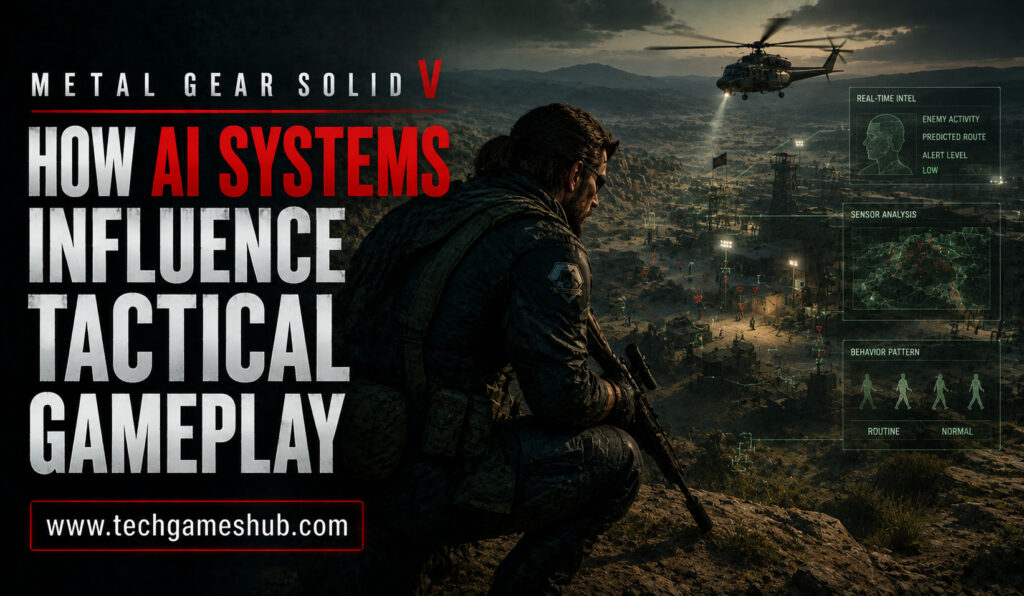
Stealth games are often built around patience, observation, and careful planning, but Metal Gear Solid V: The Phantom Pain takes these ideas much further by using sophisticated AI systems to make enemy behavior an important part of the experience. Rather than treating opponents as predictable obstacles, the game creates situations where soldiers can observe the player’s actions, respond to repeated tactics, and change their defensive strategies.
This AI-driven approach gives Metal Gear Solid V a tactical identity that remains distinctive among open-world stealth games. Players are encouraged to think ahead, adapt to changing circumstances, and understand how enemy forces react to their decisions.
AI Is at the Center of Stealth Gameplay
In many action games, enemies primarily exist to challenge the player’s combat abilities. Metal Gear Solid V takes a different approach.
Enemy soldiers patrol bases, guard important locations, communicate with one another, investigate suspicious events, and react when something appears unusual. Their behavior creates an environment where stealth depends on understanding how opponents think and respond.
The player cannot simply memorize a fixed patrol route and repeat the same trick indefinitely.
Instead, successful infiltration requires observation.
Players need to identify guards, understand patrol patterns, monitor security arrangements, and choose the right moment to move. AI therefore becomes part of the game’s core tactical system.
Enemy Awareness Makes Stealth Dynamic
One of the most important aspects of the game’s AI is enemy awareness.
Soldiers can react to unusual sounds, suspicious movements, missing personnel, or evidence that something is wrong. This creates different levels of tension during infiltration.
A player who remains undetected can carefully continue toward an objective. However, a small mistake can trigger an investigation and force the player to adjust their plan.
This makes stealth feel dynamic.
Instead of following a completely predictable sequence, players are constantly making decisions based on how much information the enemy appears to have.
AI Adapts to Player Behavior
The game also introduces an important idea: enemy forces can respond to the player’s repeated tactics.
If players consistently rely on a particular method, opposing forces can begin using countermeasures.
This means that a strategy that worked several missions ago may become less effective later.
For example, players who frequently rely on a particular type of weapon may eventually encounter enemies equipped to reduce the effectiveness of that approach. This encourages players to diversify their tactics rather than becoming dependent on one powerful strategy.
The result is a form of strategic adaptation between the player and the AI.
The Importance of Reconnaissance
Information is one of the most valuable resources in Metal Gear Solid V.
Before entering an enemy base, players can observe the area and gather intelligence. Identifying soldiers, equipment, defensive positions, and important targets can significantly improve the chances of success.
This creates a tactical loop:
observe, plan, infiltrate, adapt, and extract.
AI makes reconnaissance meaningful because enemy behavior can change the situation once the player begins interacting with the base.
A player who enters without gathering information may have to improvise. Someone who carefully studies the environment can approach the same mission with a much stronger plan.
Enemy Bases Become Dynamic Systems
The game’s open-world structure gives AI systems room to operate across larger environments.
Enemy bases are not simply collections of enemies placed around an objective. They function as interconnected spaces where guards patrol, communicate, respond to threats, and defend strategic areas.
This means players can approach an installation from different directions.
They might climb into a base from an unexpected location, move through less protected areas, disable equipment, or create distractions.
Because AI controls the behavior of guards, the same location can produce different experiences depending on how the player approaches it.
AI Makes the Open World More Tactical
Metal Gear Solid V’s open-world design is closely connected to its AI systems.
The environment provides players with multiple routes and opportunities, while AI determines how enemy forces respond.
Weather, terrain, visibility, distance, and enemy placement can all influence the player’s strategy.
A player may choose to approach a location at night because reduced visibility makes infiltration easier. Another might wait for a different environmental condition or use a distraction to move guards away from a target.
AI ensures that these environmental advantages have strategic value.
Companions Add Another Layer of Intelligence
The game’s AI is not limited to enemies.
Players can also work with companions that provide different forms of assistance. These companions can support reconnaissance, combat, transportation, or other tactical activities depending on the situation.
Their behavior gives players additional strategic options.
A companion can sometimes identify threats, provide information, attack targets, or help the player move through difficult situations.
This means players are not operating entirely alone.
Managing companion capabilities becomes part of mission planning, adding another layer to the tactical experience.
AI and Non-Lethal Strategies
Metal Gear Solid V encourages players to consider more than simply eliminating every enemy.
Non-lethal approaches can be useful, particularly when players want to expand their resources or develop their base.
This changes the way AI encounters are evaluated.
A guard is not necessarily just an obstacle to remove. The player may instead choose to avoid them, distract them, incapacitate them, or extract them.
These options create a more flexible relationship between the player and enemy AI.
The best solution is often determined by the mission objective and the player’s larger strategic goals.
AI Encourages Improvisation
One of the game’s greatest strengths is how often plans can go wrong.
A player may begin an infiltration with a carefully designed strategy, only for an unexpected enemy reaction to disrupt it.
A guard might discover an unconscious soldier. A patrol may enter an area unexpectedly. An alarm can change the security situation.
These moments force players to improvise.
Rather than restarting every time something unexpected happens, players can adapt and continue the mission.
This creates some of the game’s most memorable tactical situations.
The AI-Driven Arms Race
The relationship between player tactics and enemy countermeasures creates something similar to an arms race.
Players discover effective techniques, while enemy forces gradually introduce ways to make those techniques less dominant.
This keeps the tactical system evolving.
The player must continue experimenting with weapons, equipment, companions, infiltration routes, and timing.
As a result, progression is not simply about becoming stronger. It is also about becoming more adaptable.
Technology and AI Work Together
Metal Gear Solid V combines AI with advanced equipment to create a flexible tactical system.
Players have access to tools that can help them observe enemies, manipulate situations, move through environments, and complete objectives.
However, technology alone does not guarantee success.
Players still need to understand enemy behavior and use their equipment at the right moment.
This is an important distinction. The game rewards strategic thinking rather than simply giving players increasingly powerful tools.
AI Creates Replayable Missions
AI also contributes significantly to replayability.
A mission can be approached in many different ways, and enemy responses can change depending on player actions.
One attempt might involve careful nighttime infiltration. Another could use distractions and non-lethal equipment. A different approach may involve direct combat after a stealth plan fails.
Because players have freedom over how they approach objectives, missions can produce different experiences.
This is especially valuable in an open-world game where the same locations may be revisited multiple times.
Why Metal Gear Solid V’s AI Design Matters
The importance of Metal Gear Solid V’s AI goes beyond making enemies more difficult.
Its AI systems help create a tactical relationship between the player and the game world.
Opponents observe, react, communicate, and adjust. Players do the same.
This creates a continuous cycle of adaptation.
The player is effectively solving a tactical puzzle, while the AI is constantly changing the conditions of that puzzle.
That approach makes stealth feel less like memorizing patterns and more like managing uncertainty.
The Future of AI-Driven Stealth Games
Metal Gear Solid V demonstrates how AI can become a central part of stealth gameplay.
Future games could build on this concept with even more responsive enemies that learn from player behavior, coordinate dynamically, share information across larger networks, and adjust strategies in real time.
AI could potentially make enemy factions feel more like organizations with distinct tactical identities rather than collections of individual guards.
Such developments could create stealth worlds where players need to constantly evolve their strategies.
Conclusion
Metal Gear Solid V: The Phantom Pain demonstrates how AI systems can transform tactical gameplay. Enemy awareness, adaptive countermeasures, patrol behavior, reconnaissance, companion systems, and dynamic responses all contribute to a stealth experience where planning and improvisation are equally important.
The game’s most impressive quality is the way it turns AI into a strategic opponent rather than simply a source of difficulty. Players must study enemy behavior, experiment with different approaches, and adapt when their plans fail.
Ultimately, Metal Gear Solid V shows that powerful tactical gameplay does not depend only on better weapons or larger battlefields. Sometimes, the most important technology is the intelligence behind the opponents—and the challenge of staying one step ahead of them.