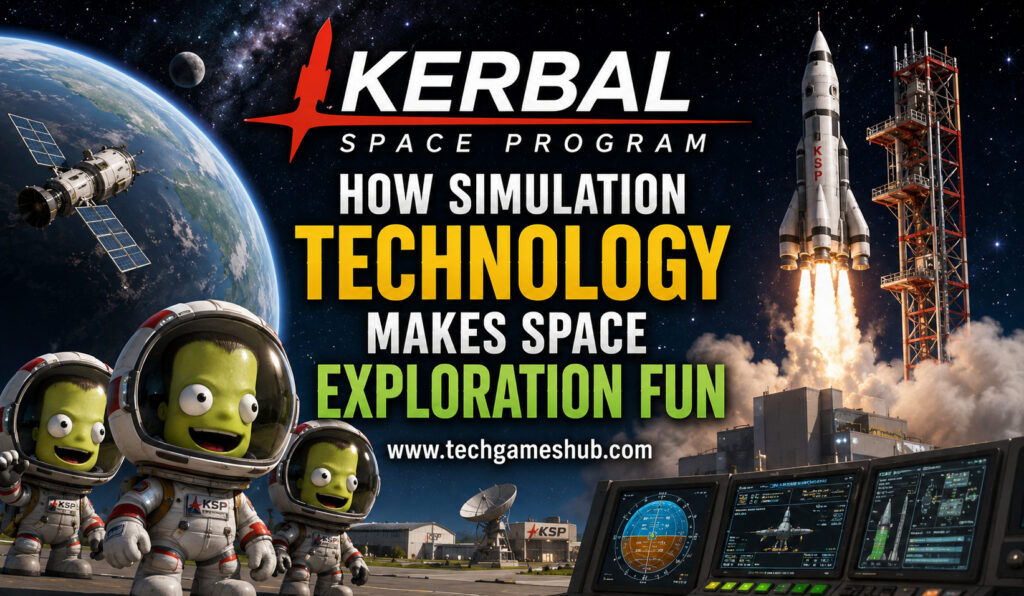
Kerbal Space Program turns space exploration into a unique combination of science, engineering, experimentation, and unpredictable comedy. Instead of simply giving players a powerful spacecraft and asking them to reach a destination, the game makes players design rockets, understand orbital movement, manage fuel, plan missions, and learn from failure.
Its simulation technology is central to this experience. Physics, aerodynamics, orbital mechanics, propulsion, gravity, and spacecraft design all interact to create situations that can be surprisingly realistic while remaining entertaining.
The result is a space game where failure is often just as memorable as success.
What Makes Kerbal Space Program Different?
Many space games simplify the technical side of space travel so players can focus on exploration. Kerbal Space Program takes another approach.
Players are given tools that resemble the fundamentals of real aerospace engineering and then encouraged to experiment.
A rocket that looks impressive is not necessarily a good rocket. A spacecraft with too little fuel may never reach its destination. A poorly designed vehicle can become unstable during launch.
This creates an unusual gameplay loop.
Players build something, test it, watch what happens, identify the problem, and try again.
Simulation technology makes those experiments possible.
Physics Becomes Part of the Gameplay
Physics is not simply running behind the scenes in Kerbal Space Program. It directly determines what players can and cannot accomplish.
Gravity affects spacecraft movement. Thrust changes velocity. Mass influences acceleration. Orbital motion determines how vehicles travel around celestial bodies.
These systems create consequences for player decisions.
If a player changes the design of a rocket, its behavior can change. Adding more fuel increases mass, while additional engines can provide more thrust but also affect the overall vehicle design.
Understanding these relationships gradually becomes part of the game.
Rocket Design Is an Engineering Puzzle
One of the most enjoyable parts of Kerbal Space Program is constructing spacecraft.
Players can combine different components to create rockets designed for specific missions.
A simple vehicle might be enough for a short flight, while more ambitious missions require multiple stages, additional fuel, specialized equipment, and careful planning.
This creates a natural engineering challenge.
Players must think about what the spacecraft needs to accomplish before deciding how to build it.
The construction system therefore encourages experimentation rather than simply rewarding players for following a fixed blueprint.
Launches Create Immediate Feedback
Rocket launches are where simulation technology becomes especially entertaining.
A carefully designed rocket may rise smoothly into the atmosphere, while a poorly balanced design can begin spinning, wobbling, or breaking apart.
These outcomes are not necessarily scripted events. They can emerge from the interaction between the player’s design and the game’s simulation systems.
That unpredictability makes every launch exciting.
Even experienced players can encounter unexpected problems when testing new spacecraft.
Orbital Mechanics Turn Space Into a Puzzle
Reaching space is only the beginning.
Players eventually need to understand orbital mechanics to travel efficiently between celestial bodies.
Instead of simply pointing a spacecraft toward a destination, players must consider velocity, trajectory, orbital position, and timing.
This can initially seem complicated, but the game turns these concepts into practical problems.
Players learn by doing.
A failed maneuver can reveal why a particular trajectory did not work, while a successful transfer can provide a satisfying understanding of how orbital movement functions.
Failure Is Part of the Fun
Kerbal Space Program is famous for making failure entertaining.
A rocket may explode shortly after launch. A spacecraft might miss its intended trajectory. A landing attempt can turn into an uncontrolled crash.
While these outcomes can be frustrating, they are also often funny.
The game’s charming presentation and memorable Kerbal characters make mistakes feel less punishing.
More importantly, failure provides information.
Players can examine what went wrong and redesign their spacecraft or mission plan.
This transforms failure from an endpoint into part of the learning process.
Simulation Encourages Experimentation
The game’s simulation systems create an environment where experimentation is valuable.
Players are not expected to understand everything immediately.
They can test different rocket configurations, change launch strategies, experiment with staging, or attempt new maneuvers.
The game effectively rewards curiosity.
Instead of giving players a single correct solution, it provides systems that allow multiple approaches.
This is one reason the simulation remains engaging even after players become familiar with basic mechanics.
The Importance of Staging
Rocket staging is another example of how technology becomes gameplay.
A rocket can use different stages to separate fuel tanks, engines, and other components during flight.
This allows players to build more efficient spacecraft for increasingly demanding missions.
Understanding when and how to separate stages becomes an important part of mission planning.
A successful design requires players to consider the entire flight rather than simply the launch.
This makes spacecraft construction feel like an engineering process rather than a cosmetic activity.
Exploration Has Real Consequences
Kerbal Space Program makes exploration meaningful because reaching another celestial body can require substantial preparation.
Players need to think about fuel, spacecraft design, trajectory, landing equipment, communication, and return plans.
A mission can succeed in reaching another world but still fail if the spacecraft cannot return.
This creates a strong sense of accomplishment when a complicated mission works as intended.
Even a simple landing can feel significant because the player understands the chain of decisions that made it possible.
Technology Supports Progression
As players complete missions and advance through the game’s progression systems, they gain access to new technologies and components.
These additions expand what players can build and the types of missions they can attempt.
A basic rocket may eventually become a sophisticated spacecraft capable of traveling between multiple celestial bodies.
Technology therefore represents more than character progression.
It expands the player’s engineering possibilities.
Each new component can inspire a new mission idea or solve a problem that previously prevented success.
Simulation Makes Space Feel Large
A major strength of Kerbal Space Program is the way simulation creates a sense of scale.
Celestial bodies are not simply destinations on a menu. They exist within a system governed by movement and gravity.
Traveling between them requires planning.
This gives space a sense of distance and complexity that many simplified space games do not attempt to reproduce.
The player begins to understand that space travel is less about pointing a rocket toward a planet and more about controlling movement within a larger gravitational system.
Creativity and Engineering Work Together
Kerbal Space Program is both a simulation and a creative sandbox.
Players can build practical spacecraft, unusual experimental vehicles, giant rockets, aircraft, space stations, and other inventions.
Some creations may be highly efficient, while others exist simply because the player wants to see whether they can work.
The game encourages this creativity by providing a flexible construction system and simulation environment.
Players can create their own challenges rather than relying entirely on predefined objectives.
Why the Simulation Remains Fun
Realistic systems can sometimes make games difficult or inaccessible. Kerbal Space Program succeeds because it combines technical concepts with experimentation and humor.
Players can learn complicated ideas gradually without needing to master them before starting.
A failed launch is often entertaining enough to encourage another attempt.
Over time, players begin recognizing patterns. They learn how to improve stability, manage fuel, plan trajectories, and construct better spacecraft.
The learning process itself becomes part of the entertainment.
The Future of Space Simulation Games
Kerbal Space Program demonstrates the potential of simulation technology in interactive entertainment.
Future space games could combine advanced physics with improved artificial intelligence, realistic planetary environments, dynamic spacecraft systems, and more sophisticated mission simulations.
Players could potentially manage complex space programs, construct large orbital infrastructure, or operate fleets of autonomous spacecraft.
As computing power improves, simulations may become increasingly detailed while still using accessible interfaces to make complicated systems understandable.
Conclusion
Kerbal Space Program shows how simulation technology can turn space exploration into a hands-on learning experience without sacrificing fun.
Physics, orbital mechanics, aerodynamics, propulsion, spacecraft construction, and mission planning are not simply technical details. They are the mechanics that create the game’s challenges and rewards.
The most important feature is that players learn through experimentation. A failed rocket can reveal a design problem, an incorrect trajectory can teach orbital planning, and a successful landing can provide a genuine sense of achievement.
By combining realistic simulation with creativity, humor, and experimentation, Kerbal Space Program demonstrates that complex technology can make gameplay more engaging rather than less accessible. Space exploration becomes fun precisely because players are given the opportunity to build, test, fail, learn, and eventually reach places they once thought were impossible.