
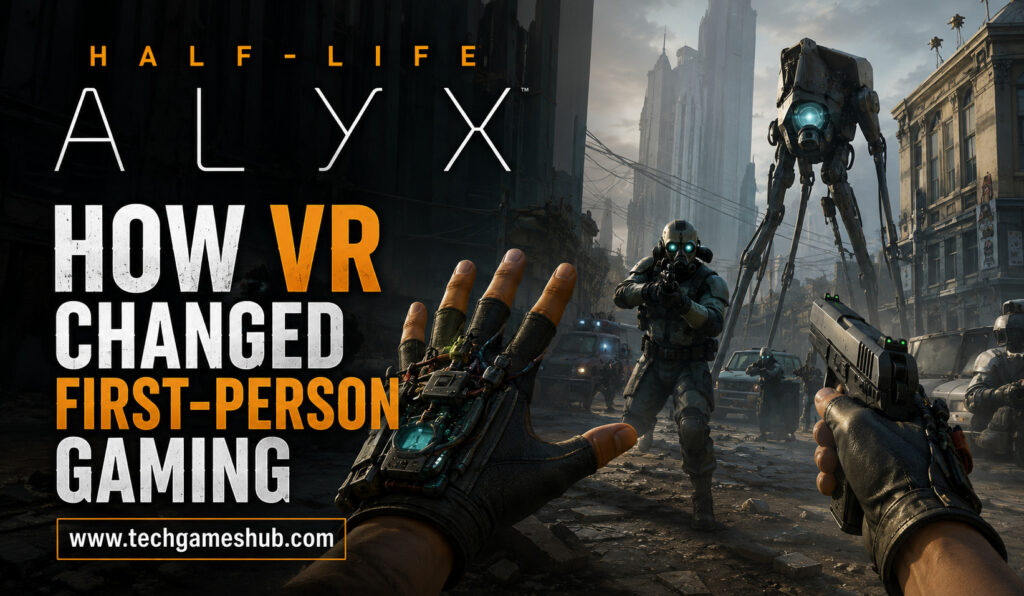
Virtual reality has existed as a gaming technology for years, but Half-Life: Alyx demonstrated how VR could fundamentally change the way a first-person game is designed. Rather than simply placing a traditional shooter inside a virtual headset, Valve created gameplay systems around physical interaction, spatial awareness, exploration, and direct manipulation.
Released as a virtual reality title in the Half-Life universe, Half-Life: Alyx showed that VR could support a detailed, story-driven first-person experience without relying entirely on conventional controls. Players could reach for objects, manually reload weapons, interact with the environment, search through spaces, and physically aim at enemies.
The result was an experience that made the player feel less like a character being controlled from a distance and more like a person actually occupying the game world.
VR Changes the Meaning of First-Person Perspective
Traditional first-person games use the camera to represent the player’s viewpoint. The player controls movement and aims using a mouse, controller, or other input device.
VR changes this relationship.
In Half-Life: Alyx, the player’s head movement directly controls what they see. Looking around no longer requires moving a camera with a joystick or mouse. Players can physically turn their heads and inspect the environment.
This creates a stronger connection between the player and the virtual space.
A dark hallway can feel more intimidating when the player can physically look around it. An object on a shelf can become interesting simply because the player can lean closer and examine it.
The environment becomes something players inhabit rather than simply observe.
Physical Interaction Becomes Gameplay
One of the biggest innovations in Half-Life: Alyx is its use of physical interaction.
Players can pick up objects, move items, open containers, manipulate equipment, and interact with their surroundings using VR controllers.
These actions are fundamentally different from pressing a single button.
In a traditional game, opening a drawer may involve approaching it and pressing a key. In VR, the player can physically reach toward the drawer, grab it, and pull it open.
This creates a stronger feeling of presence.
Simple actions become meaningful because the player performs them directly.
Weapon Handling Feels More Personal
First-person shooters have traditionally simplified weapon handling. Reloading, aiming, switching weapons, and using equipment can often be performed with a few buttons.
Half-Life: Alyx uses VR to make these actions more physical.
Players need to aim weapons using their hands and perform certain actions through gestures and controller inputs. Reloading becomes an interactive process rather than a simple animation triggered by a button.
This makes combat feel more immediate.
The player’s physical movements become part of the gameplay, which can create greater tension during difficult encounters.
Spatial Awareness Becomes Essential
VR also changes how players perceive threats.
In a conventional first-person game, players mainly monitor what appears on the screen. In VR, they can look around the environment naturally.
An enemy can approach from a direction the player was not watching. A sound behind the player may encourage them to turn around physically. Objects can exist above, below, or beside the player’s normal field of attention.
This creates a stronger sense of spatial awareness.
Players are not simply watching an action sequence unfold. They are actively monitoring a three-dimensional environment.
Exploration Feels More Immersive
Half-Life: Alyx uses VR to make exploration more engaging.
Players can inspect rooms, search containers, examine objects, and look around environments from their own perspective.
The ability to physically investigate spaces makes even ordinary locations more interesting.
A room is no longer just a collection of textures surrounding the player. It becomes a place that can be searched and examined.
This approach is especially effective in a narrative-driven game because environmental details can contribute to the atmosphere and storytelling.
Environmental Storytelling Gains New Power
Half-Life games have traditionally used environments to communicate information without relying entirely on dialogue or cutscenes.
VR strengthens this technique.
Players can look closely at objects, signs, rooms, machinery, and other details. Because they can control their viewpoint naturally, they may notice things that could be missed during a conventional playthrough.
This encourages curiosity.
Instead of simply walking toward the next objective, players can stop and investigate their surroundings.
The environment becomes part of the story.
Puzzles Become Physical Experiences
Puzzle design also benefits from VR.
Traditional puzzles often involve selecting objects, pressing buttons, or interacting through menus. VR allows players to physically manipulate puzzle elements.
They can pick up objects, position components, search for clues, and experiment with physical arrangements.
This creates a more intuitive relationship between the player and the puzzle.
The solution is not merely something the character performs. It becomes something the player performs.
That distinction is one of the most important ways VR changes game design.
VR Makes Small Details Important
A traditional game camera is controlled primarily by the player through an input device. Developers can therefore predict where players are likely to look.
VR makes this much harder.
Players can look almost anywhere.
This encourages developers to create environments with more detailed visual information because players may inspect areas that would normally be ignored.
A shelf, table, doorway, or dark corner can become part of the player’s exploration experience.
Small environmental details can therefore have greater value in VR.
Immersion Comes From Interaction
Graphics are important for immersion, but Half-Life: Alyx demonstrates that interaction can be equally powerful.
A highly detailed environment can look impressive on a monitor, but physically reaching toward an object and manipulating it can create a different kind of connection.
The player’s brain receives information through vision, movement, and spatial awareness simultaneously.
This combination helps create the sensation of being inside the environment.
VR therefore changes immersion from something players primarily observe into something they actively participate in.
Horror and Tension Become More Intense
VR is particularly effective at creating tension.
When an enemy appears on a monitor, the player knows they are looking at a screen. In VR, the virtual environment surrounds the player’s field of vision.
This can make dark environments, sudden sounds, and unexpected encounters more intense.
The ability to physically look around also means that players can become genuinely uncertain about what might be nearby.
This creates a different type of suspense from traditional first-person games.
The player is not simply watching a frightening scene. They are physically positioned inside it.
Movement and Accessibility
VR also introduces new design challenges.
Developers must consider motion sickness, comfort, movement preferences, and different ways of interacting with the world.
Half-Life: Alyx demonstrates the importance of giving players control over how they move and interact.
VR games need to balance immersion with physical comfort. A mechanic that looks impressive but causes discomfort can quickly become frustrating.
This means successful VR design is not simply about adding more physical interactions. It requires careful consideration of how those interactions affect the player.
Why Half-Life: Alyx Matters to VR Gaming
Half-Life: Alyx showed that VR could support a major, polished first-person adventure rather than being limited to short experimental experiences.
Its design demonstrated that VR mechanics could be integrated into storytelling, combat, exploration, puzzles, and progression.
The game helped establish an important principle for VR development: the technology is most effective when gameplay is designed around it from the beginning.
Simply placing a traditional game inside a headset does not automatically create a great VR experience.
The strongest results come when developers rethink interaction itself.
The Future of First-Person VR
The ideas demonstrated by Half-Life: Alyx can influence future first-person games.
As VR hardware improves, developers may be able to create more detailed environments, more responsive physics, smarter characters, and increasingly sophisticated interaction systems.
Artificial intelligence could also make VR worlds more reactive. Characters might respond dynamically to player behavior, while physical environments could change based on how players interact with them.
This could make future first-person games feel even more personal.
Instead of following a predetermined sequence of actions, players may be able to manipulate environments and characters in increasingly complex ways.
Conclusion
Half-Life: Alyx demonstrates how virtual reality can fundamentally change first-person gaming. Instead of simply giving players a different display, it changes how they look, move, interact, fight, explore, and solve problems.
Physical weapon handling, environmental interaction, spatial awareness, exploration, and VR-based puzzles all contribute to a stronger sense of presence.
The game’s greatest achievement is showing that VR works best when it is treated as a new design medium rather than simply another way to display a traditional game.
By building its gameplay around physical interaction and spatial presence, Half-Life: Alyx helped demonstrate the potential of VR as a serious platform for immersive first-person storytelling and gameplay. Its influence can be seen in the broader idea that the future of first-person gaming may not simply be about seeing a virtual world—it may be about physically feeling like you are inside it.