
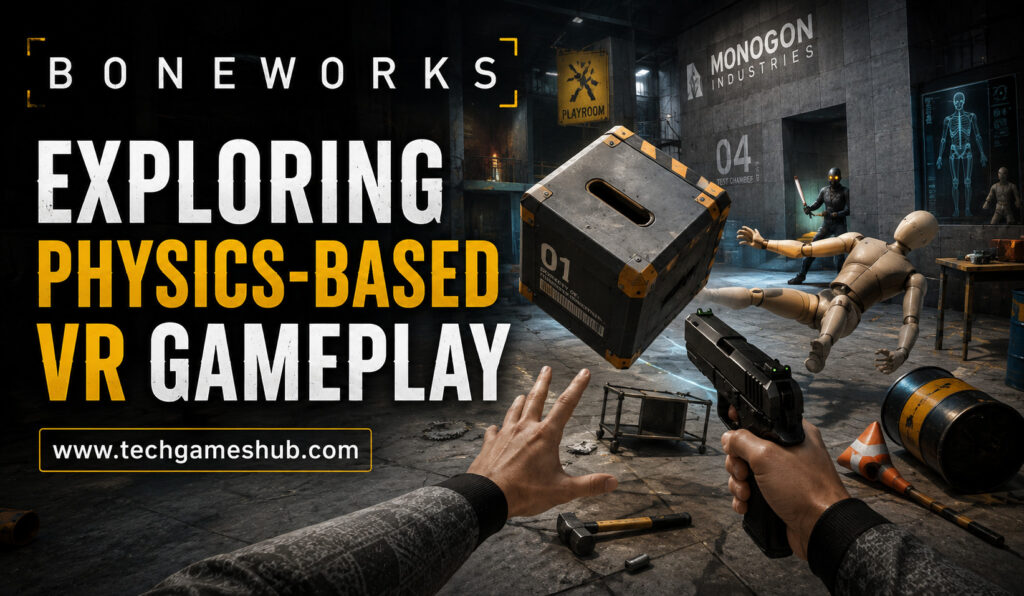
Boneworks is a virtual reality game built around a simple but ambitious idea: what happens when physical simulation becomes the foundation of first-person gameplay? Developed by Stress Level Zero, the game uses VR interaction, physics, object manipulation, combat, and environmental puzzles to create an experience where players are encouraged to physically experiment with the virtual world.
Rather than treating virtual reality as a different way to view a traditional game, Boneworks makes physics and interaction central to its design. Objects can be picked up, moved, stacked, thrown, used as tools, and incorporated into combat. Players can interact with the environment using their virtual hands, creating situations that are difficult to reproduce with a conventional controller.
This approach makes Boneworks an interesting example of how physics technology can change the possibilities of VR gaming.
What Is Physics-Based VR Gameplay?
Physics-based gameplay uses simulated physical rules to determine how objects behave and interact. In a conventional game, many actions are controlled by predefined animations. A character may press a button to open a door, perform a melee attack, or pick up an object.
Physics-based VR can make these actions more dynamic.
In Boneworks, players can manipulate objects directly using their VR controllers. The way an object moves depends on its position, momentum, weight, and interaction with other objects.
This creates a stronger connection between player movement and the virtual environment.
VR Hands Become the Main Interface
One of Boneworks’ most important design choices is its use of virtual hands as a primary interaction system.
Instead of relying heavily on traditional menus, players can reach toward objects and manipulate them directly.
A box can be grabbed and moved. A tool can be picked up and positioned. Objects can be placed on surfaces or used to interact with mechanisms.
This makes the player’s hands function as an extension of the controller.
The result is a more physical style of gameplay in which players learn by experimenting with the environment.
Objects Have Gameplay Value
In many first-person games, environmental objects are mainly decorative. A chair or box may look realistic but cannot be meaningfully manipulated.
Boneworks takes a different approach.
Objects can become useful tools.
Players can pick up items, move obstacles, create makeshift solutions, or use objects during combat. This increases the importance of the environment because players are encouraged to look at ordinary objects as potential resources.
A simple object can become useful depending on how the player chooses to interact with it.
Physics Creates Unpredictable Moments
Because objects are governed by simulated physical behavior, interactions do not always produce identical results.
An object can fall differently depending on how it is positioned. A thrown item can travel according to the player’s movement. Objects can collide with one another and create unexpected outcomes.
This unpredictability is part of the appeal.
Players can experiment with different actions and observe what happens.
The game therefore encourages curiosity rather than limiting players to a narrow set of predefined interactions.
Combat Becomes Physical
Boneworks applies physics to combat as well.
Weapons can be handled through VR controllers, allowing players to physically position and move them.
This makes combat feel different from traditional first-person shooters.
Instead of pressing a button to trigger an attack animation, the player performs movements using the controller. The relationship between the player’s motion and the virtual weapon becomes part of the combat system.
This can create a greater sense of control, but it also introduces complexity because physical interactions are less predictable than traditional animations.
Environmental Puzzles Encourage Experimentation
Physics-based puzzles are another important part of Boneworks.
Rather than always asking players to locate the correct button or key, the game can present situations that encourage physical problem-solving.
Players may need to move objects, climb, manipulate mechanisms, or use available items to overcome obstacles.
There can be multiple ways to approach certain situations.
This is one of the biggest advantages of physics-driven design. The developer can establish the physical rules while allowing the player to decide how to use them.
The Environment Becomes a Toolset
Boneworks encourages players to see the environment differently.
A wall may become something to climb. A box can become a platform. An object can be used to reach another area. A physical barrier may be overcome through experimentation rather than a single scripted solution.
This creates a sandbox-like quality within the game’s designed environments.
The world is not simply a place the player moves through. It becomes a collection of physical possibilities.
Physics and Immersion
Physics contributes significantly to the feeling of presence in VR.
When an object responds to the player’s movement in a believable way, the interaction can feel more convincing.
Players can see their virtual hands moving and observe objects reacting to those movements.
This creates a feedback loop between action and response.
The player moves, the virtual world responds, and the response influences the next action.
That relationship can make even simple interactions feel surprisingly engaging.
Why Physics Can Make VR More Complicated
Physics-based VR also introduces challenges.
Traditional game mechanics are predictable because developers control exactly how an animation or interaction works.
Physics systems are less predictable.
Objects can become difficult to position, weapons may behave unexpectedly, and character movement can sometimes feel unusual.
This means developers need to carefully balance simulation accuracy with usability.
A completely realistic system is not necessarily the most enjoyable one. Games need interactions that are understandable, responsive, and comfortable.
Boneworks demonstrates the possibilities of physics-driven design while also highlighting the complexity involved in building such systems.
Movement Changes in a Physics-Based World
Movement is another important consideration.
In a traditional first-person game, the player character’s body is largely controlled through standard movement inputs. In VR, players see and control virtual hands while moving through a simulated environment.
Boneworks attempts to connect these elements through physical interaction.
This can make movement feel more immersive but also requires players to understand how their virtual body interacts with objects and surfaces.
The relationship between player movement and physics becomes part of the learning process.
Player Creativity Becomes a Core Mechanic
Physics-based VR can encourage players to solve problems creatively.
Instead of asking only, “What action does the game expect me to perform?” players can begin asking, “What can I do with the objects around me?”
That shift is important.
It gives players more agency and can create solutions that feel personal.
Two players may approach the same obstacle differently depending on what they notice and how they choose to manipulate the environment.
This is one of the strongest arguments for physics-driven VR design.
Boneworks and the Future of VR Technology
Boneworks represents an important experiment in how VR can use advanced physics to create new gameplay possibilities.
Future VR games could combine physics simulation with improved hand tracking, more precise haptic feedback, artificial intelligence, and increasingly responsive environments.
Characters could react more naturally to physical actions. Objects could have more sophisticated properties. Environments could respond dynamically to player behavior.
These developments could make virtual worlds feel less like collections of scripted interactions and more like spaces governed by consistent physical rules.
Physics Can Change Game Design
The broader importance of Boneworks goes beyond individual mechanics.
It demonstrates that physics can become a design philosophy rather than simply a visual feature.
When developers trust a physical simulation to determine how objects behave, they can create gameplay situations that emerge naturally from player actions.
This reduces the need to script every possible interaction.
The result can be unpredictable, sometimes chaotic, but also highly memorable.
For VR, this approach is especially powerful because players can physically participate in those interactions.
Conclusion
Boneworks explores what happens when physics becomes a central part of VR gameplay. Its virtual hands, interactive objects, physical combat, environmental puzzles, and simulated interactions create an experience built around experimentation.
The game’s greatest strength is the freedom it gives players to think about the virtual environment as a collection of physical possibilities. A box is not simply decoration, a weapon is not just an animation trigger, and an obstacle may have several possible solutions.
This approach can make VR feel more immersive because the player is not only observing the virtual world. They are physically interacting with it.
Boneworks shows that the future of VR gaming may depend not just on sharper graphics or more powerful hardware, but on increasingly convincing interactions between players and virtual environments. When physics, VR controls, and creative game design work together, even simple actions can become meaningful gameplay.