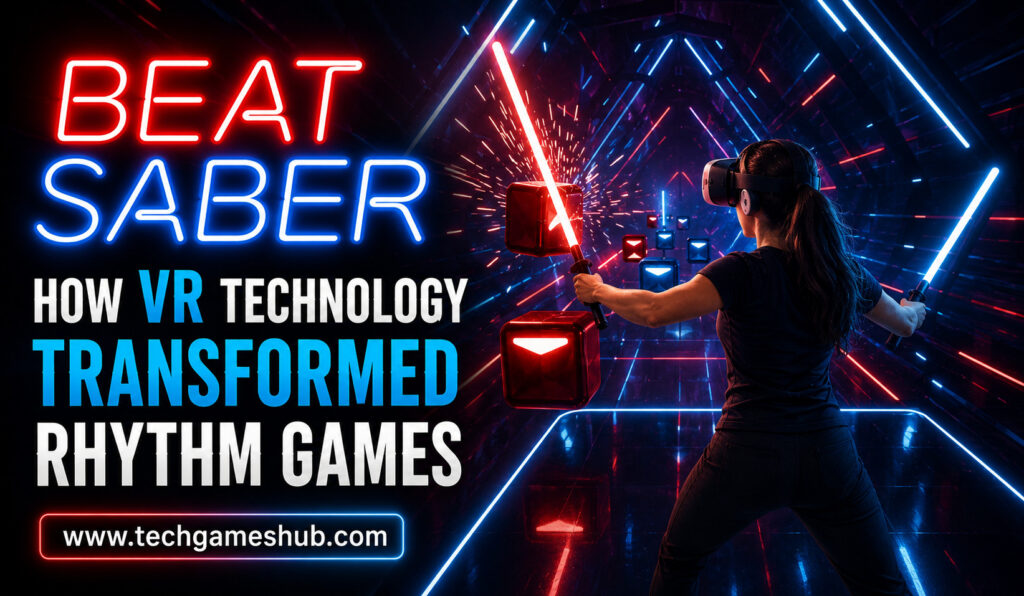
Beat Saber is one of the clearest examples of how virtual reality can transform a familiar gaming genre into something more physical, immersive, and interactive. Rhythm games have traditionally asked players to press buttons or follow patterns on a screen. Beat Saber changes that formula by putting players inside a virtual environment where they use motion controllers to physically slice approaching blocks in time with music.
The concept is easy to understand, but its combination of rhythm, movement, audio, visual effects, and VR technology creates an experience that feels very different from traditional music games.
Instead of simply watching a rhythm pattern, players become physically involved in it.
How Beat Saber Uses VR Technology
At its core, Beat Saber uses VR tracking technology to connect the player’s physical movements with virtual sabers.
Players hold motion controllers that are represented as glowing blades in the virtual environment. As blocks approach, players need to swing the sabers in the correct direction and at the appropriate moment.
The system tracks the position and movement of the controllers and translates those actions into the virtual world.
This creates a direct relationship between music and physical movement.
The player does not simply press a button when a note appears. They physically perform the action.
Rhythm Games Become Physical
Traditional rhythm games often depend on hand-eye coordination, timing, and memorizing patterns.
Beat Saber keeps those elements but adds full-body movement.
Players may need to swing from side to side, move their arms quickly, duck under obstacles, and adjust their position while following the rhythm.
This changes the physical experience of playing a rhythm game.
The music becomes something players respond to with movement rather than simply button presses.
That physical connection is one of the main reasons Beat Saber became such an influential VR rhythm game.
Motion Tracking Makes Timing More Important
VR motion tracking is essential to the gameplay.
The game needs to recognize where the player’s hands are and how they are moving. Accurate tracking helps ensure that successful hits feel responsive and that mistakes are understandable.
When a player swings at the correct angle and timing, the visual and audio feedback reinforces the action.
This creates a satisfying feedback loop.
The player hears the music, sees the approaching block, moves the controller, and immediately receives a response.
The closer these elements are synchronized, the more immersive the experience becomes.
Music and Visuals Work Together
Beat Saber does not rely on music alone to create rhythm.
The visual environment is designed to reinforce the beat. Blocks, effects, movement, and lighting work together to create a strong connection between sound and visual information.
Players can anticipate upcoming actions partly by reading these visual patterns.
This is particularly important in VR because the player is surrounded by the environment.
Instead of looking at a small section of a screen, players experience the rhythm patterns within a three-dimensional space.
VR Creates a Strong Sense of Presence
Presence is one of the defining qualities of virtual reality, and Beat Saber uses it effectively.
The virtual sabers appear to be attached to the player’s hands. When players move their arms, the sabers respond immediately.
This makes the interaction feel intuitive.
The player does not need to imagine pressing a button to perform an action. They simply move their hand.
That simplicity is one of the game’s greatest strengths.
VR technology can make complex game mechanics feel natural when the virtual action closely matches the player’s physical action.
Difficulty Comes From Speed and Precision
Beat Saber becomes increasingly challenging as players progress.
Blocks can arrive faster, patterns can become more complicated, and players need to perform accurate movements with very little time to react.
This creates a skill-based progression system.
Players gradually improve their timing, coordination, reaction speed, and ability to recognize patterns.
Because the controls are relatively simple, improvement is easy to understand.
A player can feel the difference between struggling with a song and eventually completing it successfully.
Rhythm Becomes a Movement Language
One of the most interesting aspects of Beat Saber is how it turns music into a movement language.
Different musical sections can produce different patterns.
A fast sequence may require rapid alternating swings. Another section may involve large directional movements. A change in rhythm can require the player to change their physical approach.
The result is a game where the player is effectively interpreting music through movement.
This is different from traditional rhythm games because the body becomes part of the input system.
Exercise and Gaming Overlap
Because Beat Saber requires physical movement, it can also blur the boundary between gaming and exercise.
Players can become physically active while playing, especially during longer or more difficult sessions.
However, its primary purpose remains entertainment.
The important technological point is that VR can turn ordinary game input into physical activity simply by changing how the player interacts with the virtual environment.
This possibility has influenced the broader perception of VR as a platform that can combine entertainment with movement.
Accessibility Through Simple Controls
Beat Saber also demonstrates that a VR game can have relatively simple controls while still offering considerable depth.
The basic idea is easy to understand: move the sabers and hit the blocks correctly.
Players do not need to memorize a large collection of buttons.
The challenge comes from timing, accuracy, movement, and increasingly complex patterns.
This makes the game approachable for newcomers while still providing room for skilled players to improve.
The Role of Audio Technology
Sound is obviously central to a rhythm game, but VR adds another dimension to audio design.
Players depend on music to anticipate rhythm and timing while simultaneously using visual information to identify incoming blocks.
The combination of audio and visual cues can help create a strong sense of synchronization.
When a successful swing matches the beat and produces immediate feedback, the player feels connected to the music.
This relationship between sound, movement, and feedback is a major part of Beat Saber’s appeal.
Why Beat Saber Works So Well in VR
Not every traditional game benefits equally from virtual reality.
Beat Saber is particularly well suited to VR because its core mechanic naturally maps onto physical movement.
A saber in the virtual world corresponds directly to a controller in the player’s hand. A block represents an action that the player can physically perform.
There is little need to translate complex button combinations into VR controls.
The technology and gameplay concept fit together naturally.
That is one of the most important lessons Beat Saber offers VR developers.
VR Changes the Player’s Role
In a conventional rhythm game, players often remain relatively stationary while interacting with buttons or controllers.
Beat Saber turns the player into part of the performance.
The player becomes physically involved in the rhythm.
This can create a stronger feeling of participation.
Instead of controlling an on-screen character who performs the action, the player performs the action directly through their own movements.
That distinction is subtle but powerful.
Beat Saber and the Future of Rhythm Games
Beat Saber demonstrates that VR can create new possibilities for rhythm-based gameplay.
Future games could use advanced hand tracking, improved haptic feedback, body tracking, spatial audio, and more responsive environments to make musical interaction even more immersive.
Players might eventually use their entire bodies to interact with virtual instruments, dance environments, or dynamically generated music.
Artificial intelligence could also potentially adapt difficulty and rhythm patterns to individual players, creating personalized musical challenges.
These developments could push rhythm gaming beyond traditional screens.
Conclusion
Beat Saber demonstrates how VR technology can transform rhythm games by replacing conventional button presses with physical movement.
Motion tracking connects the player’s hands to virtual sabers, while music, visual patterns, spatial design, and immediate feedback create a highly interactive experience.
The game’s success comes from the simplicity of this connection. Players hear the music, see the rhythm approaching, and physically respond.
That makes Beat Saber more than a rhythm game with VR support. It is an example of how virtual reality can change the relationship between players and game mechanics.
By turning music into movement, Beat Saber helped demonstrate that VR can make familiar genres feel completely different. Its influence can be seen in the growing interest in games that combine entertainment, physical interaction, immersive technology, and responsive environments.