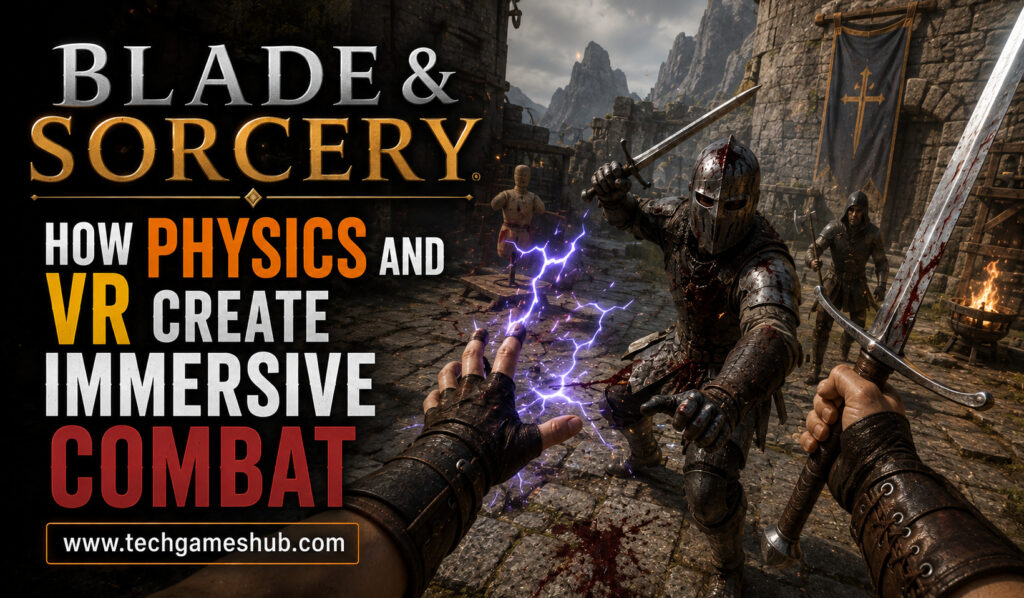
Blade & Sorcery is a virtual reality combat game that demonstrates how physics and immersive technology can completely change the way players experience first-person action. Instead of relying mainly on button-based attacks and predetermined animations, the game gives players physical control over weapons, shields, spells, and movement.
This approach makes combat feel more direct. Players can swing weapons with their own hands, block attacks, grab objects, interact with the environment, and experiment with different fighting techniques. Physics plays an important role in making these interactions feel responsive and dynamic.
The result is a VR experience where the player is not simply controlling a warrior. They are physically participating in the combat system.
VR Changes First-Person Combat
Traditional first-person combat games usually translate player actions through buttons and analog sticks. Pressing a button might trigger an attack animation, while moving a mouse or controller aims the character’s weapon.
Blade & Sorcery takes a different approach.
The player’s VR controllers represent their hands, allowing them to physically manipulate weapons. A sword can be held at different angles, moved through different trajectories, and repositioned during combat.
This creates a much stronger connection between physical movement and gameplay.
The player decides how to move the weapon rather than selecting from a small number of predefined attacks.
Physics Is at the Center of the Experience
Physics is one of the most important technologies behind Blade & Sorcery’s combat.
Weapons, characters, objects, and environments interact through simulated physical systems. When players move an object, its behavior depends on factors such as movement, position, and collisions.
This creates a combat system that feels less scripted.
A weapon can be used in different ways depending on how the player handles it. A shield can be positioned to block attacks, while environmental objects can become part of an encounter.
The physics system provides rules, while the player decides how to use them.
Weapons Become Physical Tools
One of the biggest differences between Blade & Sorcery and conventional action games is the way weapons are handled.
Players can physically hold swords, axes, shields, bows, and other equipment. The virtual weapon follows the player’s controller movement.
This makes weapon selection more meaningful.
Different weapons can feel different because of their shape, handling, reach, and interaction with the environment.
Players can experiment with how they hold and move each weapon rather than simply pressing a button to perform an attack.
That physical control is a major part of the game’s immersive appeal.
Combat Becomes an Experiment
Because the game relies heavily on physics, players can approach encounters in different ways.
Instead of following a fixed attack sequence, they can experiment with movement, positioning, blocking, grabbing, and environmental interaction.
This makes combat feel more like a sandbox.
A player may develop a preferred fighting style based on the weapons they enjoy using and the way they interact with the physics system.
Another player may approach the same encounter completely differently.
This freedom gives the combat system considerable replay value.
Blocking Requires Physical Awareness
Defense also changes significantly in VR.
In a traditional game, blocking may involve pressing a button or holding a trigger.
In Blade & Sorcery, players can physically position a shield or weapon to defend themselves.
This requires spatial awareness.
Players need to pay attention to the direction of incoming attacks and move their virtual equipment accordingly.
The result is a more active defensive system.
Instead of simply activating a defense mechanic, players physically participate in the defensive action.
The Environment Becomes Part of Combat
Physics also allows the environment to play a role in encounters.
Objects can be picked up and manipulated, while surfaces and structures can affect movement and positioning.
This gives players more opportunities to experiment.
The environment is not simply a background for combat. It can become part of the interaction system.
This principle is particularly powerful in VR because players can physically reach toward objects and manipulate them.
The world becomes a collection of potential tools rather than a fixed stage.
Immersion Comes From Physical Interaction
Graphics are important for VR, but physical interaction can be equally significant.
When players look down and see virtual hands holding a weapon, then move their real hands and see the weapon respond, the connection between player and game becomes immediate.
This interaction can create a stronger sense of presence than conventional controls.
The player is not merely watching a character swing a sword.
They are controlling the movement of that sword through their own physical actions.
That difference is central to the game’s design philosophy.
Movement Adds Another Layer
Movement in a VR combat game needs to balance immersion, control, and comfort.
Players need to navigate environments while maintaining awareness of their surroundings. They also need to manage weapons and defend themselves at the same time.
This creates a more complicated relationship between movement and combat.
Positioning becomes important.
Standing too close to an opponent can limit weapon movement, while creating distance can provide more room to maneuver. Players also need to think about where they are physically positioned within the virtual environment.
The result is a combat system that uses space as an important gameplay resource.
Magic Expands the Interaction System
Blade & Sorcery is not limited to physical weapons.
Magic abilities introduce another dimension to combat and allow players to interact with enemies and the environment through virtual powers.
Because these abilities are designed for VR interaction, they can feel different from simply pressing a spell button.
The player’s hands become part of the casting process, creating a stronger sense of participation.
This demonstrates how VR can make familiar fantasy mechanics feel more interactive.
Why Physics Makes Combat Less Predictable
Traditional combat systems are often designed around predictable animations.
Physics-driven combat can be less predictable.
Objects may move differently depending on how players interact with them. Weapon trajectories can vary, and environmental interactions can produce unexpected results.
This unpredictability can create memorable moments.
Players may discover new ways to use weapons or objects simply by experimenting.
While physics can occasionally produce awkward interactions, the same unpredictability can also be responsible for some of the game’s most entertaining situations.
VR Makes Skill More Physical
Blade & Sorcery also changes how players develop combat skills.
Players can improve their timing, coordination, spatial awareness, and ability to control weapons.
Success is not determined only by learning which button performs a particular move.
Instead, players gradually become more comfortable with the physical control system.
This makes improvement feel personal.
The player’s real-world coordination becomes part of their virtual combat ability.
Technology Supports Player Freedom
The game’s technology is most effective when it supports freedom rather than restricting players to a narrow set of actions.
Physics establishes how objects behave, while VR controllers provide the means to interact with them.
Together, these systems allow players to experiment.
This is an important principle for immersive game design. Developers do not need to predict every possible action if the underlying systems are flexible enough to produce interesting outcomes.
The Future of VR Combat
Blade & Sorcery provides a glimpse of how future VR combat games could evolve.
Advances in hand tracking, haptic feedback, artificial intelligence, animation systems, and physics simulation could make virtual opponents even more responsive.
Enemies could potentially react to the direction of attacks, adjust their positioning, and respond dynamically to player behavior.
More advanced physical simulation could also make weapons and environmental objects behave with greater consistency.
These developments could make VR combat increasingly interactive.
AI Could Make Opponents More Dynamic
Artificial intelligence could become particularly important in future VR combat experiences.
Instead of enemies simply following predetermined attack patterns, AI systems could analyze player behavior and adapt their tactics.
An opponent might recognize repeated attacks, change its defensive strategy, maintain distance, or attempt to exploit the player’s positioning.
Combined with physics-based interactions, this could create much more unpredictable encounters.
Players would need to react not only to physical attacks but also to changing enemy behavior.
Why Blade & Sorcery Matters
The importance of Blade & Sorcery goes beyond its individual combat mechanics.
It demonstrates how VR can change the design philosophy of an action game.
Instead of asking which animations should play when a player presses a button, developers can ask what physical rules should govern the world.
That shift opens up new possibilities.
Players can interact with weapons, enemies, objects, and environments through direct physical actions.
The game becomes less about selecting actions and more about performing them.
Conclusion
Blade & Sorcery shows how physics and VR technology can create a fundamentally different approach to first-person combat. Physical weapon control, environmental interaction, defensive movement, magic systems, and simulated object behavior combine to create an experience built around player interaction.
The technology does not simply make combat look more realistic. It changes how combat works.
Players develop physical skills, experiment with different approaches, and use the environment as part of their strategy. Because physics can create unexpected outcomes, encounters can feel less predictable than traditional animation-driven combat systems.
As VR hardware, physics engines, and AI continue to improve, games could push this concept even further. More responsive enemies, precise hand tracking, advanced haptics, and dynamic environments could make future virtual combat worlds increasingly interactive.
Blade & Sorcery demonstrates the potential of this approach: when players can physically control their weapons and interact with a responsive world, first-person combat becomes more than something they watch or command. It becomes something they physically experience.