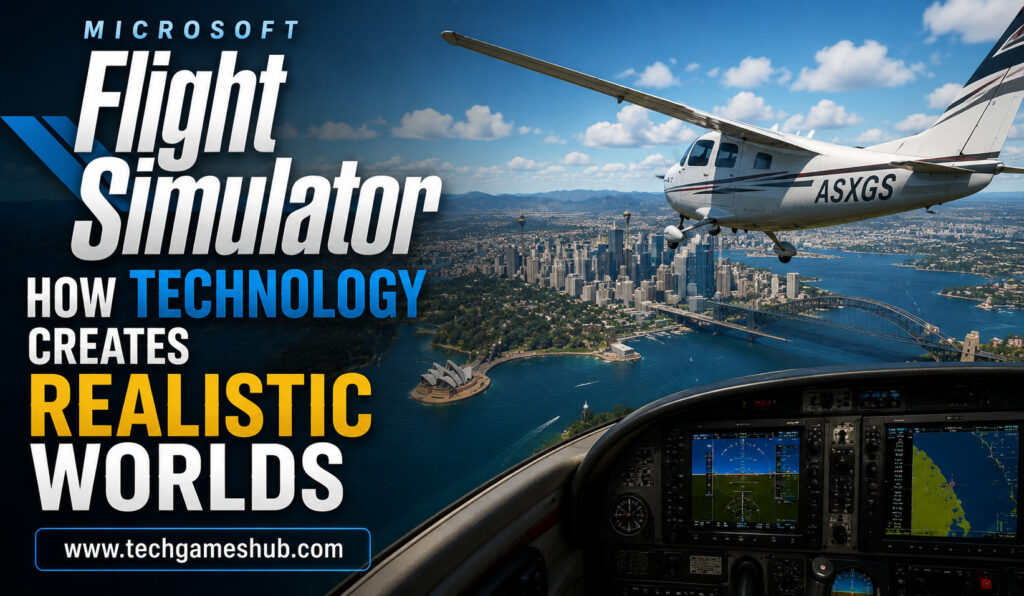
Microsoft Flight Simulator demonstrates how modern gaming technology can transform an enormous amount of real-world information into an interactive digital environment. Instead of placing players inside a small collection of handcrafted airports and landscapes, the simulator aims to recreate a vast representation of the planet, complete with cities, mountains, coastlines, airports, weather, aircraft, and changing atmospheric conditions.
The experience depends on several technologies working together. High-quality graphics, satellite imagery, terrain data, cloud systems, artificial intelligence, procedural generation, physics simulation, and cloud-based data streaming all contribute to the feeling of flying through a living world.
What makes Microsoft Flight Simulator especially interesting is that realism is not produced by one technology alone. It comes from combining many different systems into one enormous simulation.
Turning Real-World Data Into a Game World
Creating a realistic digital version of the Earth manually would be practically impossible.
There are too many cities, roads, mountains, buildings, coastlines, forests, airports, and other geographical features to model individually.
Microsoft Flight Simulator addresses this challenge by using large amounts of geographical and visual data to generate its virtual environment.
Satellite and mapping information can help establish the underlying structure of landscapes. Digital terrain data provides information about elevation, while additional datasets can contribute to roads, buildings, vegetation, and other features.
The game can then process this information and turn it into something players can explore from the cockpit.
This approach demonstrates how data-driven technology can expand the scale of game worlds dramatically.
AI Helps Build a Massive Environment
Artificial intelligence and machine-learning techniques can play an important role in transforming geographical information into visual environments.
Instead of manually designing every building, automated systems can analyze available data and generate approximations of structures and landscapes.
This does not mean every location is recreated with identical accuracy.
Rather, technology allows the simulator to produce a convincing representation across an enormous geographic area.
The advantage is scale.
A traditional game might spend years manually creating a relatively small map. A modern flight simulator can use automated processes to represent an environment spanning huge portions of the planet.
Procedural Generation Makes the World Possible
Procedural technology is another important part of creating a large-scale virtual Earth.
Procedural generation uses rules and data to create elements of a game world automatically.
Terrain, vegetation, buildings, roads, and other environmental details can be generated according to information available to the simulation.
This approach allows the game to create environments without requiring developers to manually place every object.
For players, the result is a world that feels enormous.
They can take off from one location and travel across landscapes that look dramatically different from one another.
Cloud Technology Connects Players to Data
Modern flight simulation also relies heavily on cloud-based technology.
A complete representation of the planet would require an enormous amount of storage. Instead of installing every piece of environmental data directly on a player’s computer, some information can be streamed as needed.
This allows the simulator to access large datasets without requiring players to store everything locally.
The concept is similar to streaming other types of digital content, but the challenge is much greater because the simulator needs geographical information continuously as the aircraft moves.
Cloud infrastructure therefore becomes an important part of creating a world that feels far larger than the local hardware could store on its own.
Realistic Terrain Creates a Sense of Scale
One of the first things players notice in Microsoft Flight Simulator is the scale of its environment.
Mountains, oceans, deserts, forests, cities, and coastlines can stretch across enormous distances.
From the cockpit, these features provide visual references that help make the world feel geographically connected.
Flying over a mountain range feels different from crossing a densely populated urban region.
The changing landscape helps reinforce the idea that the player is traveling through a continuous world rather than moving between separate game levels.
Aircraft Physics Make the World Interactive
A realistic world would mean little if aircraft did not respond convincingly to player input.
Flight simulation technology therefore plays a crucial role.
Aircraft need to respond to factors such as speed, altitude, thrust, lift, drag, weight, and control inputs.
Different aircraft can have different handling characteristics, making the experience more than simply moving a camera through a landscape.
The aircraft becomes part of the simulation.
Players need to manage their plane while simultaneously interpreting the environment around them.
Weather Adds Another Layer of Realism
Weather is an important part of realistic flight simulation.
Clear skies can provide excellent visibility, while clouds, rain, storms, wind, and other conditions can change the experience.
Weather technology adds movement and uncertainty to the environment.
Instead of flying through a static sky, players can experience changing atmospheric conditions.
This is particularly important because weather affects both the visual appearance of the world and the challenge of operating an aircraft.
A flight through calm conditions can feel completely different from one involving poor visibility or significant turbulence.
Lighting Makes the World Feel Alive
Modern rendering technology also contributes to realism.
Lighting affects how players perceive terrain, buildings, clouds, water, and aircraft.
Sunrise and sunset can dramatically change the appearance of a landscape. Shadows provide depth, while atmospheric effects can make distant mountains appear different from nearby objects.
These details may seem minor individually, but together they influence the overall sense of presence.
A realistic simulation needs more than accurate geography. It also needs convincing presentation.
Airports Are More Than Starting Points
Airports are another important part of the experience.
They provide structured environments where players can take off, land, taxi, and interact with aircraft operations.
Major airports can include runways, taxiways, terminals, lighting systems, and surrounding infrastructure.
This gives players a more realistic context for flight.
Landing at an airport is not simply reaching a destination marker. Players need to approach the runway, control their aircraft, and respond to environmental conditions.
The combination of realistic airports and aircraft systems creates a more authentic simulation experience.
Technology Makes Long-Distance Exploration Possible
One of the most fascinating aspects of Microsoft Flight Simulator is that the entire planet becomes an exploration space.
Players can recreate real-world journeys or create completely fictional travel plans.
A short flight can focus on local scenery, while longer journeys can cross countries and oceans.
Because the world is so large, exploration becomes an ongoing activity.
Players can discover how different regions look from above and compare familiar locations with their virtual counterparts.
This transforms geographical exploration into gameplay.
Simulation and Accessibility Can Coexist
Realistic simulation can be intimidating for newcomers.
Flight controls, navigation, aircraft systems, and aviation terminology can create a steep learning curve.
Microsoft Flight Simulator addresses this challenge by allowing players to approach the experience at different levels.
A newcomer can focus on basic flying and exploration, while more experienced users can engage with increasingly detailed aircraft systems and procedures.
This flexibility is important because realism does not have to mean that every player must operate the aircraft like a professional pilot.
The technology can provide depth without forcing everyone to use it in the same way.
The Importance of Real-Time Systems
Modern simulation technology increasingly focuses on dynamic systems rather than static environments.
Weather can change. Lighting conditions can evolve. Aircraft can interact with the environment. Traffic and other simulated elements can make the world feel active.
These systems help create the impression that the world continues to exist independently of the player.
That is a major difference between a static game map and a simulation-driven environment.
The player is not simply exploring a collection of scenery assets. They are participating in a continuously changing system.
Realism Is About More Than Graphics
It is easy to associate Microsoft Flight Simulator with impressive visuals, but its realism goes deeper than graphics.
The experience depends on the interaction between geographical data, aircraft physics, weather, lighting, procedural generation, cloud computing, and simulation systems.
A beautiful landscape alone would not create an authentic flight experience.
The world needs to behave in a way that supports the player’s sense of flying through it.
That combination of appearance and behavior is what makes simulation technology so powerful.
The Future of Realistic Virtual Worlds
Microsoft Flight Simulator offers a glimpse into where large-scale game worlds could go.
As AI, satellite data, cloud computing, procedural generation, and graphics technology continue to improve, virtual environments may become increasingly detailed and dynamic.
Future simulations could generate cities with more accurate structures, create more responsive weather systems, simulate traffic more realistically, and provide environments that react to player activity.
Artificial intelligence could also make virtual characters and vehicles more convincing, adding additional layers of life to massive digital worlds.
The distinction between a game map and a digital simulation of reality could become increasingly difficult to define.
Conclusion
Microsoft Flight Simulator demonstrates how technology can create realistic worlds on a scale that would have been unimaginable for traditional game development.
Satellite and geographical data help establish the foundation, procedural generation and AI help expand the environment, cloud technology makes enormous datasets accessible, and advanced rendering brings the world to life.
At the same time, aircraft physics, weather, lighting, airports, and simulation systems make the world interactive rather than merely visual.
The result is more than a collection of detailed landscapes. It is a virtual representation of a planet designed to be explored through flight.
By combining massive datasets with advanced simulation and graphics technology, Microsoft Flight Simulator shows how modern games can move beyond handcrafted levels and create living digital worlds that feel remarkably close to the real one.