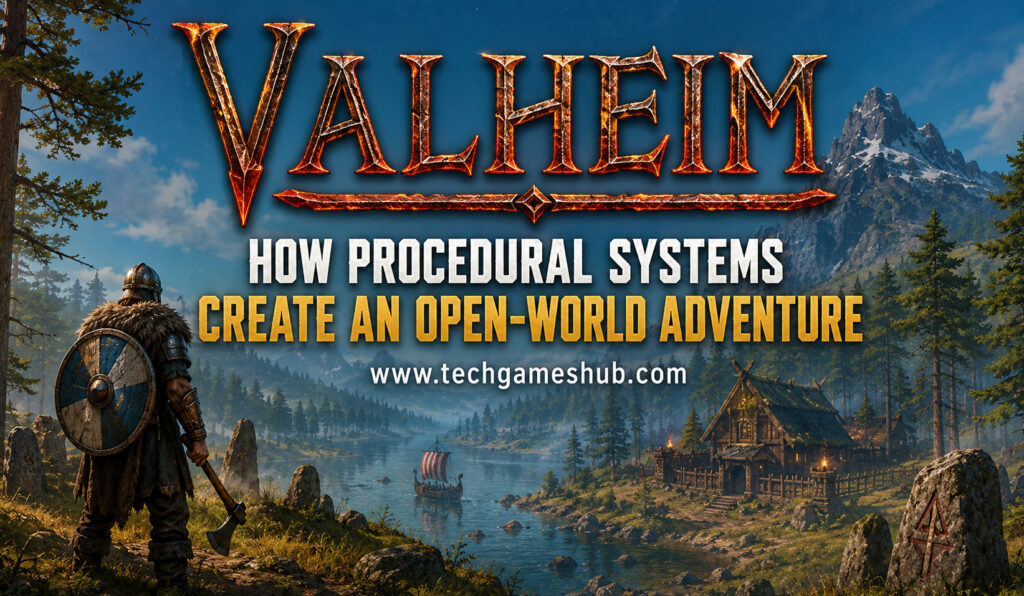
Valheim combines survival mechanics, exploration, combat, crafting, building, and Norse mythology into an open-world adventure that feels different for every player. One of the game’s most important technical features is its use of procedural systems to create its expansive environment.
Rather than placing every mountain, forest, island, and resource by hand, Valheim uses procedural generation to construct its world according to carefully designed rules. This creates an environment that can feel unpredictable while still maintaining the gameplay structure needed for survival and progression.
The result is a world where exploration is not simply about following a predetermined route. Players must observe their surroundings, gather resources, establish settlements, overcome enemies, and decide where to travel next.
What Is Procedural Generation in Valheim?
Procedural generation is a technique that uses algorithms to create game content dynamically. Developers design the rules that control the environment, while the game uses those rules to generate individual worlds.
In Valheim, this approach affects major aspects of the landscape. Mountains, forests, coastlines, rivers, islands, resources, points of interest, and different biome regions can be arranged differently depending on the generated world.
This means two players can begin separate adventures and encounter very different maps.
The underlying game mechanics remain consistent, but the world surrounding the player can change dramatically. That difference is central to Valheim’s replayability.
A World Built for Exploration
Valheim’s procedural environment is designed around exploration. Players begin in one area but eventually need to travel farther to discover new resources, biomes, enemies, and challenges.
The world gradually encourages players to move beyond familiar territory.
A nearby forest may provide early materials, while more distant regions introduce different resources and stronger enemies. This creates a natural reason to explore rather than allowing players to remain permanently in one location.
Procedural generation makes the journey less predictable. Players may discover a coastline, mountain range, open meadow, or dangerous region in a different position from what another player experiences.
Biomes Give the World Structure
Although the map is procedurally generated, Valheim does not feel completely random because its world is organized into distinct biomes.
Different regions have their own environments, resources, creatures, and levels of danger. Meadows can provide a relatively accessible starting environment, while other biomes introduce harsher conditions and stronger enemies.
This biome structure gives procedural generation a sense of progression.
Players can look at an unfamiliar landscape and make decisions based on what they see. A dangerous-looking area might indicate that they are not yet prepared, while a familiar biome may provide resources they urgently need.
The generated world therefore communicates information through its environment.
Procedural Terrain Makes Every Journey Different
One of the most interesting effects of procedural generation is that travel itself becomes part of the adventure.
A fixed game map allows players to memorize roads, landmarks, and shortcuts. Valheim’s generated landscapes make navigation more personal.
Players may need to sail around large coastlines, cross forests, climb mountains, or search for safe routes through unfamiliar territory.
Even when players understand the general structure of the game, they cannot rely entirely on memory when starting a new world.
This makes exploration feel more active and creates stories around the journey itself.
Sailing and the Procedural World
Valheim’s ocean system adds another dimension to procedural exploration.
Water separates many areas, making transportation an important part of progression. Players can build boats and use them to explore coastlines, search for new islands, and reach distant regions.
Because the world layout changes, sailing routes can also vary.
One world may make a particular journey relatively straightforward, while another could require longer travel and more careful planning.
The ocean therefore becomes more than empty space. It acts as a natural barrier, transportation network, and exploration opportunity.
Resources Drive Exploration
Procedural generation works especially well in Valheim because exploration is directly connected to resource progression.
Players need materials to create tools, weapons, armor, buildings, and other equipment. As they progress, they encounter resources associated with different environments.
This encourages players to venture into unfamiliar territory.
The journey to collect a particular resource can become an adventure of its own. Players may encounter enemies, discover new locations, find potential building sites, or become stranded far from their base.
Because the environment is generated differently in each world, resource gathering does not always follow the same route.
Building Turns Generated Land Into a Home
Valheim’s building system adds an important layer to procedural exploration.
Players are not simply passing through the generated environment. They can transform parts of it into permanent settlements.
A hillside can become a fortress. A coastline can become a harbor. A meadow can become a farming area. A remote location can become an outpost for future expeditions.
Because the world is different every time, choosing where to build becomes part of the adventure.
Players must consider access to resources, terrain, nearby threats, transportation, and the visual character of the surrounding environment.
The procedural landscape therefore becomes a creative resource.
Procedural Generation Creates Uncertainty
Survival games depend heavily on uncertainty, and Valheim uses procedural generation to reinforce that feeling.
Players cannot know the complete layout of a new world immediately. They have to explore it gradually and record what they discover.
This creates a strong sense of adventure.
A distant mountain might contain valuable resources, but reaching it could require crossing dangerous territory. An unfamiliar island might provide a strategic location for a new base, but it could also contain powerful enemies.
The uncertainty makes decisions more meaningful because players do not always know what awaits them.
Procedural Systems Support Player Stories
One of the most interesting consequences of procedural generation is that it can create personal stories without requiring developers to script every event.
A group of players might spend hours sailing through storms to reach a distant region. Another group might build a massive settlement near a coastline and use it as a central trading and exploration hub.
Someone else might become lost while exploring a mountain and discover a location that eventually becomes their favorite base.
These stories emerge from the interaction between the player and the generated environment.
The developers create the systems, but players create the memories.
Technology and Game Design Work Together
Procedural generation is only one part of Valheim’s design. Its success comes from the way the technology interacts with other systems.
Combat gives exploration risk. Crafting provides progression. Building gives players a reason to settle. Resources encourage travel. Biomes establish environmental progression.
The procedural world connects all of these mechanics.
Without meaningful gameplay systems, a large generated map could quickly become boring. Valheim avoids that problem by ensuring that exploration is connected to survival and progression.
Why Procedural Worlds Improve Replayability
The biggest advantage of procedural generation is replayability.
Once players learn a fixed map, future playthroughs can become predictable. Valheim reduces this familiarity by changing the world layout.
Players can start a new seed and encounter different coastlines, resource locations, biome arrangements, and travel routes.
This allows experienced players to retain their knowledge of the game’s mechanics while facing a new environmental puzzle.
Every new world becomes an opportunity to experiment with different strategies, settlement locations, exploration routes, and progression choices.
The Future of Procedural Open Worlds
Valheim demonstrates how procedural systems can support large-scale open-world adventures without requiring every element to be handcrafted.
Future games could take this concept even further by combining procedural generation with artificial intelligence, dynamic ecosystems, advanced weather systems, and responsive environments.
Imagine a procedural world where settlements grow based on player activity, wildlife populations change naturally, landscapes evolve over time, and characters respond differently to what happens around them.
Such systems could make open worlds feel increasingly alive while still providing the variety associated with procedural generation.
Conclusion
Valheim shows how procedural technology can transform an open-world survival game into a constantly changing adventure. Its generated landscapes give players different maps to explore, while biomes, resources, enemies, sailing, crafting, and building ensure that exploration always has a purpose.
The technology works because Valheim does not treat procedural generation as a simple way to make a larger map. Instead, the generated world becomes the foundation for survival, progression, creativity, and discovery.
Every mountain can become a challenge, every coastline can lead to a new destination, and every unexplored region can contain something unexpected.
By combining procedural systems with meaningful gameplay mechanics, Valheim demonstrates why dynamically generated worlds can make open-world adventures more personal, unpredictable, and replayable.