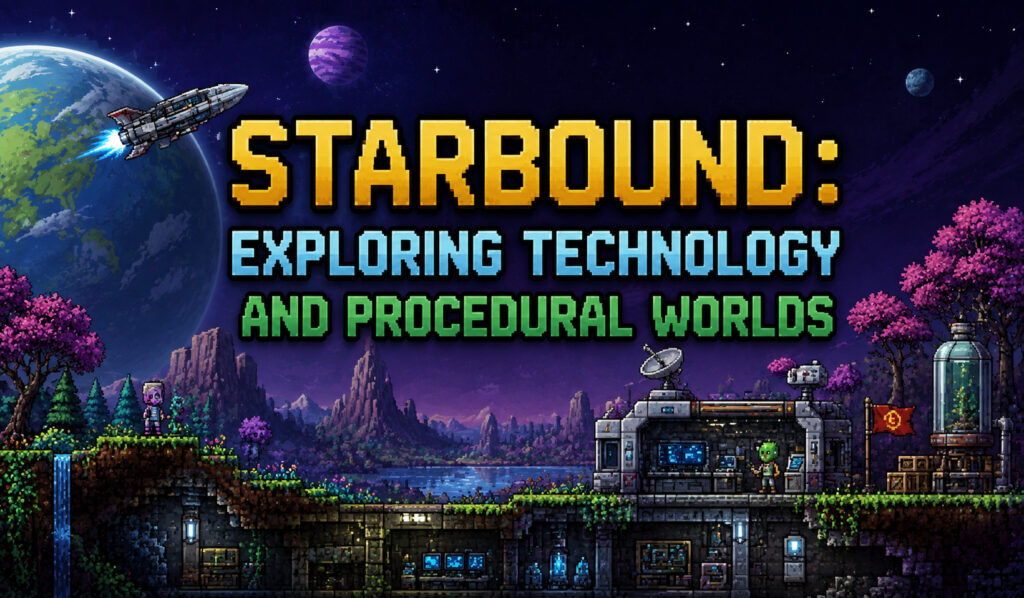
In the world of sandbox games, Starbound stands out by combining exploration, survival, crafting, science-fiction technology, and procedurally generated environments into one expansive adventure. Instead of restricting players to a single handcrafted map, the game offers a universe filled with planets that can be explored, harvested, built upon, and transformed.
Its procedural world generation is a major part of the experience. Every planet can have its own terrain, atmosphere, resources, creatures, structures, and environmental characteristics. At the same time, technology plays an important role in helping players travel between worlds, survive unfamiliar environments, and develop better equipment.
Together, these systems create a game where exploration and technology constantly influence each other.
What Makes Starbound’s Universe Different?
Starbound is built around the idea of exploring a large science-fiction universe. Players can travel between planets rather than remaining in one fixed environment.
This design gives the game a strong sense of scale. Instead of simply moving across one enormous map, players can leave one planet behind and search for another destination.
Each world can provide different opportunities. Some planets may contain useful resources, while others can offer unusual landscapes, settlements, enemies, or structures.
Because procedural generation determines many aspects of these worlds, exploration can remain unpredictable even after players understand the basic mechanics.
How Procedural Generation Creates Variety
Procedural generation uses algorithms to assemble game environments according to predefined rules. Developers establish the systems that control terrain, objects, creatures, resources, and other elements, while the game generates individual worlds using those systems.
In Starbound, this approach allows planets to differ in appearance and gameplay possibilities.
Terrain can include hills, forests, underground areas, oceans, caves, and other environmental features. Different combinations of these elements can create worlds that feel distinct from one another.
The technology is not simply producing random pixels. It is following a framework designed to create playable environments.
This is important because completely uncontrolled randomness could produce worlds that are difficult to navigate or uninteresting to explore. Procedural generation works best when variation is guided by thoughtful design.
Planet Exploration Creates Endless Possibilities
One of Starbound’s biggest attractions is the feeling that there is always another world to visit.
A planet can serve as a temporary base, a resource-gathering location, a place to discover structures, or simply an environment worth exploring.
The ability to travel between planets changes the traditional sandbox formula. Instead of building everything around a single map, Starbound turns the universe itself into the playground.
This structure also encourages players to develop their own reasons for exploration. One player may focus on collecting resources, another may search for unusual locations, while someone else may spend most of their time building.
Procedural generation supports all of these play styles by providing a large variety of environments.
Technology Makes Exploration Possible
Science-fiction technology is not simply part of Starbound’s visual identity. It also supports the gameplay loop.
Players use technological tools and equipment to travel, gather materials, fight enemies, build structures, and survive different environments.
As players progress, improved equipment can make exploration easier and expand their capabilities.
This creates a natural relationship between technology and procedural exploration. New worlds create challenges and opportunities, while technological progression gives players better ways to respond to them.
For example, a difficult environment may become easier to explore after acquiring improved equipment. A new tool can also encourage players to revisit locations or investigate areas they previously ignored.
The Importance of Resources
Procedural worlds become more meaningful when players have reasons to interact with them.
Starbound uses resources as a major part of its progression system. Players explore planets to collect materials that can be used for crafting, construction, equipment, and other purposes.
Because resources are connected to progression, exploration becomes more than sightseeing.
A player might land on an unfamiliar planet because they need a particular material. While searching, they may discover a cave, encounter a creature, find a structure, or uncover something unexpected.
This creates a chain of discovery in which one objective naturally leads to another.
Caves and Underground Environments
The underground areas of Starbound add another layer to procedural exploration.
A planet’s surface provides one type of experience, but digging below it can reveal caves, tunnels, resources, enemies, and hidden locations.
Procedurally generated underground environments make exploration less predictable. Players cannot always know how deep a cave extends or what they might find beyond the next passage.
Mining therefore becomes an exploration activity rather than simply a method of collecting materials.
The underground world can also encourage players to establish temporary bases, create pathways, or develop their own methods for navigating dangerous areas.
Procedural Worlds and Player Creativity
One of the strongest advantages of a sandbox environment is the freedom it gives players to create.
Starbound allows players to build structures and modify the environments they encounter. A procedurally generated planet can therefore become the foundation for a completely personal creation.
One player might build a futuristic laboratory, while another creates a village, underground shelter, research facility, or elaborate base.
The generated environment provides the starting point, but the player’s imagination determines what happens next.
This combination of algorithmic world generation and player creativity is one of the reasons sandbox games can remain engaging for long periods.
Technology Changes the Way Players Interact With the World
As players become more advanced, technology changes the relationship between them and their surroundings.
Better tools can make gathering resources faster. Improved equipment can make dangerous environments more manageable. Transportation systems can make large areas easier to explore.
This creates a sense of progression without requiring the universe itself to remain static.
The world is generated according to established systems, but the player’s capabilities continue to evolve.
As a result, returning to an earlier planet with better technology can produce a different experience from the first visit.
The Balance Between Randomness and Consistency
Procedural generation presents a difficult design challenge: how can a game provide variety without losing its identity?
Starbound addresses this by using consistent mechanics across different environments.
Players know how basic systems work even when the planet changes. They understand how to gather materials, build structures, fight enemies, craft objects, and navigate the universe.
This familiarity provides stability, while procedural generation provides variation.
The result is a useful balance. Players are not constantly learning entirely new rules, but they are frequently encountering new situations.
Why Procedural Generation Improves Replayability
A fixed map eventually becomes familiar. Once players know where important locations, resources, and landmarks are found, exploration can become predictable.
Procedural generation helps reduce this problem by changing the environment.
Starting a new adventure can mean encountering different planets, landscapes, underground areas, resources, and locations.
The player still brings their previous knowledge of the game, but the world presents new circumstances.
This is especially valuable in sandbox games because replayability depends heavily on discovery and experimentation.
Starbound and the Future of Procedural Technology
Starbound provides an interesting example of how procedural generation can support a science-fiction sandbox.
As technology continues to improve, future games could use procedural systems to generate more detailed ecosystems, dynamic settlements, realistic weather patterns, intelligent creatures, and environments that react to player actions.
Artificial intelligence could also make generated worlds more interactive. Instead of simply creating different landscapes, future systems might generate characters, stories, missions, and societies that evolve according to what players do.
That could make procedural worlds feel less like collections of generated locations and more like living environments.
Conclusion
Starbound demonstrates how procedural technology can expand the possibilities of sandbox game design. Its universe combines randomly generated planets with exploration, crafting, resources, technology, combat, and construction to create an experience that can continually offer something new.
The game’s technology is most effective because it works together with player progression. Every new tool can change how players approach the world, while every new planet can provide different challenges and opportunities.
Procedural generation gives Starbound its enormous sense of scale, but technology gives players the ability to make that scale manageable and meaningful.
Ultimately, Starbound shows that procedural worlds are not valuable simply because they are large. Their real strength comes from giving players reasons to explore, experiment, create, and return to the universe again and again.