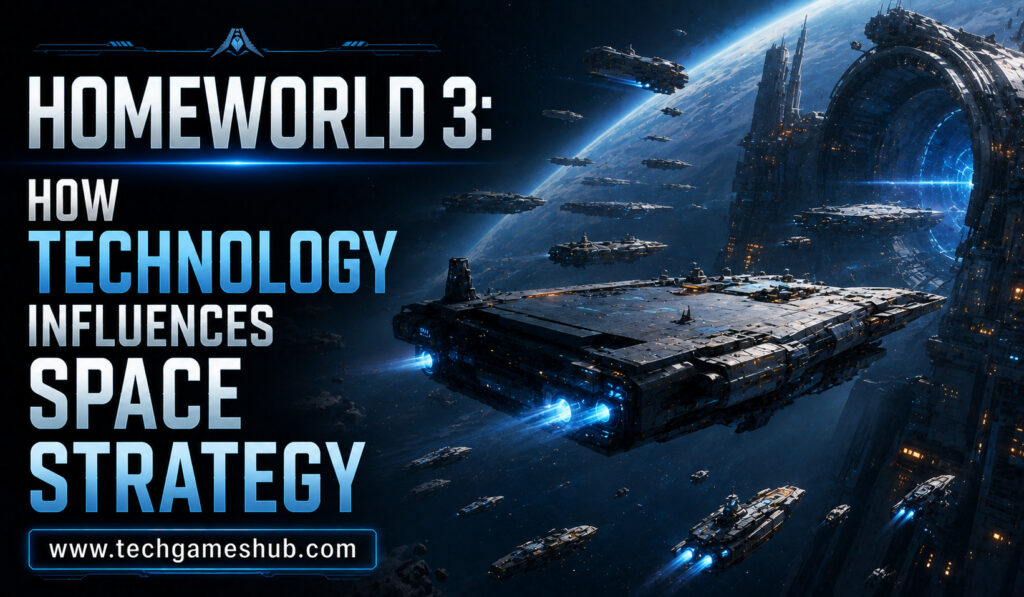
Space strategy games have always been about more than simply moving fleets and destroying enemy ships. The best titles challenge players to understand positioning, resources, technology, timing, and the strengths of different units. Homeworld 3 continues this tradition while introducing modern technological systems that influence how players explore, fight, and manage their fleets across the vastness of space.
Developed by Blackbird Interactive and published by Gearbox Publishing, Homeworld 3 combines real-time strategy with three-dimensional space combat. Its technology-focused gameplay creates opportunities for players to approach battles in different ways, making technological development an important part of strategic decision-making.
What Makes Homeworld 3’s Strategy Unique?
Homeworld 3 builds upon the foundations established by earlier games in the series while expanding the possibilities of modern space warfare. Instead of fighting exclusively across a flat battlefield, players operate in a fully three-dimensional environment.
Ships can move above, below, around, and through large structures in space. This creates additional tactical possibilities and makes positioning extremely important.
Technology supports this approach by giving players access to different ship types, weapons, defenses, and strategic tools. Knowing what technology to develop and how to use it can determine whether a fleet survives a difficult encounter.
Technology and Fleet Development
A successful fleet requires more than a large number of ships. Players need to understand the roles different units perform and how those units work together.
Technology affects the development of combat capabilities, allowing players to build fleets suited to different situations. Some ships may provide powerful offensive capabilities, while others offer defensive support, reconnaissance, or specialized functions.
This creates an important strategic question: should a player invest heavily in a particular type of technology or maintain a more balanced fleet?
A specialized fleet can be extremely effective when used correctly, but it may also have weaknesses that an opponent can exploit. A balanced fleet offers flexibility but may lack overwhelming strength in a specific area.
Homeworld 3 encourages players to consider these trade-offs throughout a campaign.
Three-Dimensional Technology and Tactical Thinking
One of the defining characteristics of Homeworld 3 is its three-dimensional battlefield. Technology becomes particularly interesting when combined with this environment.
A weapon or ship capability is not useful simply because it has high statistics. Players also need to consider where and when it is being used.
A fleet positioned behind a massive structure may have defensive advantages. Another group could attack from an unexpected direction. Certain ships may be more effective when they can approach enemies from favorable angles.
This makes technology part of tactical planning rather than something players simply unlock and forget.
The battlefield itself becomes another strategic resource.
The Importance of Positioning
Technology cannot compensate for poor positioning in every situation. Even a powerful fleet can suffer serious losses if it enters combat without considering the surrounding environment.
Homeworld 3 places considerable emphasis on movement and spatial awareness. Players must think about distance, formations, obstacles, and attack directions.
This means technological advantages often become more valuable when combined with good positioning.
For example, a player who understands how to use the environment can potentially make a smaller fleet more effective. Rather than depending entirely on superior numbers, the player can use terrain-like objects in space and three-dimensional movement to create tactical opportunities.
Advanced Technology and Combat Adaptation
Space battles can change quickly. An opponent may introduce a different type of ship or alter its formation, forcing the player to respond.
Technology provides tools for adaptation.
If a player’s initial fleet composition is ineffective, technological upgrades or access to different units can provide alternative approaches. This encourages players to evaluate the battlefield continuously rather than following one predetermined plan.
Adaptation is particularly important in longer engagements. A strategy that works during the opening phase of a battle may become less effective later as enemy forces reposition or new units enter the conflict.
Technology gives players more options when those situations arise.
Resource Management and Technological Choices
Technology also has an economic dimension. Players cannot develop everything immediately, which means resources must be allocated carefully.
Investing in technology can improve a fleet’s future capabilities, but resources spent on development may not be available for immediate fleet expansion or other strategic needs.
This creates a classic real-time strategy dilemma.
Should a player invest in stronger technology now, or use available resources to produce more ships?
The answer depends on the situation. If an enemy is preparing an attack, immediate military production may be necessary. If the battlefield is relatively stable, technological development could provide a stronger advantage later.
These decisions make technology closely connected to overall strategic planning.
Technology Encourages Different Playstyles
One of the benefits of technological progression is that it allows players to develop different approaches to space warfare.
Some players may prefer aggressive strategies focused on overwhelming opponents quickly. Others may favor defensive tactics, careful positioning, and gradual technological advancement.
A technology-focused strategy can be particularly useful for players who prefer long-term planning. Instead of seeking immediate victories, they can build an increasingly capable fleet and prepare for larger confrontations.
Meanwhile, players who prioritize early military production can attempt to gain territory and resources before technological advantages become significant.
The existence of these different approaches helps make each campaign more dynamic.
The Role of Reconnaissance Technology
Information is another form of power in space strategy.
Before committing a fleet to battle, players need to understand what they are facing. Reconnaissance and awareness can reveal enemy movements, fleet composition, and potential threats.
Technology that improves information gathering can therefore have strategic value even if it does not directly increase offensive strength.
Knowing where an enemy fleet is located can prevent an ambush. Understanding the size of an opposing force can help determine whether an engagement is worth taking.
This demonstrates an important principle of strategy games: the best technological advantage is not always the one that produces the biggest damage numbers. Sometimes information can be more valuable than firepower.
Technology and Large-Scale Battles
Homeworld 3 is designed around large space engagements where multiple units can operate simultaneously. As battles grow, technological differences become increasingly important.
Large fleets may include different classes of ships performing specialized roles. Players must coordinate these units while responding to enemy movements.
Technology helps determine how these units perform and how effectively they can work together.
A fleet with strong individual ships is not automatically guaranteed victory. Coordination, positioning, timing, and strategic awareness remain essential.
This combination prevents technology from becoming a simple shortcut to victory. Players still need to use technological advantages intelligently.
How Technology Supports Replayability
Technology also contributes to the game’s replay value. Different strategic decisions can lead to different fleet compositions and tactical experiences.
Players can experiment with different approaches and discover how technological choices influence battles. A strategy that performs well in one situation may require adjustments in another.
This experimentation is particularly important for strategy games because players often improve by learning from mistakes.
A failed battle can reveal that a particular technological investment was poorly timed, that a fleet lacked necessary support, or that the player’s strategy did not match the battlefield.
The next campaign provides an opportunity to apply those lessons.
The Future of Technology in Space Strategy Games
Homeworld 3 highlights how modern technology can influence the design of space strategy games. Rather than treating technological progression as a simple upgrade tree, developers can connect technology with movement, positioning, information, resources, and tactical decision-making.
Future space strategy games could push these ideas further. More advanced simulations could allow technologies to influence navigation, communication, ship behavior, resource systems, and battlefield environments.
Artificial intelligence could also make opponents more responsive to technological development, forcing players to constantly adapt their strategies.
Conclusion
Homeworld 3 demonstrates that technology can play a much larger role in space strategy than simply making ships stronger. It influences fleet composition, resource management, positioning, reconnaissance, tactical adaptation, and long-term planning.
Its three-dimensional battles make these choices especially meaningful because technological capabilities must be combined with spatial awareness. Players who understand how their ships, upgrades, resources, and surroundings interact can gain advantages that raw firepower alone cannot provide.
Ultimately, Homeworld 3 shows why technology remains such an important part of modern strategy gaming. When technological progression is connected to meaningful decisions, it becomes more than a progression system—it becomes a tool that shapes how players think, fight, and control the battlefield.