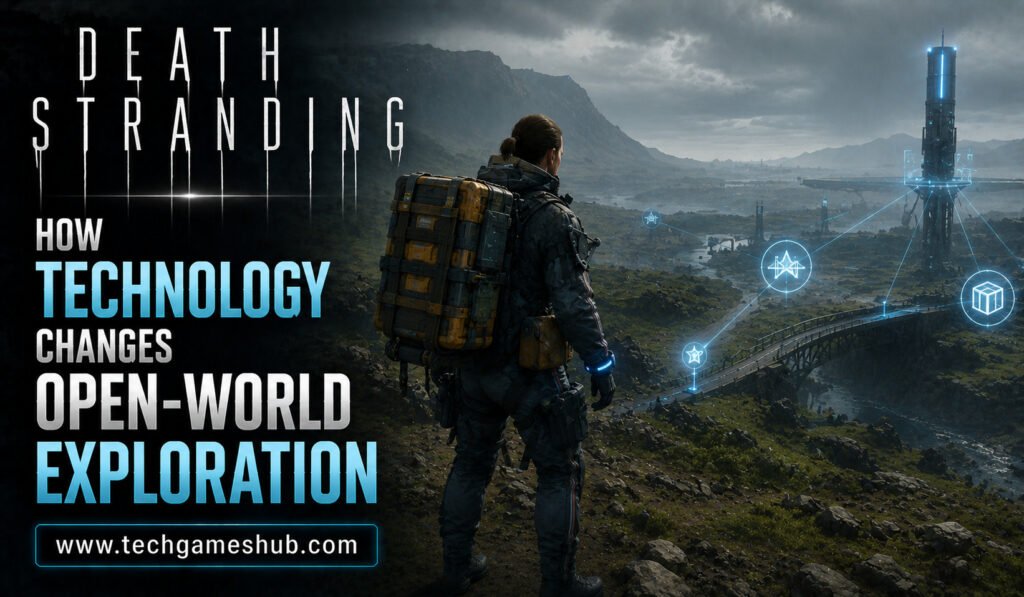
Open-world games often focus on freedom, exploration, and discovering what lies beyond the next objective. However, few games approach exploration as differently as Death Stranding. Instead of filling its world with constant combat and conventional activities, the game makes movement itself a central part of the experience.
Technology plays a major role in this design. From specialized equipment and vehicles to scanning systems, communication networks, and automated tools, technology changes how players travel through the environment. Rather than simply making exploration faster, these systems influence how players understand terrain, manage risks, and connect different parts of the world.
A Different Approach to Open-World Exploration
Death Stranding presents a large, mysterious landscape that players must gradually understand. Mountains, rivers, cliffs, rocky terrain, and other natural obstacles can make even a relatively short journey challenging.
The game’s protagonist, Sam Porter Bridges, is primarily tasked with delivering cargo and reconnecting isolated communities. This means exploration is not simply about reaching a destination. Players must consider how they will get there and what equipment they should take.
This creates a different relationship with the open world.
In many open-world games, technology helps players move through environments with fewer limitations. In Death Stranding, technology often helps players understand and overcome those limitations.
The Importance of the Odradek Scanner
One of the most recognizable pieces of technology in Death Stranding is the Odradek scanner. It provides information about the surrounding environment and helps Sam identify useful objects, terrain features, and potential hazards.
This technology changes exploration because players do not have to rely entirely on visual observation.
The scanner provides additional information that can influence route planning. Before crossing an unfamiliar area, players can use it to understand what might be ahead.
The result is an exploration system where information becomes a valuable resource.
Instead of simply following a map marker, players are encouraged to examine the environment and make decisions based on what their equipment reveals.
Terrain Becomes Part of the Challenge
Technology becomes particularly important because of Death Stranding’s emphasis on terrain.
Steep slopes, deep rivers, uneven ground, and rocky paths can affect Sam’s movement. Carrying heavy cargo makes these challenges even more significant.
This turns the landscape into an active gameplay system.
A mountain is not merely something that exists in the background. It can determine the route players choose, the equipment they carry, and the amount of time required to complete a delivery.
Technology provides tools for overcoming these obstacles, but players still need to decide when and how to use them.
The Power of the PCC
The Portable Chiral Constructor, commonly known as the PCC, is one of the game’s most important technological tools. It allows players to construct useful structures in the world.
These structures can include bridges, generators, shelters, watchtowers, and other infrastructure.
The significance of the PCC goes beyond construction. It allows players to change the environment and make future journeys easier.
A difficult route can gradually become more manageable as players and other online participants build useful infrastructure.
This creates a fascinating relationship between technology and exploration: technology does not simply help players navigate the world; it allows them to reshape it.
Roads and Infrastructure Transform Travel
Road construction provides another strong example of technology changing exploration.
Building roads requires resources and effort, but once completed, they can dramatically improve transportation across certain areas. Vehicles become more useful, and long-distance deliveries can become less difficult.
The process creates a sense of progression that is closely connected to geography.
Players can look at a difficult region and eventually transform it into a more accessible route through technological infrastructure.
This makes the open world feel less static. The landscape may remain physically unchanged, but the way players interact with it can evolve significantly.
Vehicles Change the Meaning of Distance
Vehicles also have a major influence on exploration. Carrying cargo on foot is often slow and demanding, while motorcycles and trucks can make transportation considerably more efficient in suitable terrain.
However, vehicles are not universally useful.
Certain environments may remain difficult to navigate even with transportation technology. Rough terrain, narrow paths, rivers, and steep areas can still force players to travel on foot.
This limitation is important because it prevents technology from eliminating the challenge of exploration.
Instead, players must understand which tool is appropriate for each situation.
Technology and Cargo Management
Death Stranding also connects technology with inventory management.
Sam frequently carries multiple pieces of cargo, and how that cargo is arranged can affect balance, movement, and overall efficiency.
Players must decide what equipment to bring and what can safely be left behind.
Technology can improve cargo transportation, but it does not remove the need for planning.
This creates a strategic layer within exploration. A player preparing for a long mountain journey may need climbing equipment, support tools, and appropriate transportation options. Taking too much equipment, however, can create additional burdens.
The best explorers therefore learn to prepare according to the environment.
The Chiral Network Connects the World
Technology is also central to the game’s larger narrative.
The Chiral Network is designed to reconnect isolated settlements and expand communication across the United States. As players connect locations, they gain access to information and shared infrastructure.
This technological system reinforces one of Death Stranding’s central themes: connection.
Exploration is not only about discovering new places. It is also about connecting people and creating systems that make future journeys easier.
The network therefore has both a gameplay function and a narrative purpose.
Asynchronous Multiplayer and Shared Technology
One of Death Stranding’s most unusual ideas is its asynchronous multiplayer system. Players do not typically share the same world in the traditional multiplayer sense, but their actions can influence the experiences of others.
A bridge built by one player can help another player. A useful structure placed along a difficult route can save someone else time and resources.
Players can also leave signs, equipment, and other helpful contributions.
This system changes how technology affects exploration because infrastructure becomes a shared resource.
The world feels more connected without requiring players to directly meet.
Technology Encourages Smarter Route Planning
Because the environment can be challenging, successful exploration often depends on preparation.
Players need to evaluate terrain, cargo weight, weather, available infrastructure, and transportation options before starting a journey.
Technology provides information and tools, but players still need to interpret that information.
This makes exploration feel closer to planning a real expedition than simply moving between mission markers.
The question is not only “Where do I need to go?” but also “What is the safest and most efficient way to get there?”
That distinction gives Death Stranding its unique identity.
Technology Does Not Remove the World’s Difficulty
A common assumption about technology in games is that better equipment should make environments progressively easier. Death Stranding takes a more nuanced approach.
Technology can reduce certain difficulties, but new challenges often appear as players reach unfamiliar regions or attempt more demanding deliveries.
Even advanced equipment has limitations.
This keeps exploration meaningful throughout the game. Players continue to think about routes and resources rather than eventually becoming completely independent of the environment.
Technology becomes a way of interacting with the world rather than a way of bypassing it.
How Technology Makes the World Feel Alive
Death Stranding demonstrates that technology can influence open-world design at a fundamental level.
The world changes as players construct infrastructure, connect locations, unlock new equipment, and contribute to shared systems. Exploration therefore has a sense of progression that is not based entirely on character statistics.
The landscape itself becomes part of the player’s development.
A route that once seemed dangerous may eventually become familiar because of bridges, roads, generators, and other technological improvements.
This gives players a tangible sense of accomplishment.
The Future of Technology-Driven Exploration
Death Stranding offers an interesting model for future open-world games. Instead of using technology only for combat upgrades or faster travel, developers can use it to change how players understand and interact with environments.
Future games could introduce dynamic infrastructure, smarter navigation systems, shared world-building, environmental scanning, and AI-powered route planning.
Such systems could make open-world exploration more meaningful by allowing players to actively shape how they experience the world.
Conclusion
Death Stranding shows how technology can completely change the meaning of open-world exploration. Its scanners, vehicles, construction systems, communication networks, and shared infrastructure are not simply convenient features. They are fundamental parts of the game’s exploration philosophy.
The technology helps players understand difficult terrain, plan routes, transport cargo, build useful infrastructure, and connect isolated communities. At the same time, the game ensures that technology never completely removes the challenges of the environment.
That balance is what makes Death Stranding’s world so distinctive. Exploration is not just about moving through a large map. It is about understanding the environment, preparing for its challenges, using technology intelligently, and gradually transforming a difficult journey into a connected network of possibilities.