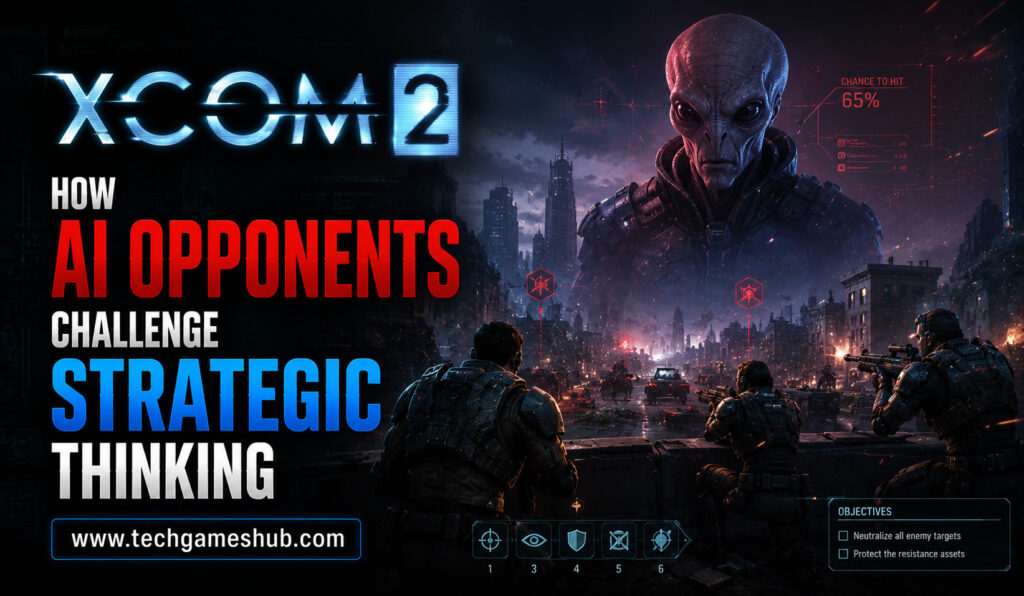
Strategy games are often defined by how well they force players to think ahead. The best tactical games do not simply test reaction speed; they require players to evaluate risks, understand the battlefield, manage limited resources, and adapt when plans go wrong. XCOM 2 is a strong example of this design philosophy, using tactical combat, enemy behavior, procedural missions, and strategic management to create a challenging experience where every decision can have consequences.
Developed by Firaxis Games and released in 2016, XCOM 2 places players in command of a resistance force fighting against an alien-controlled regime. Its gameplay combines turn-based tactical battles with a larger strategic layer involving soldiers, research, engineering, missions, and global operations.
One of the most important parts of the experience is its artificial intelligence. Enemy units are designed to respond to battlefield conditions, use their abilities, seek advantageous positions, and pressure the player’s squad. This makes AI a central part of the game’s strategic challenge.
AI Turns Every Battlefield Into a Puzzle
XCOM 2 does not present combat as a simple matter of defeating enemies as quickly as possible. Players must constantly evaluate the battlefield and determine what actions provide the greatest advantage.
Enemy units can occupy different positions, use cover, attack vulnerable soldiers, and create threats that force the player to reconsider a plan.
This means every turn becomes a tactical puzzle.
A player may have several possible actions, but choosing one can change what becomes possible later. Moving a soldier into a seemingly safe position might expose another unit. Attacking one enemy could leave a more dangerous opponent active. Advancing too quickly could trigger additional enemies.
The AI helps create these situations by making enemies active participants rather than stationary targets.
Enemy Behavior Encourages Tactical Planning
The enemy AI in XCOM 2 is designed around tactical behaviors that make combat unpredictable without being completely random.
Different alien units have different abilities and roles. Some specialize in direct attacks, while others can use special abilities, disable soldiers, create status effects, or provide support.
Because enemies behave differently, players cannot rely on a single strategy for every encounter.
A strong tactical plan must consider the composition of the opposing force.
For example, eliminating a high-damage enemy may be more important than attacking a weaker unit. Alternatively, disabling a support unit may prevent several dangerous actions later.
This encourages players to prioritize targets based on battlefield conditions rather than simply attacking whichever enemy is closest.
Cover and Positioning Make AI More Important
Cover is one of the fundamental mechanics in XCOM 2.
Soldiers can use environmental objects to reduce the chances of being hit, while enemies can also position themselves behind cover.
This creates a tactical relationship between movement and AI.
If an enemy takes strong defensive cover, the player must decide whether to attack it directly, flank it, use a special ability, or reposition.
At the same time, enemies can punish poor positioning.
A soldier who moves into an exposed location may become an easy target. A squad that advances without maintaining defensive positions can quickly lose its advantage.
The AI therefore makes the environment itself part of the strategic puzzle.
Flanking Creates Risk and Reward
Flanking is another important mechanic that demonstrates how enemy behavior affects strategy.
A player can sometimes move a soldier around an enemy’s position to gain a better attack opportunity. However, moving aggressively may expose the soldier to other enemies.
The same principle works in reverse. Enemy units can exploit openings in the player’s defensive formation.
This creates a constant balance between aggression and caution.
Players are rewarded for understanding enemy positioning, but reckless movement can produce disastrous results.
The AI makes battlefield geometry meaningful because enemy behavior determines how safe or dangerous a particular position is.
Different Enemy Types Require Different Responses
One of the strengths of XCOM 2 is the variety of enemy units.
Different enemies can create completely different tactical problems. Some are powerful attackers, others specialize in support, while certain units can manipulate battlefield conditions or target specific weaknesses.
This variety prevents the AI from becoming predictable.
Players need to understand what each enemy is capable of and determine how much attention it deserves.
As the campaign progresses, new threats can force players to change strategies. A tactic that worked against early enemies may become less effective against more advanced units.
This creates a natural learning curve.
AI Encourages Players to Think About Future Turns
Turn-based strategy gives players time to think, but XCOM 2 uses enemy behavior to make that thinking important.
The player is not simply deciding what to do now. They also need to consider what the enemy might do next.
If a soldier moves into a particular position, can an enemy flank them?
If an important target is left alive, what could it do during the next enemy turn?
If the squad uses valuable abilities now, will they be available when a stronger threat appears?
These questions turn each action into part of a larger decision-making process.
The AI effectively creates a conversation between the player’s strategy and the enemy’s potential response.
Fog of War Increases Uncertainty
Another feature that makes AI opponents challenging is the fog of war.
Players cannot always see the entire battlefield. Unknown areas may contain enemies that have not yet been discovered.
This creates uncertainty.
A commander must decide how far to advance without knowing exactly what is ahead. Moving too aggressively can reveal multiple enemies at once, while moving too slowly can cause the squad to lose valuable time.
The AI becomes more effective because players cannot always predict where threats will appear.
The result is a constant tension between information and risk.
Time Limits Change Strategic Thinking
Many missions also introduce objectives and time pressure.
Instead of simply eliminating every enemy, players may need to reach a location, recover information, destroy a target, or complete another objective within a limited number of turns.
This prevents overly cautious strategies from always being successful.
Players must balance safety with speed.
The AI becomes more challenging because enemies do not have to defeat the player’s entire squad to cause failure. They may simply delay the player long enough for the mission objective to become impossible.
This makes tactical positioning and movement even more important.
AI and Soldier Permadeath Increase the Stakes
XCOM 2’s campaign structure gives individual battles greater importance.
Soldiers can gain experience, develop abilities, and become valuable members of the squad. Losing an experienced soldier can therefore affect future missions.
This makes AI-driven combat decisions feel more consequential.
A risky attack is not simply a failed move in a single match. It can result in the permanent loss of a valuable soldier and force the player to rebuild their squad.
The possibility of permanent consequences encourages careful planning.
Strategic AI Beyond the Battlefield
Although combat AI is important, XCOM 2’s larger strategy layer also contributes to the challenge.
The player manages research, engineering, soldiers, equipment, facilities, and global operations while the enemy continues advancing its own agenda.
This means the game is not only about winning individual battles.
A player may win several tactical missions but still struggle strategically if resources are poorly managed.
The relationship between the tactical and strategic layers creates a larger decision-making system in which short-term victories must support long-term goals.
AI Creates Emergent Situations
One of the most interesting aspects of XCOM 2 is that AI behavior can combine with procedural mission layouts and player decisions to produce unexpected situations.
A mission may begin according to a familiar structure, but enemy positions, soldier actions, missed attacks, critical hits, and movement decisions can create completely different outcomes.
This produces what is often called emergent gameplay.
The developers establish the rules, but the interaction between those rules generates individual stories.
A mission that should have been straightforward can suddenly become a desperate retreat. A risky maneuver can produce an unexpected victory. A soldier who appears to be in serious danger might survive because of a carefully timed ability.
These moments make the campaign memorable.
Learning From AI Opponents
A major benefit of well-designed AI is that it teaches players.
When a tactical decision fails, players can often identify what went wrong.
Perhaps the squad moved too far forward. Maybe a soldier was left without cover. Perhaps an enemy was not prioritized correctly.
Over time, players begin to recognize patterns in enemy behavior.
This creates a natural learning process in which understanding the AI becomes part of mastering the game.
The player gradually develops better instincts for positioning, target selection, resource use, and risk management.
Why XCOM 2’s AI Matters
The AI in XCOM 2 is important because it supports the game’s central philosophy: every decision should matter.
Enemies are not simply there to provide targets. Their abilities, positioning, movement, and tactical pressure force players to make difficult choices.
The result is a strategy game where success depends on understanding both the player’s own capabilities and the behavior of opposing forces.
Good AI therefore does more than increase difficulty. It creates situations that require thought.
The Future of Strategy Game AI
Artificial intelligence in strategy games is likely to become increasingly sophisticated.
Future systems could create opponents that adapt more effectively to player behavior, coordinate complex attacks, manage resources intelligently, and respond dynamically to changing battlefield conditions.
However, stronger AI does not automatically mean better gameplay. The most effective strategy-game AI must remain understandable enough for players to learn from their mistakes.
XCOM 2 demonstrates the importance of this balance. Opponents can be challenging without making every outcome feel arbitrary.
Conclusion
XCOM 2 demonstrates how artificial intelligence can transform strategy gameplay. Enemy units create pressure through positioning, abilities, target selection, and battlefield behavior, forcing players to think several steps ahead.
Combined with cover mechanics, fog of war, time limits, soldier progression, and permanent consequences, the AI creates a tactical environment where careless decisions can have lasting effects.
The game’s greatest strength is that its AI does not simply exist to make enemies harder to defeat. It creates problems for the player to solve.
That approach represents an important direction for strategy games. As AI technology becomes more advanced, the most successful opponents may not be those that simply attack more aggressively, but those that encourage players to think more carefully, adapt their plans, and develop better strategic decision-making.