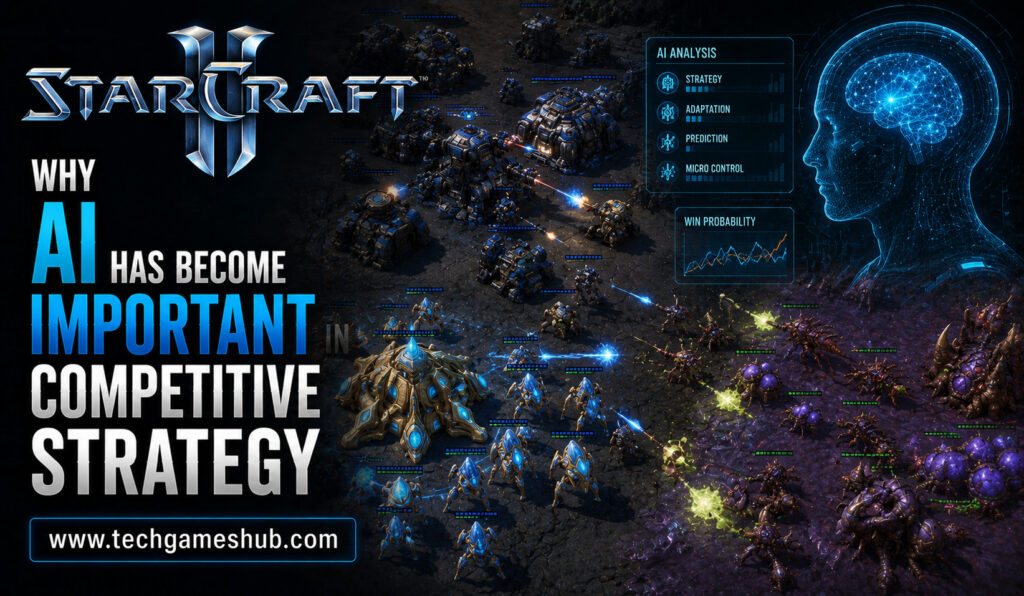
Competitive strategy games are built around decisions, timing, resource management, and the ability to anticipate an opponent. Few real-time strategy games demonstrate these principles as clearly as StarCraft II. Blizzard Entertainment’s science-fiction strategy game has developed into a major competitive title where players manage economies, control armies, scout opponents, and execute complex strategies under intense time pressure.
Artificial intelligence has become increasingly important within this ecosystem. In StarCraft II, AI is not limited to controlling computer opponents. It also plays a role in training, experimentation, game analysis, and research into machine intelligence. The game’s complex rules and enormous number of possible decisions have made it a valuable environment for exploring how artificial intelligence can interact with strategic gameplay.
Why StarCraft II Is Difficult for AI
At first glance, a real-time strategy game may seem straightforward. Players gather resources, build structures, create units, and attack opponents.
In practice, StarCraft II is extremely complicated.
Players must make decisions continuously. They need to determine when to expand their economy, which technologies to research, which units to build, where to scout, and when to attack.
At the same time, they must control individual units during battles.
This creates an enormous decision space.
An AI system must not only understand the rules of the game but also determine which decisions are useful in a rapidly changing environment.
AI Opponents Create a Training Environment
Computer-controlled opponents have long been useful for learning real-time strategy games.
New StarCraft II players can practice against AI to learn basic mechanics without immediately competing against experienced human players.
AI matches provide a controlled environment where players can experiment with different strategies.
A player can test a new build order, practice defending an early attack, or experiment with different unit combinations.
This makes AI useful as a training partner.
However, competitive players eventually need to understand that human opponents behave differently. Humans can make unusual decisions, deliberately disguise strategies, and adapt creatively.
AI is therefore most valuable when it complements human competition rather than completely replacing it.
AlphaStar Changed the Conversation
StarCraft II became particularly important in AI research because of DeepMind’s AlphaStar project.
AlphaStar was an artificial intelligence system developed to play StarCraft II at a high level. In 2019, DeepMind announced that AlphaStar had reached Grandmaster level in the game under specified conditions, making it one of the most notable demonstrations of AI performance in a complex real-time strategy environment.
The achievement attracted attention because StarCraft II requires much more than recognizing patterns.
The AI had to manage resources, produce units, scout the opponent, make tactical decisions, and control armies.
This made the game a useful environment for studying advanced decision-making.
Strategic Planning Requires Long-Term Thinking
One reason StarCraft II is challenging for AI is that actions can have consequences far into the future.
Spending resources on one technology means those resources cannot immediately be used for something else.
Building additional production facilities may strengthen future military capacity but delay an immediate attack.
Expanding the economy can create long-term advantages but may leave a player vulnerable in the short term.
Human players constantly balance these competing priorities.
AI systems need to perform similar calculations.
This is fundamentally different from games where the best action can be determined from a small set of immediate possibilities.
Resource Management and AI
The economy is at the heart of StarCraft II.
Players collect minerals and gas, construct buildings, produce workers, and allocate resources to technology and military production.
AI needs to understand how these resources influence future possibilities.
An opponent with a stronger economy may eventually produce a larger army. However, investing too heavily in economic growth can create short-term weaknesses.
This creates a strategic relationship between economy and military power.
AI systems that can recognize these trade-offs can make more sophisticated decisions.
Scouting and Information
Competitive StarCraft II is also an information game.
Players cannot see everything their opponent is doing. The fog of war hides enemy positions, production facilities, army movements, and expansions.
Scouting helps reveal this information.
AI therefore needs to understand not only what it knows but also what it does not know.
If an opponent’s main army disappears from view, several possibilities may exist. They could be preparing an attack, expanding, hiding units, or simply repositioning.
This uncertainty makes decision-making much harder.
Effective strategic AI must operate with incomplete information rather than relying on perfect knowledge.
AI and Build Orders
Build orders are carefully planned sequences of economic and military development.
Competitive players often use established openings because they provide efficient ways to reach particular strategic goals.
AI can analyze and execute these sequences with great precision.
However, the real challenge begins when an opponent deviates from the expected plan.
A good competitive strategy cannot depend entirely on memorization.
Players need to recognize what the opponent is doing and adapt.
This is where AI research becomes particularly interesting. Developing systems that can adjust to changing conditions is much harder than teaching a machine to follow a fixed sequence.
Tactical Unit Control
StarCraft II also requires detailed control of individual units.
During battles, players may need to focus fire, retreat damaged units, use special abilities, split formations, surround opponents, and manage multiple engagements simultaneously.
Human professionals can perform these tasks while also maintaining their economies.
AI systems need to solve the same problem.
The challenge is not simply deciding which army should attack. It can involve determining how individual units should move and interact with one another during rapidly changing battles.
This makes StarCraft II a valuable environment for studying real-time decision-making.
The Importance of Speed and Accuracy
Competitive StarCraft II places significant demands on player speed.
Actions per minute, often abbreviated as APM, are commonly used as one way of describing the amount of activity a player performs during a match.
However, speed alone does not guarantee success.
A player can issue many commands without making good strategic decisions.
This distinction is important for AI research.
An effective AI should not simply perform actions quickly. It should choose useful actions.
The combination of strategic intelligence and precise execution is what makes high-level play so difficult.
AI Can Analyze Competitive Matches
Artificial intelligence can also contribute to the competitive scene through analysis.
Game data can be examined to identify patterns in player behavior, build orders, unit choices, timings, and strategic outcomes.
This can help players understand why certain strategies succeed or fail.
AI-assisted analysis could potentially identify weaknesses that are difficult for humans to notice manually.
For example, a system might discover that a player consistently delays a particular technology or reacts too slowly to a certain type of attack.
This creates opportunities for more personalized training.
AI as a Strategy Testing Tool
Competitive players can also use AI systems to test ideas.
A strategy that looks powerful in theory can be evaluated against different types of opponents.
This allows players to explore possibilities before using them in tournaments or ranked matches.
AI can therefore function as a laboratory for strategy.
The player develops an idea, tests it, observes the results, changes the strategy, and tests it again.
This process can accelerate experimentation.
Human Creativity Still Matters
Despite advances in game-playing AI, human creativity remains an important part of competitive StarCraft II.
Human players can intentionally take unusual risks, create deceptive strategies, and adapt based on psychological factors.
They can also understand the broader competitive environment.
For example, a player may choose a strategy not because it is mathematically optimal but because they believe their opponent is likely to respond in a particular way.
This human element is difficult to reduce to simple calculations.
AI can analyze enormous amounts of information, but competitive strategy also involves creativity, intuition, and adaptation.
AI Has Changed How Strategy Is Understood
StarCraft II has helped demonstrate that artificial intelligence can operate in environments where decisions are continuous, information is incomplete, and actions have long-term consequences.
The game provides a useful example of how AI can move beyond simple rule-based opponents.
Instead of only asking whether a computer can defeat a player, researchers can study how machines learn strategies, adapt to opponents, and manage complex decision spaces.
This has broader implications for AI research beyond gaming.
What Competitive Strategy Can Learn From AI
The relationship between AI and StarCraft II also provides lessons for human players.
AI highlights the importance of evaluating information, balancing short-term and long-term objectives, and adapting strategies when circumstances change.
Players who rely too heavily on predetermined plans can become predictable.
Similarly, an AI that cannot adapt to unexpected behavior may struggle despite having strong tactical abilities.
Competitive success therefore depends on flexibility.
The Future of AI in Strategy Games
Future AI systems could become more useful as training and analysis tools.
They may provide personalized feedback, identify recurring strategic mistakes, simulate different opponents, and help players prepare for specific matchups.
AI could also make computer opponents more adaptive and realistic.
Instead of following predictable difficulty patterns, future opponents could develop different strategic personalities and react more effectively to player behavior.
The challenge will be creating AI that is both competitive and enjoyable.
Conclusion
StarCraft II demonstrates why artificial intelligence has become increasingly important in competitive strategy. The game’s combination of resource management, hidden information, tactical combat, long-term planning, and real-time decision-making makes it an unusually demanding environment for both humans and machines.
Projects such as AlphaStar showed that AI can perform at an extremely high level in a complex real-time strategy environment. At the same time, conventional game AI remains valuable for training, experimentation, and learning.
The most important development may not be AI replacing human players. Instead, it is the way AI can help people understand strategy more deeply.
By analyzing matches, testing tactics, creating challenging practice environments, and exploring new approaches to decision-making, AI is becoming another tool in the competitive strategy ecosystem.
As artificial intelligence continues to evolve, games like StarCraft II will remain valuable testing grounds for understanding how intelligent systems plan, adapt, compete, and make decisions under pressure.