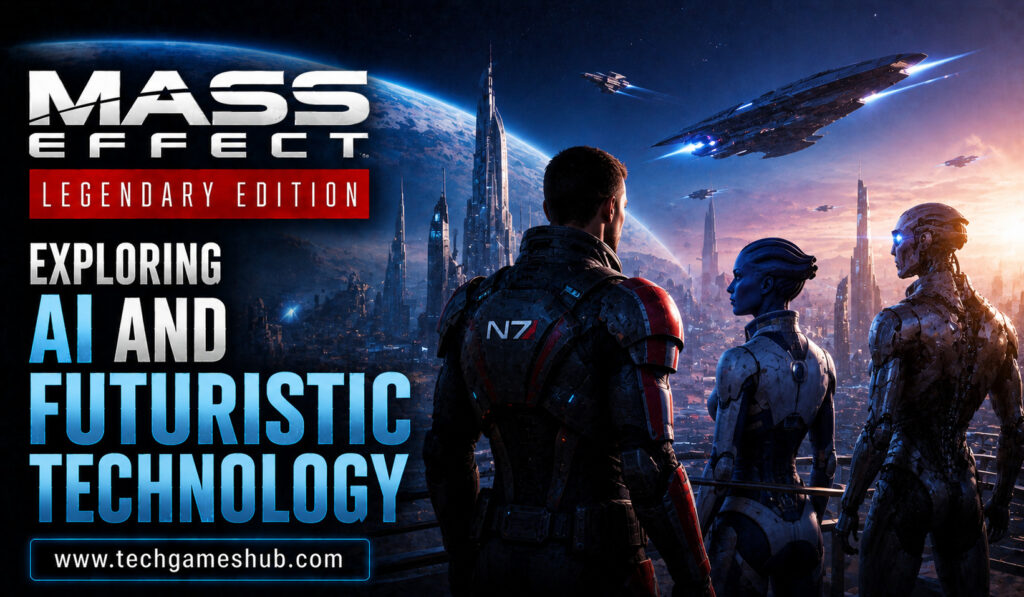
Few science-fiction game series have created a universe as focused on advanced technology, artificial intelligence, and the future of civilization as Mass Effect. The Mass Effect Legendary Edition brings together the original trilogy in a remastered collection, allowing players to experience a galaxy where humans, alien civilizations, synthetic beings, and highly advanced technologies interact on an enormous scale.
Technology in Mass Effect is not simply a background element. It influences warfare, communication, transportation, medicine, artificial intelligence, exploration, and even the relationship between organic and synthetic life. Through its story and gameplay, the trilogy explores an important question: as technology becomes more powerful, how should intelligent civilizations use it?
A Galaxy Built on Advanced Technology
The Mass Effect universe is set in a future where civilizations have developed technologies far beyond modern capabilities. Faster-than-light travel allows species to move between star systems, while advanced communication systems connect distant worlds.
The discovery of ancient technology also plays an important role in the development of galactic civilization.
Mass relays allow ships to travel vast distances almost instantly, transforming the galaxy into a connected network of planets and civilizations. This technology influences politics, trade, military strategy, and exploration.
For Commander Shepard, access to these systems makes it possible to travel across the galaxy and interact with different cultures.
Artificial Intelligence and Synthetic Life
AI is one of the most important technological themes in Mass Effect.
The trilogy repeatedly explores the difference between artificial intelligence, advanced machines, and organic intelligence. The existence of synthetic beings raises questions about whether artificial entities can develop independent goals, emotions, or forms of consciousness.
This theme becomes particularly significant through characters and factions associated with synthetic intelligence.
Rather than presenting AI as simply a useful tool, Mass Effect treats it as a complicated technological development with political and ethical consequences.
The question is no longer just whether machines can become intelligent. It becomes whether intelligent machines should have rights, limitations, or independence.
EDI and the Evolution of AI
EDI is one of the clearest examples of how artificial intelligence influences the Mass Effect universe.
Initially functioning primarily as a shipboard intelligence, EDI gradually becomes a more complex character throughout the trilogy.
Her development raises questions about identity and individuality.
As EDI becomes increasingly capable of independent reasoning and interaction, players are encouraged to consider what separates a highly advanced AI from an organic person.
This is one of the ways Mass Effect uses technology to support character development rather than treating AI as a purely technical feature.
The Geth and the Question of Machine Consciousness
The Geth provide another major exploration of artificial intelligence.
Created by the Quarians, the Geth are networked synthetic beings that eventually develop increasingly sophisticated forms of intelligence.
Their existence leads to conflict with their creators and becomes one of the trilogy’s most complex technological storylines.
The Geth challenge the idea that machines are simply tools.
As their intelligence evolves, the relationship between creator and creation becomes increasingly complicated. The story asks whether synthetic beings should always remain under organic control or whether they can develop their own society and identity.
This conflict gives the game’s AI themes considerable depth.
Technology Shapes Galactic Warfare
Advanced technology also defines combat in Mass Effect.
Weapons, armor, biotics, shields, spacecraft, drones, and specialized equipment all influence how characters approach battles.
Players can develop Shepard according to different combat styles and combine weapons with abilities to create different tactical approaches.
Technology therefore supports player choice.
Instead of forcing every character into the same combat role, the game allows players to experiment with different combinations of equipment and abilities.
This makes futuristic technology an important part of gameplay progression.
Biotics and the Relationship Between Science and Power
Although biotics are not exactly artificial intelligence, they demonstrate another way Mass Effect combines futuristic science with extraordinary abilities.
Biotic powers allow characters to manipulate mass and generate effects that resemble supernatural abilities.
The game provides a technological and scientific context for these capabilities, helping them fit into the broader futuristic setting.
This mixture of scientific concepts and fictional technology makes the Mass Effect universe feel distinctive.
Players encounter abilities that seem impossible by modern standards but are treated as understandable parts of the game’s future civilization.
Cybernetics and Human Enhancement
Mass Effect also explores the idea of enhancing organic beings through technology.
Cybernetic implants, medical technology, advanced armor, and other systems can improve physical capabilities.
These developments raise questions about where the boundary between biological life and technology should exist.
As technology becomes capable of repairing or enhancing the human body, the concept of human identity becomes increasingly flexible.
The trilogy uses futuristic technology to explore these possibilities without reducing them to simple upgrades.
Advanced Space Travel Changes Exploration
Space travel is central to the Mass Effect experience.
The ability to travel between star systems allows players to explore a huge galactic environment and visit different civilizations.
This technology changes the scale of storytelling.
Instead of focusing on a single planet, the trilogy presents a network of worlds with different political systems, cultures, economies, and histories.
The player’s ability to move between these locations reinforces the idea that technological progress has transformed civilization itself.
Technology Connects Different Civilizations
Communication and transportation technologies help connect the many species of the Mass Effect universe.
Humanity’s arrival in the broader galactic community is possible largely because of these systems.
However, technology does not eliminate political conflict.
Different civilizations have different beliefs about AI, military power, genetic engineering, synthetic beings, and other technological developments.
This demonstrates an important idea: technology may connect societies physically without necessarily making them culturally or politically similar.
The Mako and Ground Exploration
The original trilogy also uses technology to support planetary exploration.
The Mako, particularly in the first game, allows Shepard and the crew to travel across difficult planetary environments.
While its handling became famous among players for unusual reasons, the vehicle represents an important aspect of the game’s design: technology gives players access to environments that would otherwise be difficult to explore.
It also reinforces the sense that exploration in the Mass Effect universe depends heavily on futuristic equipment.
The Normandy as a Technological Hub
The Normandy is another major technological element of the trilogy.
The spacecraft functions as a home, transportation system, command center, and strategic platform.
Its systems allow Shepard’s team to travel between worlds, communicate with allies, analyze missions, and prepare for combat.
As the trilogy progresses, the Normandy becomes more than a vehicle. It represents the combination of technology, teamwork, and exploration that defines the Mass Effect experience.
Technology and Ethical Questions
Perhaps the most interesting aspect of Mass Effect is that technology is rarely presented as completely good or bad.
The same technological progress that allows civilizations to travel between stars can also create powerful weapons.
AI can provide enormous benefits while raising questions about autonomy and control.
Genetic and medical technologies can save lives but may also produce unexpected consequences.
This balanced approach makes the futuristic setting feel more believable.
Technology creates opportunities, but every major advancement can introduce new responsibilities.
Ancient Technology and the Reapers
The trilogy’s larger conflict is deeply connected to advanced technology and ancient civilizations.
The Reapers represent an enormous technological force whose origins and purpose gradually become central to the story.
Their existence expands the game’s technological themes from individual machines and AI to questions about civilization itself.
The trilogy asks what happens when civilizations reach extraordinary levels of technological advancement and whether progress can protect them from forces they do not understand.
This gives the technology-focused narrative a much larger scale.
Why Mass Effect’s Technology Still Feels Relevant
Although Mass Effect is science fiction, many of its technological questions remain relevant today.
Artificial intelligence, robotics, automation, cybernetics, advanced communication, and human-machine relationships are all areas of real-world technological development.
The games exaggerate these ideas to create a futuristic universe, but their underlying questions remain recognizable.
Who controls intelligent machines? How should advanced technology be regulated? Can artificial intelligence become independent? What happens when technology advances faster than society’s ability to understand it?
These questions help keep the trilogy relevant years after its original release.
The Future of AI in Science-Fiction Games
Mass Effect demonstrates how AI can be used as both a gameplay element and a storytelling device.
Future science-fiction games could build on these ideas with more advanced artificial characters, dynamic conversations, adaptive companions, and worlds where technological systems respond to player decisions.
AI could become increasingly important in creating believable futuristic civilizations.
Instead of simply giving players advanced weapons and vehicles, developers can use intelligent systems to make entire worlds feel more responsive.
Conclusion
Mass Effect Legendary Edition offers a rich exploration of artificial intelligence and futuristic technology through its interconnected galaxy, advanced spacecraft, synthetic civilizations, cybernetics, weapons, and scientific systems.
What makes the trilogy particularly memorable is that technology is never treated as merely a collection of futuristic gadgets. It influences politics, relationships, exploration, warfare, identity, and the survival of civilizations.
Through the Geth, EDI, the Normandy, mass relays, and numerous other technologies, Mass Effect asks difficult questions about the future of intelligent life.
Ultimately, the trilogy suggests that technological progress is neither automatically beneficial nor inherently dangerous. Its impact depends on how civilizations choose to develop, control, and understand the powerful tools they create.