
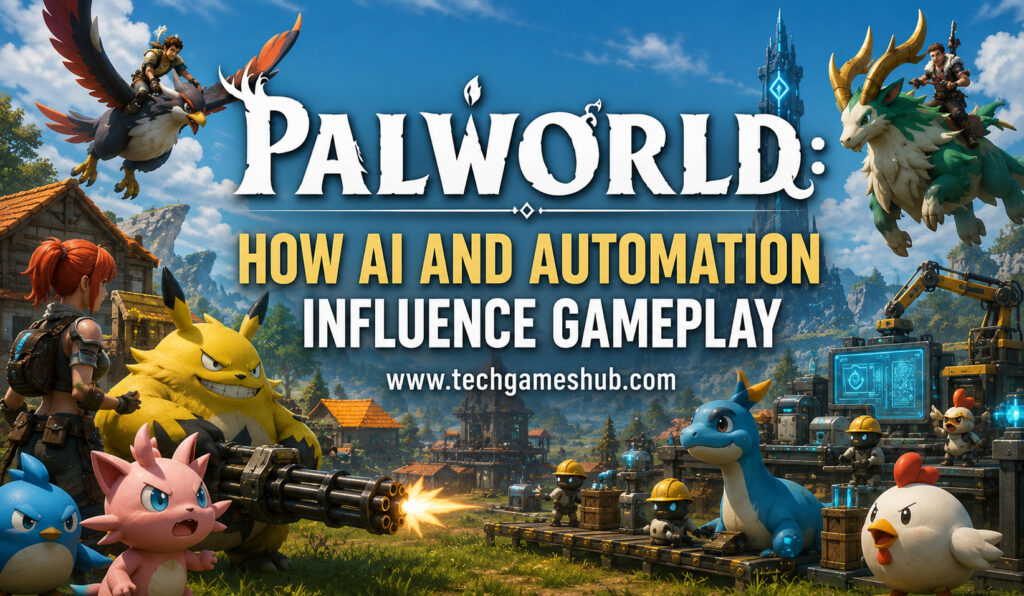
Palworld combines creature collection, survival, crafting, exploration, combat, and base building into an experience where technology plays an important role in how players interact with the game world. One of its most interesting design features is the way artificial intelligence and automation influence everyday gameplay.
Instead of treating captured creatures only as companions or combat partners, Palworld gives them practical roles around a player’s base. Pals can help with activities such as gathering, crafting, farming, transportation, and other tasks. Their behavior systems allow players to build workflows in which different creatures contribute to the development of a functioning base.
This combination of AI-driven creature behavior and automation gives Palworld a distinctive gameplay loop. Players are not simply collecting creatures; they are deciding how those creatures can be used to make survival and progression more efficient.
How AI Shapes Pal Behavior
At the heart of Palworld’s automation system are its Pals. Each Pal can have different abilities and characteristics that determine how useful it can be in particular situations.
Some Pals are better suited to working with crops, while others can help with transportation, gathering, production, or construction-related activities. These capabilities create a basic form of specialization.
AI systems determine how Pals interact with their surroundings and respond to available tasks. Instead of requiring players to control every action directly, the game allows creatures to perform activities within the base environment.
This creates a more dynamic feeling because the player’s settlement can continue functioning while they focus on exploration or combat.
Automation Changes Survival Gameplay
In many survival games, players must repeatedly perform basic tasks themselves. Gathering materials, producing items, farming resources, and maintaining a base can consume a significant amount of time.
Palworld introduces automation to reduce some of that repetitive work.
Once players have established an appropriate base and assigned suitable Pals, certain tasks can happen without constant direct control. This changes the player’s role from someone who performs every task into someone who manages a system.
The difference is important.
Instead of asking, “How do I collect everything I need?” players begin asking, “How can I organize my base so that resources are produced more efficiently?”
That shift adds a management layer to the survival experience.
Pals as Automated Workers
The idea of assigning creatures to different jobs gives Palworld much of its automation identity.
A player might assign one Pal to farming, another to mining, and another to transporting materials. The exact setup depends on the player’s available creatures and the needs of the base.
This creates a simple production chain.
Resources are gathered, moved, processed, and eventually used to create new equipment or structures. Pals can participate in different stages of this process.
As a result, the base becomes more than a storage location. It becomes a functioning production environment.
Base Building Becomes a Management Challenge
Automation also changes how players approach base construction.
Building a large settlement is not only about making it look impressive. Players also need to consider how efficiently their Pals can move between workstations, resource locations, storage areas, and other facilities.
A poorly organized base can make automated workers less effective.
This creates an interesting relationship between architecture and AI behavior. The physical layout of a player’s settlement can influence how smoothly the automation system operates.
Players therefore have an incentive to design bases that are both visually appealing and practical.
AI and Resource Management
Resource management is one of the most important parts of survival gameplay, and automation can significantly change it.
Players need materials for equipment, buildings, crafting, and progression. Instead of personally collecting every resource, they can use their Pals to help maintain a supply.
This allows players to spend more time on other activities.
For example, while automated tasks continue at the base, the player can explore a distant area, search for new Pals, fight enemies, or investigate unfamiliar locations.
Automation therefore creates a division between management and adventure.
Exploration Benefits From Automation
At first, automation might seem like something that reduces the need for exploration. In practice, it can have the opposite effect.
When basic resource production becomes more efficient, players have more freedom to leave their base.
They can spend longer periods exploring without constantly worrying about returning to gather essential materials.
This makes automation a support system for exploration rather than a replacement for it.
The player’s base can continue producing useful resources while the player searches for new areas, stronger creatures, rare materials, and other discoveries.
AI Creates Different Gameplay Strategies
Because different Pals have different abilities, players can approach automation in different ways.
One player might prioritize gathering resources quickly. Another may focus on farming and food production. Someone else might design a highly organized crafting facility.
These choices can influence how the entire base operates.
The system therefore creates opportunities for experimentation. Players can try different combinations of creatures and workstations to find arrangements that suit their preferred play style.
This is one of the strengths of AI-driven gameplay: the system provides rules, while the player decides how to use them.
Automation and Progression
As players progress through Palworld, their needs become more complex.
Early in the game, basic gathering and crafting may be enough to survive. Later, players can become more dependent on organized production and efficient resource management.
Automation becomes increasingly valuable as the player’s ambitions grow.
A small settlement may only require a few workers and simple facilities. A larger base can involve multiple production processes operating at the same time.
This creates a sense of technological progression. Players are not just becoming stronger in combat; they are becoming better at managing their virtual infrastructure.
The Difference Between Manual and Automated Gameplay
Manual gameplay gives players direct control over every action. It can feel satisfying but can also become repetitive when the same tasks need to be performed repeatedly.
Automation changes that balance.
The player still makes important decisions, but the execution of routine tasks can be delegated to AI-controlled creatures.
This creates a higher-level gameplay experience where planning becomes more important.
Players must decide which tasks should be automated, which Pals are suitable for specific roles, and how the base should be organized.
In that sense, Palworld combines survival gameplay with elements of resource management and simulation.
AI Makes the World Feel More Active
AI-driven Pals also contribute to the atmosphere of the game world.
A base where creatures are walking between workstations, carrying resources, producing materials, or performing other tasks feels more active than an empty collection of buildings.
The creatures appear to have roles within the settlement rather than simply existing as inventory items.
This can make the player’s base feel like a living workplace.
Even when the player is not directly interacting with every Pal, their activity creates the impression that the settlement is functioning independently.
Challenges of AI-Driven Automation
Automation systems can also create challenges.
AI-controlled creatures need to navigate environments, recognize available tasks, and respond to changing conditions. If their behavior is inefficient, players may need to adjust the base layout or change assignments.
This can sometimes create unexpected situations.
However, these imperfections can also become part of the gameplay experience. Players learn how the system behaves and adapt their strategies accordingly.
From a design perspective, this demonstrates that AI in games does not always have to behave like human intelligence. Even relatively simple task-based systems can create interesting gameplay when players are required to understand and manage them.
The Future of AI and Automation in Games
Palworld illustrates how AI can be used for more than enemy behavior or character dialogue.
AI can support economic systems, resource production, base management, and creature behavior. Future survival and simulation games could expand these ideas significantly.
More advanced systems could allow NPCs and creatures to learn routines, adapt to player decisions, respond dynamically to environmental changes, or develop more complex relationships with their surroundings.
Automation could also become more sophisticated, allowing players to design entire production networks rather than simply assigning individual tasks.
This could create games that feel increasingly like living simulations.
Conclusion
Palworld demonstrates how AI and automation can change the structure of survival gameplay. Its Pals are not only creatures to collect and use in combat; they can also become important parts of resource gathering, farming, transportation, crafting, and base management.
This creates a gameplay loop built around delegation and optimization. Players collect Pals, understand their abilities, assign them to useful roles, organize their bases, and gradually develop more efficient systems.
The result is a survival experience where technology and creature behavior work together.
By combining AI-driven activities with automation and player-controlled decision-making, Palworld shows how intelligent systems can make a game world feel more active while giving players new ways to approach progression, exploration, and creativity.