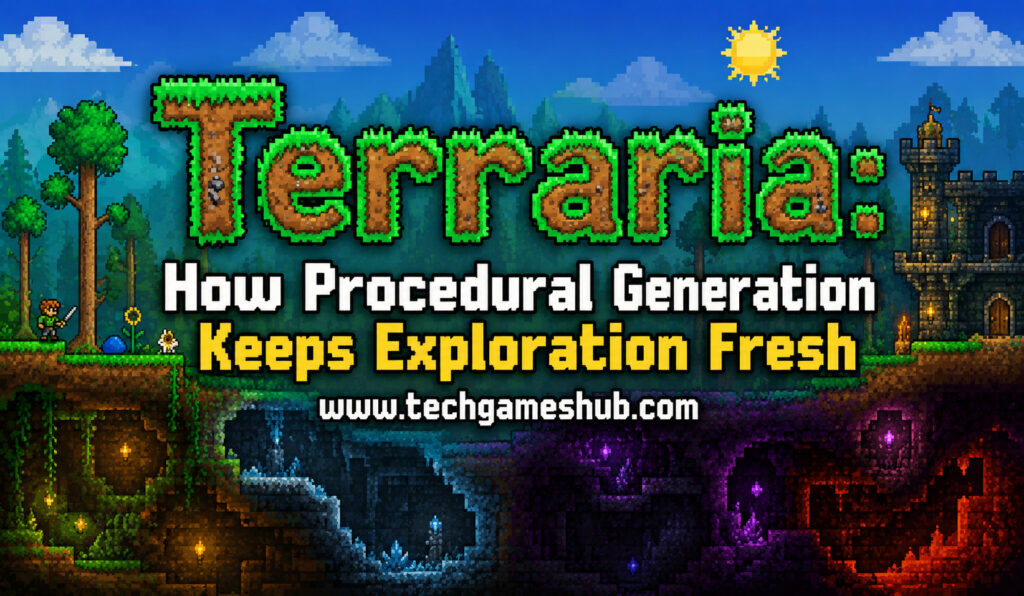
Terraria is one of those games that can make a familiar adventure feel different every time a new world is created. Although its 2D presentation may look simple at first, the game combines exploration, survival, crafting, combat, building, and discovery into a world that constantly encourages players to investigate what lies beyond the next hill or beneath the next layer of underground terrain.
A major reason for this replayability is procedural generation. Instead of giving every player an identical map, Terraria creates worlds using algorithms that determine terrain, caves, resources, biomes, structures, and other environmental features. This approach makes each new world feel like a fresh opportunity rather than another version of the same adventure.
What Is Procedural Generation in Terraria?
Procedural generation is a game development technique in which algorithms are used to create content according to predefined rules. Developers establish the systems, possibilities, and limitations, while the game uses those systems to construct a world.
Terraria applies this concept to many parts of its environment. When a new world is generated, its landscape can contain different combinations of mountains, forests, underground areas, bodies of water, caves, deserts, snow regions, and other biomes.
The result is a world that follows recognizable rules but does not necessarily look exactly like the previous one.
This balance between structure and variation is what makes procedural generation especially useful for an exploration-focused game.
Every New World Can Feel Different
One of Terraria’s strongest features is that players cannot completely predict what they will find when creating a new world.
The general ingredients of the game remain familiar, but their arrangement can change. A particular biome may be closer or farther away, underground tunnels can take different shapes, and valuable resources may require players to explore different areas.
This means starting a new world does not simply repeat the same sequence of events.
Players still understand the fundamentals of Terraria, but the changing environment forces them to adapt. That small element of uncertainty can make even experienced players curious about what their next world will contain.
Underground Exploration Becomes Unpredictable
The underground world is one of the clearest examples of procedural generation supporting exploration.
Terraria’s underground environments contain interconnected caves, tunnels, chambers, resources, enemies, and other discoveries. Their layouts can vary significantly between worlds.
Instead of following a fixed underground map, players must explore and make decisions based on what they encounter.
One tunnel may lead to a large open cavern, while another may end unexpectedly or connect to another passage. Players often have to dig, navigate, place torches, manage equipment, and decide whether continuing deeper is worth the risk.
This uncertainty turns exploration into an active part of gameplay.
Biomes Add Variety to Exploration
Procedural generation becomes even more effective when combined with Terraria’s biome system.
Different biomes introduce distinct environments, enemies, resources, backgrounds, and gameplay conditions. Forests, deserts, snow-covered regions, jungles, oceans, underground areas, and more dangerous environments can all provide different experiences.
Because these areas are positioned differently in generated worlds, players cannot always approach exploration in exactly the same way.
A player beginning a new world may need to travel farther to reach a particular environment or discover an unexpected route while exploring.
The changing relationship between biomes helps prevent the world from feeling like a repetitive collection of identical areas.
Resources Encourage Players to Explore
Procedural generation would have limited value if there were no reason to explore the world.
Terraria solves this by connecting exploration with progression.
Players search for ores, materials, treasure, equipment, crafting ingredients, and other useful items. The desire to improve equipment naturally encourages players to investigate places they might otherwise ignore.
Because the layout of the world changes, the path toward those resources can also change.
This creates an important gameplay relationship: procedural generation changes the environment, while the progression system gives players reasons to interact with it.
Structures and Discoveries Create Surprises
Generated worlds are not only about terrain. Terraria also includes structures and locations that give exploration additional purpose.
Players can encounter unusual underground areas, valuable treasure, dangerous locations, and other points of interest while moving through the world.
These discoveries create memorable moments because players may not know exactly when or where they will encounter them.
A carefully placed handcrafted level can provide a predictable experience, while procedural generation can introduce an element of surprise. Terraria uses both approaches by combining designed gameplay systems with worlds that are assembled differently for each seed.
World Seeds Give Players More Control
Terraria’s world seed system adds another interesting layer to procedural generation.
A seed determines how a particular world is generated. This means players can recreate certain worlds or share specific world configurations with others.
Seeds turn procedural generation into something that can be discussed and experimented with.
Players can search for unusual world layouts, challenge themselves with specific conditions, or share interesting discoveries with friends. This gives generated worlds an identity beyond a simple random map.
It also demonstrates that procedural content can create communities around discovery.
Randomness Does Not Mean Chaos
A common misconception about procedural generation is that it simply produces random content.
In reality, successful procedural generation requires carefully designed rules.
Terraria’s worlds need to remain playable. Important areas must be generated in ways that support progression, resources need to exist in useful quantities, and terrain must provide opportunities for exploration and construction.
The developers therefore create systems that control how the world is assembled.
The algorithm introduces variation, but the underlying design ensures that the resulting world still feels like Terraria.
This combination of randomness and structure is essential to the game’s long-term appeal.
Why Procedural Generation Improves Replayability
Traditional games often have a fixed world. Once players learn its layout, subsequent playthroughs can become easier and more predictable.
Terraria reduces this problem by changing the world itself.
A returning player knows how Terraria works but does not necessarily know where everything will be. That distinction is important.
Experienced players can use their knowledge of crafting, combat, and progression while still facing a world that requires fresh exploration.
This makes procedural generation particularly effective for sandbox games. The mechanics remain familiar, but the environment creates new circumstances.
Procedural Generation and Player Creativity
Terraria also demonstrates how procedural worlds can encourage creativity.
Players do not simply explore the generated environment. They modify it.
They build houses, create underground bases, construct farms, develop transportation systems, reshape terrain, and design elaborate structures. The generated world becomes the foundation for player-created content.
Because each world can have a different shape, players may need to adapt their building plans.
A mountain, underground cavern, ocean, or biome can inspire completely different construction ideas. In this way, procedural generation does not limit creativity; it can provide new constraints that encourage players to think differently.
The Technology Behind Endless Exploration
The most important achievement of procedural generation in Terraria is not the ability to create large maps. It is the ability to make those maps meaningful.
Terrain variation, biome placement, resource distribution, underground generation, structures, enemies, and progression all work together to create an environment that encourages curiosity.
The technology operates behind the scenes, but its impact is visible every time a player enters a new world.
Instead of developers manually designing every possible map, they create systems capable of producing many different combinations. This allows Terraria to offer enormous replayability without requiring an entirely new handcrafted world for every playthrough.
The Future of Procedural Worlds
Procedural generation continues to evolve across the gaming industry. Modern developers can combine procedural systems with advanced simulation, artificial intelligence, dynamic weather, environmental systems, and more complex world-building tools.
Future sandbox games could potentially create worlds that change not only when they are generated but also while players are living inside them.
Terraria’s approach provides an early and effective example of why this technology works so well. A generated world does not have to be completely unpredictable. It simply needs to offer enough variation to make exploration feel worthwhile.
As procedural technology becomes more advanced, developers may be able to create worlds with greater environmental diversity and deeper interactions while maintaining the advantages of algorithmic generation.
Conclusion
Terraria shows how procedural generation can transform a relatively simple 2D sandbox into an experience with remarkable replayability. Every new world can offer different terrain, underground layouts, biome locations, resources, structures, and exploration routes.
The technology works because it is combined with strong gameplay systems. Players have reasons to explore, materials to find, enemies to fight, equipment to improve, and spaces to build.
That combination keeps discovery at the heart of Terraria. Even after hundreds of hours, creating a new world can still produce the question that drives exploration in the first place: What is waiting beyond the next area?
By using procedural generation to create variation while maintaining carefully designed gameplay rules, Terraria proves that endless exploration does not require endless handcrafted maps. Sometimes, the most exciting worlds are the ones that the game builds differently every time.