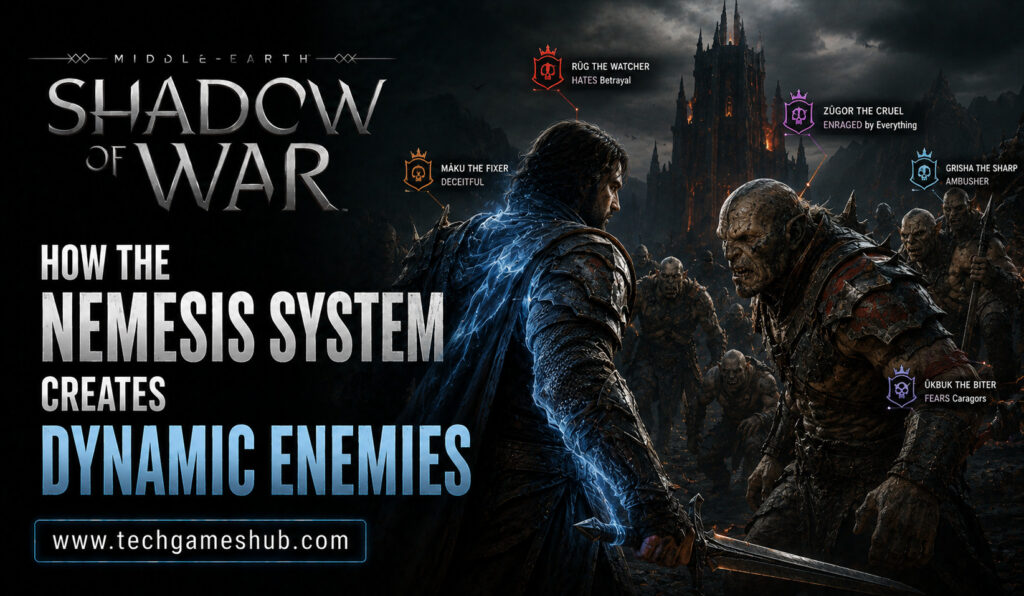
Middle-earth: Shadow of War is one of the most interesting examples of how artificial intelligence can make video game enemies feel personal. While many action games use enemies that disappear after being defeated, Shadow of War gives its opponents something much more memorable: relationships, rivalries, personalities, and the ability to remember what happened to them.
At the center of this experience is the Nemesis System, a gameplay technology that turns ordinary enemies into individual characters. Orc captains can defeat the player, escape from battles, return with new abilities, develop weaknesses, gain strengths, and even become obsessed with getting revenge.
This system changes the way players think about enemies. Instead of treating every opponent as another target, players begin to recognize names, personalities, strengths, weaknesses, and previous encounters. The result is a world where battles can create stories that feel different from one player to another.
What Is the Nemesis System?
The Nemesis System is the foundation of Shadow of War’s dynamic enemy structure. It generates and manages relationships between the player and important Orc characters throughout the game.
Orc captains are not simply stronger versions of standard enemies. They have individual identities, personalities, combat abilities, weaknesses, and relationships with other characters.
When players encounter an Orc captain, they may discover that the character has a particular fighting style or personality. One captain might specialize in ranged attacks, while another could use poison, fire, or powerful melee abilities.
These differences encourage players to approach each enemy differently.
More importantly, the system can remember interactions between the player and Orcs. A battle therefore has the potential to influence future encounters.
Enemies Can Remember the Player
One of the most impressive aspects of the Nemesis System is its ability to turn previous battles into future gameplay opportunities.
Suppose Talion encounters an Orc captain and nearly defeats him, but the enemy manages to escape. That Orc may return later with a new title, different dialogue, additional strengths, or a personal grudge against the player.
This creates a sense of continuity.
In many games, defeating an enemy means that character is simply removed from the world. In Shadow of War, failure can actually make the enemy more interesting.
An Orc that kills Talion may become stronger and gain confidence. When that character appears again, the encounter can feel like a rematch rather than a completely new battle.
Player Failure Becomes Part of the Story
Most games encourage players to avoid failure, but Shadow of War uses failure as a gameplay mechanic.
When an Orc defeats Talion, that event can influence the hierarchy of enemies. The victorious Orc may rise in power and become a more important threat.
This creates an unusual relationship between success and failure.
Losing a battle does not necessarily mean that the player has simply wasted time. Instead, failure can produce a new enemy with a history.
A seemingly ordinary encounter can therefore develop into a long-running rivalry.
That unpredictability is one of the reasons the Nemesis System feels different from traditional enemy AI.
Procedural Personalities Make Orcs Memorable
The Nemesis System uses procedural generation to give Orcs different characteristics. Their appearances, voices, personalities, combat styles, strengths, and weaknesses can vary.
This means that players can encounter Orcs who behave very differently from one another.
Some may be arrogant and constantly mock Talion. Others may be frightened, aggressive, ambitious, or obsessed with proving themselves.
Their personalities are not simply cosmetic details. They influence how encounters feel.
A player might remember an Orc because of his strange voice, unusual appearance, ridiculous personality, or repeated appearances throughout the campaign.
This is an important lesson in game design: an enemy does not need to be a major story character to become memorable.
AI Creates Emergent Stories
The biggest strength of the Nemesis System is its ability to create emergent storytelling.
Instead of every player experiencing exactly the same enemy relationships, the system allows different events to develop naturally.
For one player, an Orc might become a dangerous rival after repeatedly surviving battles. For another player, a different Orc could become an unexpected ally after being recruited.
These stories are not necessarily written line by line by a traditional script. They emerge from the interaction between the player’s actions and the game’s systems.
This gives Shadow of War a level of replayability that conventional scripted encounters often struggle to provide.
Orc Hierarchies Make the World Feel Alive
The Nemesis System is also connected to the game’s larger Orc hierarchy.
Orcs can occupy different positions of power, and their relationships with one another can change. Captains can compete for influence, rise through the ranks, betray others, and become stronger.
This creates the impression of an organized society rather than a collection of enemies waiting for the player.
The hierarchy also gives the player reasons to pay attention to individual characters.
Defeating one Orc may affect another. Recruiting a captain can change the balance of power. Allowing an enemy to survive can create a future problem.
The world therefore reacts to player decisions in ways that are difficult to predict completely.
Strengths and Weaknesses Change Combat Strategy
Another important feature is that Orc captains can have specific strengths and weaknesses.
One enemy may be resistant to certain attacks but vulnerable to another strategy. Another might be difficult to approach directly but easier to defeat using a specific ability.
This encourages players to gather information before attacking.
Instead of simply asking, “How powerful is this enemy?” players begin asking, “What does this enemy do, and how can I exploit his weaknesses?”
That transforms combat from a simple test of reflexes into a combination of observation, preparation, and tactical decision-making.
The System Makes Revenge Feel Personal
Few things make an enemy memorable like revenge.
In Shadow of War, Orcs can develop rivalries with Talion based on previous encounters. When a familiar enemy returns and recognizes the player, the confrontation immediately gains emotional weight.
The dialogue can remind players of previous events, making the Orc feel like a character who has experienced the same world rather than a disposable opponent.
This is where AI and storytelling become closely connected.
The system does not need to write a long cinematic scene explaining the relationship. A short interaction between the player and a returning enemy can communicate the history.
Dynamic Enemies Increase Replayability
The Nemesis System gives Shadow of War a major advantage in replayability.
Players can complete the same general objectives while experiencing very different enemy relationships. The specific Orcs they encounter, the rivalries they develop, and the outcomes of individual battles can vary.
This makes repeated playthroughs less predictable.
Even after understanding the basic mechanics, players cannot know exactly which Orc will become their next major rival.
The uncertainty encourages experimentation and makes the world feel less like a fixed sequence of missions.
Why the Nemesis System Was Important for AI in Games
The significance of the Nemesis System extends beyond Shadow of War. It demonstrates that artificial intelligence can be used to create relationships and memories rather than simply control combat behavior.
Traditional game AI often focuses on questions such as where an enemy should move, when it should attack, or how it should react to the player’s position.
The Nemesis System adds another layer: what happened before?
That historical context allows enemies to develop continuity.
An Orc is not defined only by what it is doing right now. Its previous encounters with the player can influence how the next encounter feels.
This is an important direction for interactive game design because it shows how systems can create stories without requiring every event to be manually scripted.
The Balance Between Randomness and Design
The Nemesis System also demonstrates that procedural systems work best when randomness is combined with carefully designed rules.
Completely random enemies would not necessarily be interesting. The system needs recognizable structures, abilities, personalities, relationships, and progression mechanics.
Within those boundaries, however, the game can generate unexpected situations.
That balance gives players enough familiarity to understand the world while maintaining enough unpredictability to keep encounters exciting.
Conclusion
Middle-earth: Shadow of War shows how artificial intelligence can transform ordinary enemies into memorable characters. Through the Nemesis System, Orcs can develop rivalries, remember encounters, gain power, change their roles, and create stories that emerge naturally from gameplay.
The most important achievement is that the system makes players care about enemies they were originally supposed to defeat.
A random Orc captain can become a hated rival. A difficult opponent can return stronger after surviving a battle. A player failure can create a completely new challenge.
That is what makes the Nemesis System so effective. It does not simply make enemies smarter—it gives them history.
By combining procedural generation, AI behavior, character relationships, and player-driven events, Shadow of War demonstrates how dynamic enemy systems can make virtual worlds feel more personal, unpredictable, and alive.