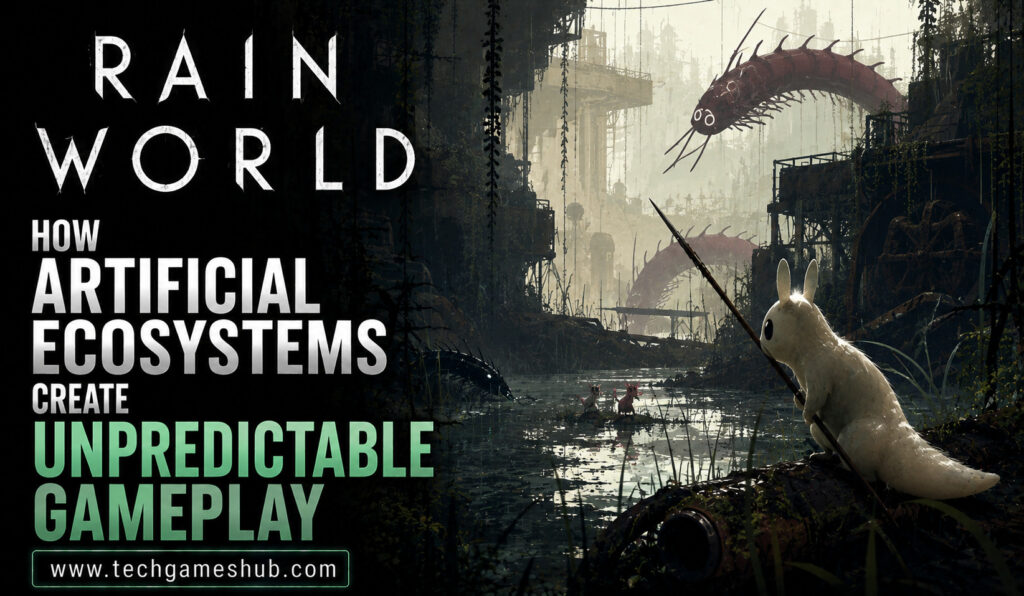
Rain World is one of the most unusual survival games ever created. At first glance, its pixel-art visuals and simple-looking protagonist may suggest a traditional platforming adventure. But underneath that visual simplicity is a complex simulated ecosystem where creatures hunt, compete, flee, explore, and interact with one another.
Instead of designing every enemy encounter around the player’s location, Rain World creates a world that continues to function independently. Predators can hunt other creatures, animals can fight over territory, and different species can react to environmental conditions. The player is not necessarily the center of this ecosystem.
This approach makes Rain World feel unpredictable in a way that few games achieve. Artificial intelligence does not simply exist to make enemies harder. It helps create a living environment where survival depends on understanding the behavior of creatures and adapting to situations that cannot always be predicted.
A World That Does Not Revolve Around the Player
Many games are designed around the idea that the player is the most important character in the environment. Enemies spawn nearby, encounters are triggered by entering certain areas, and creatures often wait for the player before becoming active.
Rain World takes a different approach.
Its ecosystem is designed to continue operating even when the player is not directly interacting with it. Creatures have their own behaviors and priorities. They move through environments, search for food, avoid threats, and interact with other animals.
This creates the impression that the world existed before the player arrived and will continue after the player leaves.
That design philosophy is one of the main reasons Rain World feels so alive.
Predators Are More Than Standard Enemies
In a conventional platforming game, an enemy usually exists to challenge the player. Its behavior is designed around attacking, blocking, or chasing the protagonist.
In Rain World, predators can feel more like actual animals.
A creature may be hunting because it needs food rather than because the game has decided it is time for an encounter. It might pursue another creature, investigate movement, retreat from danger, or change its behavior depending on the situation.
This distinction dramatically changes how players perceive enemies.
A predator that is chasing the player may suddenly become interested in another animal. A creature that appears dangerous might be distracted by something else. Another predator may enter the area and create an entirely new situation.
The player has to observe rather than assume.
Artificial Intelligence Creates Emergent Gameplay
The most important concept behind Rain World’s ecosystem is emergent gameplay.
Emergent gameplay occurs when relatively simple systems interact to produce situations that developers did not need to script individually.
For example, imagine entering an area where a predator is searching for food. Another creature crosses its path, and the predator begins chasing it instead of the player. While those two creatures are distracted, another animal enters the area.
The player now has an unexpected opportunity to move through the environment.
Nothing necessarily had to be scripted specifically for that moment. The situation can emerge naturally from the interaction between AI behaviors.
This is what makes Rain World different from games where every enemy encounter has a predetermined outcome.
The Food Chain Influences Survival
The game’s ecosystem is strongly connected to survival.
Different creatures have different relationships with one another, and the player exists within that broader network.
The slugcat is vulnerable to many predators, which means survival often depends on understanding the ecosystem rather than simply defeating enemies.
Players can observe which creatures are dangerous, which ones can become distractions, and which situations are better avoided entirely.
This creates a survival experience based on environmental awareness.
Instead of asking only, “How do I defeat this enemy?” players often need to ask, “Why is this creature here, and what is it doing?”
That small change in thinking has a major impact on gameplay.
Predators Can Become Unpredictable Threats
One reason Rain World can be so stressful is that players cannot always predict what a creature will do.
A predator might appear to be moving away and then suddenly change direction. Another creature may enter the area and alter the predator’s priorities.
This means that learning the environment does not completely eliminate danger.
Players can develop an understanding of creature behavior, but they cannot always calculate exactly what will happen next.
That uncertainty is intentional.
The game rewards players who pay attention while still leaving room for unexpected events.
The Environment Becomes Part of the AI System
The ecosystem would not be nearly as effective without the game’s interconnected environments.
Different areas provide different spaces for creatures to move through. Narrow passages, open rooms, vertical structures, tunnels, and shelters can all influence how animals interact.
For the player, this means the environment is not simply a path from one objective to another.
A small passage might provide protection from a predator. An open area might expose the player to several threats. A vertical route could provide an escape opportunity.
Understanding the physical environment therefore becomes just as important as understanding creature behavior.
Weather and the Survival Cycle Add Pressure
One of Rain World’s most distinctive mechanics is its dangerous weather cycle.
The enormous rains that periodically sweep through the world create a powerful survival deadline. Players need to find shelter before the cycle ends, adding pressure to exploration.
This system interacts naturally with the ecosystem.
Creatures are also affected by the environment, which means the world is not simply waiting for the player to finish a mission. The changing conditions influence how the entire environment feels.
The result is a survival loop in which exploration, food, predators, shelter, and environmental timing are connected.
Learning Comes From Observation
Rain World does not always explain its systems directly.
Instead, players often learn by watching what happens.
A predator’s movement can reveal its priorities. A creature’s reaction can provide clues about danger. An apparently safe route may become dangerous when another animal enters the area.
This creates a relationship between the player and the ecosystem.
The player gradually develops an understanding of how the world works, not because every rule is explained through tutorials, but because experience teaches them.
That makes successful survival feel earned.
Failure Can Teach Players About the Ecosystem
Death is a common part of Rain World, but failure can provide valuable information.
A player might discover that a particular route is frequently occupied by predators. Another attempt may reveal that waiting for a creature to move away is safer than trying to rush past it.
Over time, players build their own mental model of the ecosystem.
This is particularly effective because the game does not guarantee that the same situation will happen in exactly the same way every time.
The player learns principles rather than memorizing scripts.
Why the Ecosystem Feels More Realistic
The realism in Rain World does not come from photorealistic graphics. It comes from behavior.
Creatures appear to have their own goals and reactions. They do not exist solely for the player’s convenience.
This creates an important psychological effect.
When a predator ignores the player because it is chasing another animal, the world suddenly feels independent. When two creatures fight in the distance, the player understands that the conflict is part of the ecosystem rather than a scripted event designed specifically for them.
These moments make the environment feel alive.
A Different Approach to Artificial Intelligence
Rain World demonstrates that effective AI does not always mean creating enemies that are incredibly intelligent in isolation.
Instead, interesting gameplay can emerge when multiple creatures operate according to different behavioral rules and interact with one another.
The complexity comes from the ecosystem as a whole.
This is an important concept for modern game design. Developers can create memorable experiences by allowing systems to interact rather than scripting every possible scenario.
The player then becomes another participant in the simulation instead of the unquestioned center of the world.
Conclusion
Rain World uses artificial intelligence in a fundamentally different way from many survival and platforming games. Its creatures are not simply obstacles waiting for the player. They exist within an ecosystem that continues to operate independently.
Predators hunt, creatures react to threats, environmental conditions create pressure, and unexpected interactions can completely change a player’s situation.
The result is gameplay that feels unpredictable without being completely random.
Every journey through the world becomes an experiment in observation and adaptation. Players learn how creatures behave, but they can never be completely certain what will happen next.
That is the real strength of Rain World. Its artificial ecosystem transforms AI from a simple enemy-control system into the foundation of a living world—one where survival depends not on memorizing a fixed path, but on understanding an environment that is constantly changing around you.