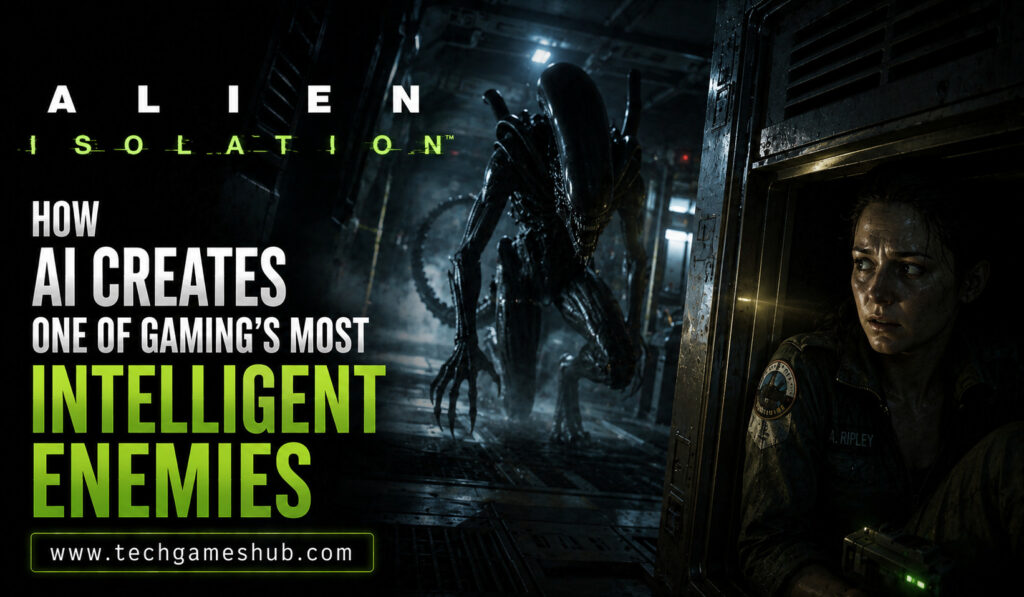
Few horror games understand the power of artificial intelligence as well as Alien: Isolation. Instead of relying only on scripted jump scares or predictable enemies, the game uses AI to make its central threat feel observant, unpredictable, and genuinely dangerous. The result is an experience where players are never completely sure what the Alien knows, where it is going, or whether it has noticed them.
Released by Creative Assembly, Alien: Isolation places players in the terrifying world of the Alien universe. You play as Amanda Ripley, who becomes trapped aboard the Sevastopol space station while searching for answers about her missing mother, Ellen Ripley. The station is already falling apart, but the presence of a deadly Xenomorph transforms the environment into a constant survival challenge.
What makes the game especially memorable is not simply the appearance of the Alien. It is the way artificial intelligence controls its behavior.
AI Makes the Alien Feel Unpredictable
Traditional horror games often use enemies that follow fixed patrol routes or appear at predetermined moments. Once players learn the pattern, the fear can disappear. Alien: Isolation takes a different approach.
The Alien is designed to behave less like a traditional video game enemy and more like a creature hunting through an unfamiliar environment. It can move around the station, investigate suspicious activity, search areas, and respond to the player’s actions.
This unpredictability creates a major psychological advantage for the game. Players cannot simply memorize every encounter. Even when they understand the general mechanics, they still have to make decisions based on what is happening in the moment.
That uncertainty is one of the biggest reasons the Alien remains frightening throughout the game.
The Alien Does Not Simply Know Everything
One of the smartest aspects of the game’s AI design is the distinction between what the Alien actually knows and what the player assumes it knows.
The creature does not simply receive the player’s exact location at all times. Instead, the game uses different systems to influence its behavior. Suspicious sounds, player actions, environmental events, and other information can encourage the Alien to investigate particular areas.
This creates believable hunting behavior.
For example, if Amanda makes too much noise, the Alien may become interested in the area. If it discovers evidence that someone has been nearby, it can begin searching. The player may successfully hide, but that does not necessarily mean the danger has disappeared.
The uncertainty becomes part of the gameplay.
A Dynamic Cat-and-Mouse Experience
The relationship between Amanda and the Alien is essentially an extended game of cat and mouse.
Amanda is not powerful enough to fight the creature directly for most of the game. Instead, survival depends on observation, stealth, timing, and resource management.
The Alien, meanwhile, has the physical advantage. It is faster, stronger, and capable of killing Amanda quickly. This imbalance forces the player to think carefully before making even simple movements.
AI therefore becomes more than a technical feature. It directly influences the game’s core design.
Every time players hear footsteps nearby, they have to consider whether moving forward is worth the risk. Every hiding place becomes a temporary solution rather than a guarantee of safety.
AI and the Use of Sound
Sound plays a crucial role in Alien: Isolation, and AI helps make those sounds meaningful.
The Alien’s footsteps are among the most recognizable audio cues in the game. Hearing them approach creates tension before the creature is even visible.
Players also need to think about the noise they create. Running, interacting with objects, or making unnecessary movements can increase the possibility of attracting attention.
This creates an interesting relationship between sound design and artificial intelligence. Audio tells the player that something may be happening, while AI determines how the Alien responds to the evolving situation.
The result is a feedback loop that constantly keeps players alert.
The Alien’s Search Behavior Builds Tension
One of the most frightening situations occurs when the Alien begins searching for Amanda.
Instead of simply walking away after failing to find the player, the creature can investigate its surroundings. It may enter rooms, move through corridors, and check locations where the player might be hiding.
This behavior makes hiding feel temporary.
A player might enter a locker or hide beneath a table and initially believe they are safe. But if the Alien remains nearby, the tension continues. The player has to decide whether to stay hidden or risk moving somewhere else.
That decision-making process is exactly what effective horror AI should create.
The Game Encourages Players to Study the Enemy
Although the Alien is unpredictable, players gradually learn how it behaves.
They begin to recognize warning signs. They learn how quickly it moves, how it reacts to sound, and when it is safer to remain hidden. This creates a fascinating balance between learning and uncertainty.
The player becomes more knowledgeable without ever becoming completely comfortable.
That is an important achievement for an AI-driven horror game. If an enemy is completely unpredictable, its behavior can feel random. If it is completely predictable, it becomes boring. Alien: Isolation attempts to remain between those extremes.
Players learn the rules, but the situation can still change unexpectedly.
AI Supports Environmental Storytelling
The artificial intelligence also works together with the game’s environment.
Sevastopol is not simply a background for combat. It is a large, damaged space station filled with maintenance areas, offices, medical facilities, vents, elevators, corridors, and other interconnected spaces.
The Alien’s ability to move through this environment makes the station feel like a hunting ground.
Players are constantly thinking about the environment in relation to the AI. A corridor may provide a quick route forward but leave Amanda exposed. A maintenance tunnel may offer an escape route. A room may contain useful supplies but also become a dangerous place to hide.
This turns level design into part of the survival strategy.
Why the Alien Feels More Intelligent Than Many Game Enemies
The Alien’s intelligence is not necessarily about solving complicated mathematical problems or displaying human-level reasoning. Its effectiveness comes from how its behavior is designed around the player’s expectations.
The game constantly gives players incomplete information.
They know the Alien is nearby, but not exactly where. They may hear movement but cannot always determine its direction. They may successfully avoid detection once, but that does not guarantee the same strategy will work later.
This makes the creature appear smarter than many enemies that technically follow more complex systems.
In horror, perceived intelligence can be more important than raw computational complexity.
The AI Creates Fear Without Constant Jump Scares
Another major strength of Alien: Isolation is that it does not need to constantly attack the player to create fear.
Sometimes the Alien is frightening simply because it might appear.
A distant sound can create tension. A flickering light can make a player hesitate. An empty corridor can become terrifying because the player knows that the Alien could enter it at any moment.
This approach allows the AI to create psychological horror rather than relying exclusively on scripted scares.
The player’s imagination fills in the gaps.
A Lasting Influence on Horror Game Design
Alien: Isolation demonstrates how artificial intelligence can transform enemy design. Instead of treating AI as a background system that controls movement and attacks, the game makes it central to the emotional experience.
The Alien’s behavior supports stealth, exploration, sound design, level design, resource management, and storytelling. All of these systems work together to make survival feel uncertain.
Its success also shows why intelligent enemy design matters in modern games. Players increasingly expect virtual characters and creatures to react to their actions rather than simply repeat predefined behaviors.
Conclusion
Alien: Isolation remains one of the strongest examples of how AI can shape horror gameplay. The Alien is terrifying not simply because it is powerful, but because the game’s systems make it feel like an active hunter.
Its ability to investigate, respond to clues, search areas, and create unpredictable encounters keeps players under constant pressure. More importantly, the AI works alongside sound, level design, stealth, and environmental storytelling to create a complete survival experience.
For players, the result is simple: every hallway feels dangerous, every noise matters, and hiding never feels completely safe.
That is the real achievement of Alien: Isolation. It turns artificial intelligence into a source of fear, proving that one of the most effective ways to frighten players is not to control exactly what happens, but to create an enemy that makes them wonder what could happen next.