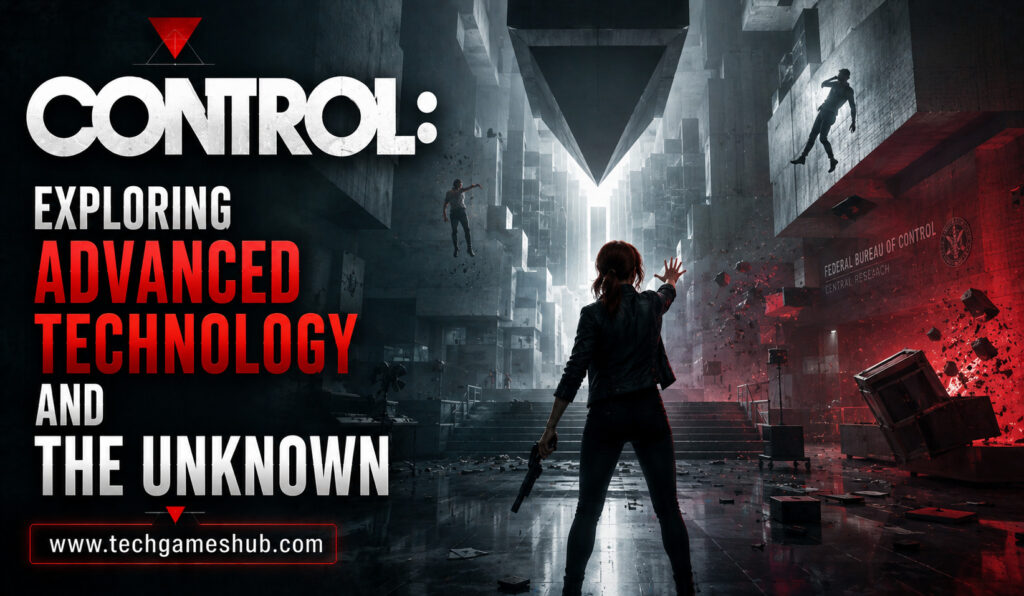
Few modern action games combine technology, mystery, science fiction, and supernatural ideas as effectively as Control. Developed by Remedy Entertainment, the game places players inside the Federal Bureau of Control, a secretive organization investigating unexplained phenomena and objects that appear to violate the normal laws of reality.
At the center of the experience is Jesse Faden, who enters the mysterious Oldest House and becomes involved in a conflict surrounding strange forces and altered objects. While Control is often described as a supernatural action-adventure game, its world constantly explores the relationship between advanced technology, scientific investigation, and things humanity cannot fully understand.
This combination gives the game a distinctive identity and makes its technological concepts an important part of both gameplay and storytelling.
A World Where Technology Meets the Unknown
Control presents a universe where unexplained events are investigated using organized scientific methods. The Federal Bureau of Control approaches paranormal incidents almost like research problems.
Strange objects are contained, studied, documented, and monitored. This creates an interesting contrast between rational technology and phenomena that seem impossible to explain.
The Bureau uses specialized equipment, laboratories, security systems, communication tools, and containment facilities to manage these unusual threats.
However, technology does not always provide complete answers.
Instead, the game repeatedly suggests that scientific knowledge has boundaries. Some phenomena can be measured and observed, but their deeper origins and consequences remain mysterious.
This tension between what humans can understand and what remains unknown is one of Control’s central themes.
The Oldest House as a Technological Environment
The Oldest House is more than a traditional building. It functions as a constantly shifting environment filled with offices, laboratories, research areas, security zones, and unexplained spaces.
Technology is integrated throughout the building.
Computers, telephones, surveillance systems, laboratories, documents, and communication equipment create the appearance of a highly advanced government facility. Yet the building itself refuses to behave according to ordinary architectural rules.
Rooms can change, corridors can appear to shift, and familiar spaces can become unsettling.
This contrast makes the Oldest House particularly effective. The environment looks like a technological workplace while simultaneously functioning as something far beyond conventional human understanding.
The Service Weapon and Advanced Technology
Jesse’s Service Weapon is one of the game’s most important pieces of technology-like equipment. Although it has supernatural characteristics, it functions as a versatile tool that can change forms to provide different combat capabilities.
The weapon allows Jesse to approach combat situations in different ways.
Instead of relying on one fixed firearm, players can adapt their weapon configuration to match different challenges. This adds a technological progression system to the game’s combat.
The Service Weapon also represents one of Control’s recurring ideas: technology can become difficult to distinguish from the supernatural when it interacts with forces that humanity does not understand.
Jesse’s Supernatural Abilities
Control expands its technological ideas through Jesse’s abilities.
She can manipulate objects, launch environmental objects at enemies, create protective barriers, and move through areas using unusual powers.
These abilities change how players interact with the environment.
Objects that normally function as ordinary office equipment can suddenly become weapons. Furniture, debris, and other environmental elements become part of combat.
This creates an interesting relationship between technology, architecture, and supernatural power. The ordinary environment becomes extraordinary depending on how the player interacts with it.
Research and Scientific Investigation
One of the strongest aspects of Control’s world-building is its focus on research.
The Federal Bureau of Control investigates strange objects and paranormal events using reports, experiments, observations, and containment procedures.
Players encounter documents and research materials throughout the Oldest House. These pieces of information gradually reveal how the Bureau thinks about unexplained phenomena.
The result is a world that feels larger than the main storyline.
Technology is not presented merely as futuristic equipment. It is part of an institutional process for understanding things that appear impossible.
The Bureau attempts to categorize the unknown, even when its own scientists do not completely understand what they are studying.
Altered Items and Technological Curiosity
Altered Items are among the most fascinating concepts in Control. These ordinary objects become associated with unusual and dangerous phenomena.
Items that would normally have little significance can suddenly possess extraordinary properties.
This concept challenges the traditional idea that technology must be advanced to be powerful.
A simple everyday object can become more dangerous than sophisticated machinery if it is connected to an unexplained force.
This creates an important message about the unknown: humanity cannot always predict where danger or power will come from.
The Hiss and Information Systems
The Hiss represents another layer of Control’s exploration of technology and information.
The phenomenon spreads through the Bureau and disrupts people, communication, and organizational stability. Its influence makes the highly structured technological environment increasingly difficult to control.
This creates an interesting contrast.
The Bureau depends on information, communication, research, and documentation to maintain control over unexplained events. Yet the Hiss demonstrates how quickly those systems can become compromised.
The game therefore raises questions about how much control technology and information can actually provide.
Technology as a Tool, Not an Answer
Control does not present advanced technology as an ultimate solution to every problem.
Instead, technology often helps characters observe, contain, and respond to unusual phenomena without necessarily explaining them.
This distinction is important.
Scientific instruments can detect something without explaining its origin. A containment system can limit a dangerous object without revealing why it has unusual properties.
The game uses these limitations to maintain mystery.
Players are given enough information to understand that the Bureau has developed sophisticated methods, but they are rarely given complete explanations for everything they encounter.
Environmental Design and Technology
Control’s environments reinforce its technological themes.
Brutalist architecture, concrete corridors, offices, laboratories, security checkpoints, computers, and research equipment create a recognizable visual language.
Then the game disrupts that familiarity.
Walls move. Objects behave strangely. Spaces transform. Ordinary offices become supernatural battlegrounds.
This contrast makes the unknown feel even more powerful.
If the entire world looked fantastical from the beginning, strange events might feel expected. Control instead begins with an environment that resembles a serious government workplace and gradually reveals how unusual it truly is.
Technology and Player Progression
Technology also influences how Jesse becomes stronger throughout the game.
Players can improve weapon capabilities and Jesse’s abilities, allowing different approaches to combat and exploration.
These upgrades encourage experimentation.
Some players may prefer direct offensive power, while others may focus on abilities that improve survivability or mobility. The progression system therefore connects technological development with personal playstyle.
This approach keeps the gameplay flexible while reinforcing the broader theme of humans developing new ways to interact with unfamiliar forces.
The Unknown as the Ultimate Challenge
Control ultimately suggests that the greatest challenge is not simply defeating an enemy. It is understanding something that does not follow familiar rules.
The Federal Bureau of Control exists because humanity encounters phenomena it cannot fully explain. Its response is to investigate, document, contain, and learn.
Technology becomes one of the primary tools for that process.
Yet the game repeatedly demonstrates that there will always be boundaries to human understanding.
That uncertainty is what gives Control much of its atmosphere.
Why Control’s Technology Still Feels Relevant
Although Control is set in a fictional world filled with paranormal phenomena, its ideas about technology remain surprisingly relevant.
Modern society increasingly relies on complex systems, artificial intelligence, communication networks, scientific research, and automated processes. These technologies can provide extraordinary capabilities, but they can also introduce new uncertainties.
Control exaggerates these ideas through supernatural storytelling, creating a world where the tools designed to understand reality become part of the mystery themselves.
The Future of Technology and the Unknown in Games
Control demonstrates how technology can be used as more than a gameplay mechanic. It can become part of a game’s central philosophical question.
Future games could explore similar themes through artificial intelligence, experimental science, virtual environments, advanced robotics, and unknown forms of intelligence.
Rather than simply showing technology as powerful, developers can explore its limitations and unintended consequences.
This can produce stories that feel both futuristic and deeply human.
Conclusion
Control offers a unique exploration of advanced technology and the unknown by placing scientific investigation alongside supernatural forces. Its laboratories, communication systems, containment facilities, weapons, research programs, and mysterious objects create a world where technology is constantly being used to understand things that may not obey conventional rules.
The game’s greatest strength is the tension between knowledge and uncertainty. The Federal Bureau of Control has sophisticated tools and systems, yet it still struggles to understand the forces surrounding it.
That tension makes Control more than a supernatural action game. It becomes an exploration of humanity’s desire to measure, control, and explain the unknown—and the possibility that some mysteries may always remain beyond the reach of technology.