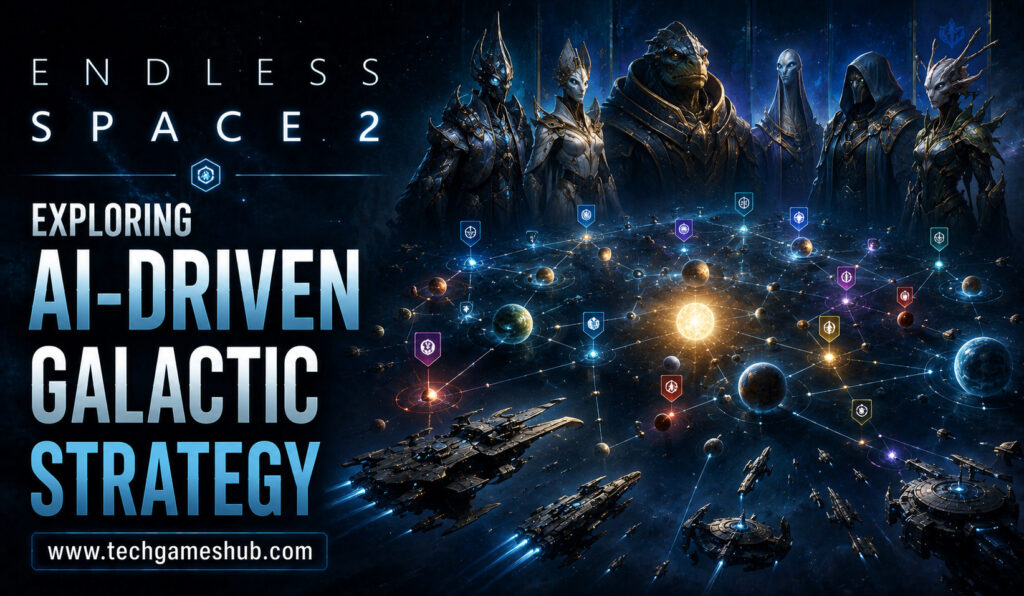
Space strategy games have always offered players a chance to think beyond individual battles and manage entire civilizations. Endless Space 2 takes that idea into a massive galactic setting where diplomacy, exploration, economics, technology, and warfare all influence the fate of an empire. One of the most interesting aspects of the game is how artificial intelligence shapes interactions between different civilizations.
Rather than simply controlling enemies that attack whenever they have enough military strength, Endless Space 2 uses AI to create opponents with different personalities, priorities, diplomatic attitudes, and strategic goals. This makes the galaxy feel less predictable and encourages players to constantly rethink their plans.
What Makes Endless Space 2 Different?
Endless Space 2 is a turn-based 4X strategy game developed by Amplitude Studios. The traditional 4X formula revolves around four major activities: exploration, expansion, exploitation, and extermination. Players explore unknown regions, establish colonies, develop resources, research technologies, build fleets, and compete against other civilizations.
What makes the experience particularly engaging is that these systems are interconnected. A player cannot focus exclusively on military power and expect to dominate every situation. Strong economies support larger fleets, advanced technology can change the balance of power, and diplomatic relationships can determine whether a powerful neighbor becomes an ally or an enemy.
AI opponents operate within this complex environment, creating a strategic challenge that goes beyond simple combat.
How AI Shapes Galactic Strategy
The AI in Endless Space 2 plays an important role in making the galaxy dynamic. Different factions have their own characteristics and objectives, meaning players cannot always use the same strategy against every opponent.
An AI empire focused on scientific development may behave differently from one that prioritizes military expansion. Another civilization may place greater emphasis on diplomacy, trade, or territorial control. Understanding these differences becomes an important part of strategic decision-making.
This creates a situation where players need to study their opponents rather than simply react to their military movements. If an empire is rapidly developing its technology, for example, the best response may not be an immediate invasion. Players might instead need to increase research, establish diplomatic relationships, or strengthen their economy.
The result is a more layered form of strategy where information and anticipation can be just as valuable as military strength.
AI Opponents Make Diplomacy More Important
Diplomacy is one of the areas where AI-driven behavior becomes particularly noticeable. Other civilizations are not simply targets waiting to be conquered. They can become trading partners, allies, competitors, or long-term threats.
Players must consider how their actions influence relationships with other empires. Aggressive expansion can alarm neighboring civilizations, while peaceful cooperation may create opportunities for trade and mutual defense.
Because AI factions have different personalities and interests, diplomatic decisions can produce different outcomes. A proposal that works well with one civilization may be ineffective with another.
This encourages players to think about the motivations of each faction. Instead of treating diplomacy as a collection of simple bonuses, Endless Space 2 makes it part of the larger strategic picture.
Exploration and AI-Driven Competition
Exploration is another important component of the game. The galaxy contains numerous systems, resources, anomalies, and opportunities for expansion. Players must decide where to send their fleets and which regions are worth claiming.
AI-controlled civilizations are making similar decisions.
This creates competition over valuable territory. A player might discover an attractive star system only to find that another empire is already moving toward it. Such situations can lead to diplomatic negotiations, territorial disputes, or military confrontation.
The AI therefore contributes to the uncertainty of exploration. Players cannot always assume that unexplored territory will remain available. Every new discovery has to be considered within the broader context of what other civilizations may be doing.
Strategic Warfare Beyond Simple Battles
Combat in Endless Space 2 is closely connected to the larger strategic system. Building a powerful fleet requires resources, technology, production capacity, and strategic planning.
AI-controlled opponents can create pressure by developing their own fleets and defending important territories. This means players have to consider more than the size of their military. Fleet composition, technological development, positioning, and economic sustainability all matter.
A large fleet can be expensive to maintain, while an economically weak empire may struggle to replace losses after a major battle. As a result, successful warfare often depends on preparation rather than simply producing as many ships as possible.
The AI helps reinforce this principle because opponents can punish poorly planned expansion or weak defenses.
Technology Changes the Balance of Power
Research is another system where strategic planning becomes essential. Technologies can improve military capabilities, economic performance, exploration, and other aspects of an empire.
The challenge is deciding which technologies deserve priority.
An empire facing a military threat may need defensive or offensive improvements. A civilization enjoying peaceful relations might instead benefit from economic development or scientific advancement.
AI civilizations contribute to this decision-making pressure because players must consider how quickly rival empires are developing. Falling behind technologically can create serious problems later in the game.
This creates a continuous strategic race. Players are not simply building their own empire; they are competing against the development of other civilizations.
AI Creates Unpredictable Galactic Stories
One of the biggest strengths of AI-driven strategy is unpredictability. A game can begin with peaceful expansion and gradually develop into a complicated web of alliances, rivalries, trade relationships, and wars.
An AI faction that initially appears harmless may become a major competitor after expanding successfully. Another empire may become a useful ally because both civilizations face the same threat.
These unexpected developments help make each campaign feel different.
Instead of following a fixed storyline, players create their own history through strategic decisions and interactions. This is one reason games such as Endless Space 2 can remain engaging even after multiple playthroughs.
The Importance of Reading the Galaxy
Winning in Endless Space 2 requires players to think beyond their immediate objectives. A strong strategy involves understanding what is happening across the galaxy.
Players need to monitor rival expansion, military development, diplomatic relationships, technology, and economic strength. Ignoring one area can create problems elsewhere.
For example, an empire may appear weak militarily but have a strong economy and advanced technology. Attacking it too early could result in an unexpectedly difficult war. Similarly, a friendly neighbor might become a serious threat if allowed to expand unchecked.
The AI encourages this broader awareness by ensuring that rival civilizations continue pursuing their own objectives.
Why AI Matters to Replayability
AI is particularly valuable in a strategy game because replayability depends heavily on variation. If opponents always behaved in exactly the same way, players could eventually memorize the optimal approach.
Endless Space 2 reduces that feeling by combining faction identities with a large number of strategic possibilities. Different galaxy layouts, starting positions, technologies, resources, alliances, and conflicts can produce very different campaigns.
Even when players choose the same civilization more than once, the surrounding galaxy can create new challenges.
This makes AI more than a background feature. It becomes an important part of the game’s replayability and long-term appeal.
Endless Space 2 and the Future of Strategy Games
Endless Space 2 demonstrates why AI remains important in strategy gaming. Artificial intelligence does not need to imitate human behavior perfectly to create an engaging experience. It simply needs to produce decisions and reactions that force players to adapt.
The most effective strategy games use AI to create meaningful uncertainty. Players should feel that other civilizations have their own goals and that the galaxy continues to evolve even when they are focused on their own empire.
As strategy games become more sophisticated, AI-driven systems could become even more detailed. Future games may create opponents that respond more dynamically to player behavior, develop longer-term plans, and adjust their strategies based on changing galactic conditions.
Conclusion
Endless Space 2 shows how AI can transform a traditional 4X strategy game into a constantly evolving galactic competition. Its AI-controlled civilizations contribute to diplomacy, exploration, warfare, technological competition, and economic decision-making.
The real strength of this approach is that players cannot rely on one universal strategy. They must observe the galaxy, understand rival civilizations, anticipate potential threats, and adapt their plans as circumstances change.
For fans of space strategy games, this combination of AI-driven opponents and interconnected gameplay systems creates a galaxy where every decision can have consequences. Endless Space 2 ultimately proves that the most memorable strategy experiences are not just about controlling an empire—they are about responding intelligently to a universe that refuses to remain predictable.