Strategy games do not always need huge maps, hundreds of units, or complicated economies to create deep gameplay. Sometimes, a small battlefield and a handful of enemies can provide an enormous strategic challenge. Into the Breach demonstrates this idea exceptionally well by combining turn-based tactics, predictable enemy attacks, limited resources, and carefully designed battlefields.
Developed by Subset Games, Into the Breach places players in control of powerful mechs fighting giant creatures known as the Vek. The objective is not simply to destroy every enemy. Players must protect civilian buildings, manage limited resources, complete objectives, and survive increasingly difficult encounters.
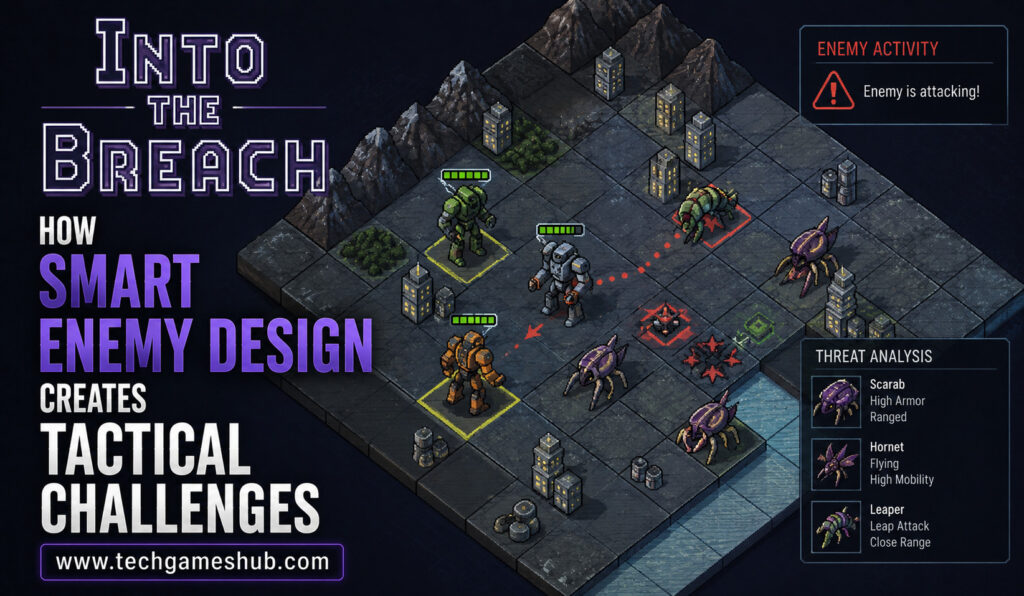
What makes the game especially interesting is its enemy design. Instead of hiding enemy intentions, Into the Breach usually shows players what enemies are planning before they attack. This seemingly simple design decision transforms combat into a tactical puzzle where success depends on understanding threats and finding the best possible response.
Enemies That Show Their Intentions
Many strategy games create difficulty by keeping enemy actions uncertain. Into the Breach takes the opposite approach.
Enemy attacks are generally displayed before they happen. Players can see which units are targeting specific locations and what type of attack they intend to perform.
This means the challenge is not primarily about guessing what the enemy will do.
Instead, the question becomes:
How can the player respond to everything that is about to happen?
This creates a unique form of strategic thinking. Players have information, but they have limited tools for changing the outcome.
The result is a game where perfect information does not make combat easy. It simply moves the challenge from prediction to problem-solving.
Every Turn Becomes a Tactical Puzzle
Because enemy intentions are visible, each turn resembles a puzzle.
Players need to examine the battlefield, identify the most dangerous threats, and determine how their mechs can interfere with enemy plans.
A mech might push an enemy away from a target. Another could block an attack. A third might destroy an important unit or manipulate its position.
The best solution is often not the most obvious one.
Destroying an enemy may seem like the ideal response, but sometimes pushing that enemy into another position can protect more buildings. In other situations, preventing one attack may cause another enemy to become more dangerous.
This interconnected design makes each turn feel carefully constructed.
Protecting Civilian Buildings
The player’s objective is not simply to survive.
Civilian buildings provide power and represent important targets that the Vek are trying to destroy. If enough infrastructure is damaged, the player’s campaign can suffer serious consequences.
This changes how players evaluate attacks.
A powerful enemy threatening an empty area may be less important than a weaker enemy targeting a valuable building.
Players therefore need to prioritize threats based on their consequences rather than enemy strength alone.
This is an important principle in strategic AI and game design: the most dangerous opponent is not always the one capable of dealing the most direct damage.
Enemy Variety Creates Different Problems
Into the Breach features different types of Vek with distinct abilities and attack patterns.
Some enemies attack directly, while others can create hazards, launch projectiles, block movement, or interfere with the player’s positioning.
This variety prevents players from solving every battle using the same tactic.
A strategy that works against one enemy may become ineffective when another enemy type is introduced.
Players must understand how different enemies interact with one another.
For example, one enemy may create a problem while another makes that problem much harder to solve. The tactical challenge comes from managing the entire group rather than focusing on individual units.
Positioning Is More Important Than Damage
Into the Breach is a good example of a strategy game where positioning can be more important than raw firepower.
Mechs have abilities that can manipulate enemy positions.
Pushing an enemy one square may appear insignificant, but that movement can change the entire battlefield.
An enemy moved away from a building might no longer be able to attack it. Another enemy could be pushed into the path of its own ally. A unit can sometimes be moved into a position where it becomes harmless.
This creates a powerful strategic idea: you do not always need to destroy a threat to neutralize it.
Sometimes changing where the threat is located is enough.
Friendly Fire Creates Additional Complexity
Enemy attacks can sometimes affect other units or objects on the battlefield.
Players can exploit this behavior by positioning enemies so that their attacks cause unintended damage to other Vek.
This turns enemy behavior into a potential resource.
Instead of treating enemy attacks only as threats, players can manipulate them to create favorable outcomes.
This is one of the smartest aspects of the game’s design because it encourages players to understand the rules governing enemy actions.
The player is effectively using the enemy’s own behavior against it.
Limited Actions Increase Decision Pressure
Players usually have only a limited number of actions available during a turn.
This means they cannot solve every problem simultaneously.
A mech might be able to attack one enemy, move to another location, or perform an ability. Choosing one option means giving up another.
This creates meaningful trade-offs.
A player may save one building but leave another vulnerable. They may eliminate a powerful enemy but fail an optional objective. They may protect a mech but allow an enemy to damage the environment.
The limited-action system prevents the game’s perfect information from becoming too powerful.
Knowing what will happen is useful, but knowing the answer does not mean the player has enough actions to execute it.
Enemy Design Encourages Creative Solutions
Because attacks are visible, players are encouraged to look for unconventional solutions.
A difficult enemy does not always need to be destroyed directly.
Players can push it away, block its movement, redirect its attack, freeze it, manipulate another enemy, or use the environment to reduce its impact.
This gives the game a strong puzzle-solving identity.
The smartest move is often the one that changes the relationships between multiple threats rather than simply removing one enemy.
Environmental Hazards Add More Variables
Battlefields can contain environmental elements that influence combat.
Water, fire, mountains, buildings, ice, and other features can affect how units move and how attacks function.
These environmental systems give players additional tools for solving tactical problems.
An enemy near a dangerous environmental feature may be easier to neutralize than one standing in an open area.
The environment therefore becomes part of the tactical toolkit.
Instead of thinking only about units, players must consider the entire battlefield.
Objectives Prevent Simple Strategies
Battles can include objectives beyond basic survival.
Players may need to protect specific buildings, destroy particular targets, complete optional challenges, or accomplish other goals.
These objectives force players to think beyond immediate combat.
A player might be able to win the battle but fail an important objective.
This creates another layer of decision-making because players must balance short-term survival with longer-term rewards.
The Campaign Structure Makes Decisions Matter
The tactical battles are connected through a larger campaign.
Players choose where to go, which areas to tackle, and which rewards to pursue.
The decisions made during one battle can influence the resources and upgrades available later.
This creates a relationship between individual tactical choices and broader campaign strategy.
Players must therefore consider whether a difficult area is worth the potential rewards and whether their current squad is prepared for the challenge.
Mech Abilities Create Tactical Synergy
Each mech has specialized abilities.
One may focus on pushing enemies, another on dealing damage, and another on supporting the squad.
The real strategic depth comes from combining these abilities.
A mech that does little direct damage can still be extremely valuable if it can reposition enemies effectively.
Players gradually learn how different abilities complement one another.
This creates a system where squad composition becomes an important strategic decision.
Why Predictable Enemies Can Be More Interesting
Into the Breach demonstrates an important lesson in game design: predictable enemies can create extremely challenging gameplay.
If players know what the enemy will do, the developers can make the battlefield itself more complex.
Instead of relying on surprise, the game challenges players to solve a difficult problem using limited resources.
This creates a sense of fairness.
When a player loses, they can often identify the mistake because the enemy’s intentions were visible.
The result is a learning-focused experience where failure encourages experimentation rather than frustration.
Smart Enemy Design Instead of Simply Stronger AI
Into the Breach also shows that intelligent enemy design does not necessarily require sophisticated artificial intelligence.
The Vek do not need to behave like human generals.
Their attacks are often predictable, but their abilities and interactions create complicated tactical problems.
This is a valuable design principle.
A game can produce intelligent-feeling opponents by giving enemies clear rules that interact in interesting ways.
The complexity comes from the player trying to solve the system rather than from enemies constantly changing their behavior.
Emergent Tactical Stories
Even with predictable enemy behavior, unexpected situations can emerge.
A player may discover that an enemy’s attack can be redirected toward another Vek. A carefully planned push can protect multiple buildings at once. A desperate move can unexpectedly turn a losing battle into a victory.
These moments create memorable tactical stories.
The game does not need scripted events to produce them. Its systems are enough to generate surprising outcomes.
Why Into the Breach Is Important for Strategy Design
Into the Breach offers a different approach to tactical difficulty.
Instead of making enemies unpredictable or giving them overwhelming advantages, it gives players information and asks them to make the best possible decisions with limited tools.
This creates a pure test of tactical reasoning.
The game demonstrates that excellent strategy design is not necessarily about complexity for its own sake. A small number of carefully balanced mechanics can create extraordinary depth when they interact effectively.
The Future of Tactical Enemy Design
Future strategy games can learn a great deal from this approach.
Developers can create more sophisticated tactical challenges by designing enemies with clearly defined abilities and interactions rather than simply increasing their health or damage.
Artificial intelligence can still play an important role, but smart rules and carefully constructed enemy behaviors can sometimes produce more satisfying challenges than unpredictable AI.
As strategy games continue to evolve, the combination of transparent enemy intentions, environmental interaction, positional mechanics, and limited resources could become even more powerful.
Conclusion
Into the Breach demonstrates how smart enemy design can create deep tactical challenges without relying on enormous armies or complicated artificial intelligence.
Its enemies reveal their intentions, but defeating them remains difficult because players must manage multiple threats with limited actions. Positioning, environmental interaction, enemy abilities, civilian protection, and squad synergy all contribute to the puzzle.
The game’s greatest lesson is that a smart opponent does not always need to surprise the player. Sometimes, the most engaging challenge comes from knowing exactly what is going to happen and still struggling to find a way to stop it.
By turning every enemy attack into a tactical problem, Into the Breach shows how thoughtful design can make a relatively simple strategy system feel remarkably deep, challenging, and rewarding.