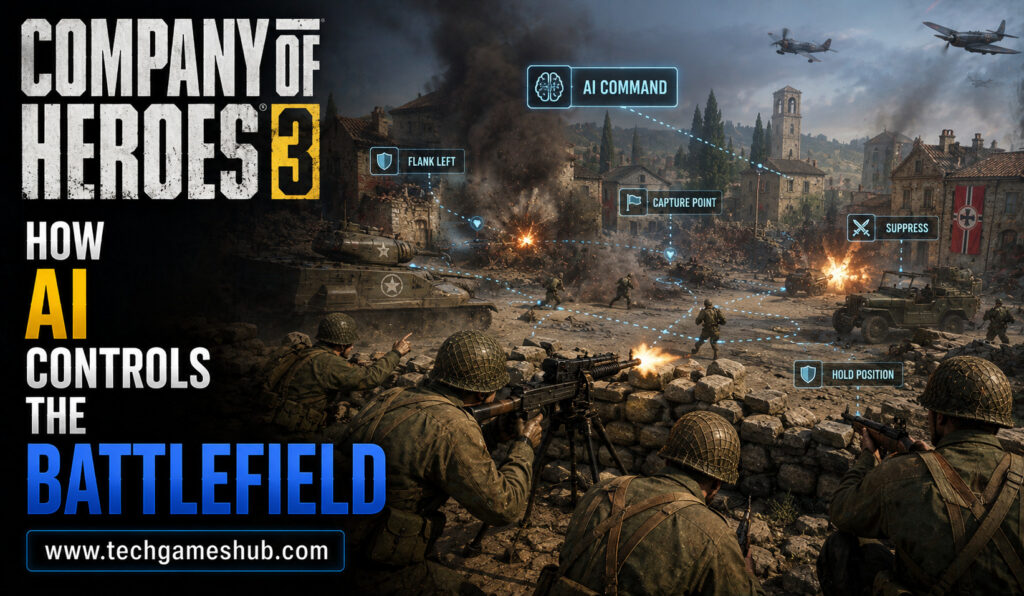
Real-time strategy games are at their best when the battlefield feels active, unpredictable, and responsive. Players should not simply move units toward stationary targets. They should have to react to enemy attacks, defend important positions, manage resources, and change plans as the battle develops. Company of Heroes 3 uses artificial intelligence, tactical positioning, terrain systems, and real-time decision-making to create this type of battlefield.
Developed by Relic Entertainment, Company of Heroes 3 builds on the tactical foundation of the series while introducing new gameplay systems and larger strategic possibilities. Its battles focus heavily on cover, positioning, line of sight, unit abilities, resource control, and combined-arms tactics.
AI plays a critical role because it controls enemy units and helps transform the battlefield into a constantly changing tactical environment.
AI Is Central to Real-Time Battlefield Strategy
Unlike turn-based strategy games, Company of Heroes 3 does not give players unlimited time to consider every move.
Units are constantly moving, attacking, retreating, capturing territory, and responding to threats.
This makes AI especially important.
Computer-controlled opponents need to make decisions while the battle is unfolding. They must determine where to send units, when to attack, which areas to defend, and how to respond when the player changes strategy.
The faster these decisions happen, the more dynamic the battlefield becomes.
Understanding Cover and Positioning
Cover is one of the defining mechanics of Company of Heroes.
Infantry can use buildings, walls, vehicles, terrain features, and other objects to reduce their vulnerability to enemy fire.
This means that AI must understand the tactical value of positions.
A unit standing in open terrain may be extremely vulnerable, while the same unit behind strong cover can survive much longer.
AI-controlled forces therefore need to move between advantageous positions while avoiding unnecessary exposure.
For players, this creates a battlefield where movement is about more than reaching a destination. The location of a unit can determine whether it survives.
AI and Tactical Movement
Movement in Company of Heroes 3 is closely connected to combat.
Units need to advance, retreat, flank, reinforce, and reposition depending on what is happening around them.
AI-controlled units can use movement to respond to threats and pursue objectives.
This becomes especially important when the player attacks from unexpected directions.
A computer opponent that simply moves units forward in a straight line would be easy to defeat. More effective battlefield behavior requires AI to consider nearby threats and the changing tactical situation.
The result is a more fluid battlefield where positions can change rapidly.
Flanking Makes AI More Challenging
Flanking is an important part of Company of Heroes-style combat.
Attacking an enemy from the side can expose weaknesses that may not be visible from the front.
Players can use flanking maneuvers to bypass defensive positions, attack support weapons, or force infantry out of cover.
AI opponents can also use similar tactics.
This creates a tactical contest in which both sides are looking for opportunities to attack vulnerable positions.
A player cannot simply establish one defensive line and assume it will remain safe throughout the battle.
The AI can pressure different areas and force the player to react.
AI Controls Different Types of Units
Company of Heroes 3 includes infantry, vehicles, artillery, support units, and other battlefield elements.
Each unit type has a different role.
Infantry can capture territory and fight in close or medium-range engagements. Vehicles can provide mobility and firepower. Support units can influence battles through specialized abilities.
AI must coordinate these different capabilities.
A strong attack may require several unit types working together rather than relying on a single group.
This is where combined-arms strategy becomes important.
Combined Arms and Battlefield Coordination
The battlefield becomes more complex when different units support each other.
An infantry unit may hold an enemy position while a vehicle attacks from another direction. Artillery can weaken a defensive location before an assault. Support units can provide additional capabilities that allow frontline troops to survive longer.
AI-controlled armies need to coordinate these elements to remain effective.
This does not mean every battle is perfectly executed by the computer. Instead, the AI provides enough tactical pressure to force players to think about how their own forces are organized.
The player must also coordinate multiple unit types if they want to compete effectively.
AI and Resource Control
Winning battles is not only about destroying enemy units.
Territory and resources are also important.
Players need to capture strategic locations to increase resource income and maintain their armies.
AI-controlled opponents can contest these areas by sending units toward resource points, defending captured territory, or attacking vulnerable locations.
This creates a larger strategic layer within individual battles.
A player might win a local firefight but still lose strategically if the enemy controls more resources.
AI therefore helps make territory meaningful.
The Importance of Map Awareness
Maps in Company of Heroes 3 can contain roads, buildings, open spaces, chokepoints, strategic locations, and other terrain features.
AI behavior interacts with this environment.
Computer-controlled forces can move through different areas and attempt to gain advantageous positions.
For the player, this means understanding the map is essential.
A strong commander does not simply ask where the enemy is. They also consider where the enemy is likely to move next and which locations could become strategically important.
AI encourages this type of forward thinking.
Tactical Retreats and Reinforcement
One of the important aspects of real-time strategy is knowing when not to fight.
A damaged unit may be better off retreating rather than being destroyed.
AI-controlled units can react to battlefield pressure, and players must also learn to recognize when their own forces are in danger.
This creates an ongoing cycle of combat, retreat, reinforcement, and redeployment.
The battlefield therefore does not always move forward.
A successful player may attack, withdraw, rebuild strength, and attack again from another direction.
AI contributes to this dynamic by keeping enemy forces active while the player reorganizes.
AI and Vehicle Combat
Vehicles introduce another layer of battlefield decision-making.
Armored units can be powerful but may have limitations involving positioning, mobility, visibility, and vulnerable areas.
AI-controlled vehicles must navigate the battlefield while responding to enemy threats.
Players can exploit poor vehicle positioning by attacking from advantageous directions or using terrain to limit movement.
At the same time, AI-controlled vehicles can punish exposed infantry and weak defenses.
This creates a tactical relationship between armor, infantry, and terrain.
Artillery and Long-Range Pressure
Long-range units can change the nature of a battle.
Artillery can pressure defensive positions without directly entering the frontline. This forces players to consider both offensive and defensive positioning.
AI-controlled forces may use long-range attacks to weaken important areas or force units to relocate.
Players must therefore avoid becoming too predictable.
If the same defensive position is used repeatedly, the opponent may gain opportunities to attack it.
The presence of long-range systems makes battlefield movement even more important.
AI Creates Emergent Combat Situations
One of the most interesting aspects of Company of Heroes 3 is the possibility of unexpected battlefield events.
An enemy attack can interrupt a planned offensive. A defensive position may collapse unexpectedly. A vehicle may arrive at exactly the wrong moment. A carefully prepared assault can succeed or fail depending on positioning and timing.
AI helps create these situations because computer-controlled forces are constantly responding to the player.
Instead of following a fixed sequence, the battlefield develops through the interaction between player decisions and AI behavior.
This is what makes individual matches feel different.
Tactical Pausing and Decision-Making
Company of Heroes 3 includes features designed to help players manage the complexity of real-time combat, including tactical pause options in certain modes.
These systems allow players to better understand battlefield conditions and issue commands when multiple things are happening at once.
Even with such tools, the underlying challenge remains the same: the player must determine which threats deserve attention first.
AI creates the pressure, while the player provides the strategic response.
AI Difficulty and Learning
AI opponents can serve as an important learning tool.
New players can use computer matches to understand unit roles, cover, resources, movement, and combat.
As their skills improve, stronger AI settings can provide greater pressure.
The goal is not simply to defeat the computer. Players can also learn from how AI-controlled forces approach different situations.
When a player loses territory or an engagement, the result can reveal weaknesses in their strategy.
Perhaps they ignored a flank, failed to protect support units, or expanded too quickly.
This makes AI useful as both an opponent and a training system.
The Technology Behind Battlefield AI
Creating AI for a real-time strategy game is technically challenging.
The system needs to handle pathfinding, target selection, unit priorities, movement, combat decisions, resource management, and responses to changing conditions.
At the same time, it needs to operate efficiently enough that large numbers of units can remain active without overwhelming system performance.
The complexity increases when vehicles, buildings, terrain, line of sight, cover, and special abilities are added.
Effective AI therefore requires a combination of decision-making systems and carefully designed game rules.
Why Company of Heroes 3’s AI Matters
The AI in Company of Heroes 3 is important because it supports the game’s core tactical identity.
The game is not simply about producing more units than the opponent. It is about positioning, timing, terrain, resource control, and coordination.
AI makes these systems meaningful by creating opponents that contest the same battlefield.
A computer opponent can pressure strategic points, attack weak positions, defend territory, and force players to reconsider their plans.
This turns the battlefield into a constantly evolving tactical problem.
The Future of Strategy Game AI
Future real-time strategy games could use more advanced AI to create even more responsive battlefield behavior.
AI systems could potentially recognize recurring player tactics, coordinate units more effectively, manage resources more intelligently, and adjust strategies during a match.
However, stronger AI should remain fair and understandable.
Players should be able to recognize why they lost and improve their strategies rather than feeling that the computer simply received unfair advantages.
Company of Heroes 3 highlights why this balance matters.
Conclusion
Company of Heroes 3 demonstrates how artificial intelligence can control and influence a complex real-time battlefield. AI affects movement, positioning, attacks, defense, resource control, vehicle deployment, and tactical pressure.
The game’s emphasis on cover and terrain makes AI behavior especially important. A computer opponent that understands the battlefield can force players to constantly reconsider their positions and strategies.
The most important lesson is that good strategy-game AI does not simply make enemies stronger. It creates meaningful decisions.
By combining AI with detailed terrain, combined-arms combat, resource management, and real-time tactics, Company of Heroes 3 creates battles where players must observe, adapt, and react.
As AI technology continues to develop, future strategy games could create opponents capable of more sophisticated battlefield coordination. Company of Heroes 3 already demonstrates the potential of AI to make real-time strategy feel less like controlling units on a map and more like commanding a constantly changing battlefield.