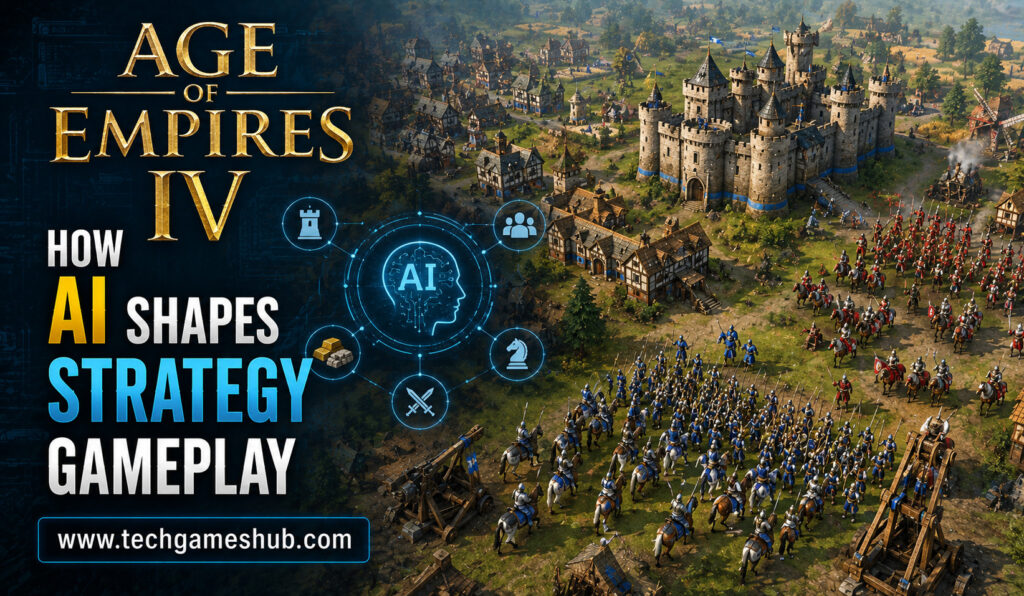
Real-time strategy games are built around decision-making. Players must gather resources, expand their territory, build armies, research technologies, and respond to opponents while everything happens in real time. Age of Empires IV takes these fundamentals and combines them with modern artificial intelligence, detailed historical civilizations, dynamic economies, and large-scale battles.
Developed by Relic Entertainment and World’s Edge, Age of Empires IV continues the long-running Age of Empires series while introducing modern systems and gameplay features. One of its important components is its AI, which controls computer civilizations and creates challenges for players who want to practice or enjoy matches without relying entirely on multiplayer opponents.
AI in Age of Empires IV is more than a source of additional units on the battlefield. It influences how players think about expansion, defense, timing, resource management, and military strategy.
AI Turns Strategy Into a Dynamic Challenge
A real-time strategy game would become predictable if computer opponents simply followed the same sequence every match.
Age of Empires IV uses AI to create opponents capable of gathering resources, constructing buildings, producing military units, expanding, defending territory, and attacking players.
This means the battlefield can develop differently depending on the decisions made by both sides.
A player might expect an early attack but instead encounter economic expansion. Another match might involve aggressive pressure that forces immediate defensive preparation.
This uncertainty encourages players to observe the opponent rather than blindly following a predetermined build order.
Resource Management and AI Decision-Making
Resources are the foundation of Age of Empires IV.
Food, wood, gold, and stone support different aspects of civilization development. Players must decide how many villagers should gather each resource and when the balance should change.
The AI operates within the same basic economic framework.
A computer opponent needs resources to build an army, advance through technological ages, construct infrastructure, and maintain its economy.
This creates a strategic relationship between economic decisions and military pressure.
If the AI invests heavily in its economy, the player may have an opportunity to attack before the opponent’s military becomes stronger. If the AI produces an army early, the player may need to sacrifice economic growth to survive.
Understanding these patterns becomes an important part of strategy.
AI Opponents Encourage Scouting
Scouting is one of the most important skills in real-time strategy games.
Players need information about enemy locations, resource distribution, military production, expansions, and defensive structures.
AI-controlled civilizations make scouting especially valuable because players cannot always know what the computer opponent is planning.
A sudden change in enemy production can indicate a shift toward a different strategy. Additional military buildings may signal an upcoming attack, while a growing economy may indicate preparation for a later power spike.
This means information becomes a strategic resource.
The better a player understands the opponent, the better they can prepare for what comes next.
Different Civilizations Create Different AI Challenges
Age of Empires IV includes civilizations with distinct technologies, units, bonuses, economies, and gameplay identities.
These differences also influence how players approach AI opponents.
An opponent with strong cavalry options can create different threats from one focused on defensive structures or ranged units.
Because civilizations have different strengths, players cannot use exactly the same strategy against every AI opponent.
This encourages adaptation.
The player must understand not only what the AI is doing but also why its civilization is capable of doing it.
Military Production and Battlefield Pressure
AI-controlled armies can create continuous pressure.
Computer opponents can produce military units and use them to attack enemy positions, defend important areas, or reinforce existing battles.
This makes military production an ongoing strategic race.
A player who focuses too heavily on economic development may eventually face a larger enemy army. Conversely, producing too many military units too early can slow economic growth and leave the civilization technologically behind.
AI opponents therefore force players to balance different priorities.
The central question is not simply “Can I build a bigger army?” It is “When should I invest in military strength, and when should I invest in my economy?”
Defensive AI Changes the Battlefield
AI is also important when computer civilizations defend themselves.
Enemy bases can include defensive structures, military units, walls, and strategic positions.
Attacking a well-defended location can require more planning than simply sending a large army forward.
Players may need to identify weak points, use siege units, attack from multiple directions, or create distractions.
This turns the battlefield into a strategic problem.
The player must consider the opponent’s defensive capabilities before committing valuable units.
AI and the Importance of Timing
Timing is one of the most important elements in Age of Empires IV.
Every civilization develops through different stages, and reaching a new age unlocks additional technologies and military options.
AI opponents create timing challenges because they can also advance and improve their capabilities.
A player may want to attack before the opponent reaches a powerful technological stage.
Alternatively, the player may choose to defend temporarily and prepare a stronger force for a later attack.
These timing decisions create the rhythm of a real-time strategy match.
Technology and Civilization Development
Technology upgrades influence military strength and economic efficiency.
AI civilizations also use technologies to improve their capabilities.
This creates another layer of strategic observation. Players need to understand what the opponent may be researching and how those upgrades could affect the battlefield.
A civilization with stronger economic technologies may become increasingly difficult to defeat if left undisturbed.
Meanwhile, a player who identifies an opponent’s military focus early can prepare counters.
Technology therefore becomes part of the information war between civilizations.
AI Makes Economic Expansion Risky
Expanding into new territory can significantly improve a civilization’s economy, but it also creates additional locations that need protection.
AI opponents can punish poorly defended expansions.
This creates an important strategic trade-off.
A player may have enough resources to establish another settlement, but doing so could stretch military forces across a larger area.
The AI makes expansion meaningful because the opponent can potentially recognize and exploit vulnerabilities.
Successful players therefore need to consider not only the benefits of expansion but also the defensive requirements that come with it.
AI and Map Control
Controlling the map is another major component of strategy.
Important resources, chokepoints, trade routes, and strategic positions can influence how a match develops.
AI opponents can contest these areas by sending armies, establishing buildings, or expanding into valuable territory.
This prevents players from treating the map as empty space.
Every area can become strategically important depending on the resources and objectives associated with it.
As a result, AI helps turn map awareness into an essential skill.
Adaptive Thinking Is More Important Than Memorization
Build orders can be useful in Age of Empires IV, but AI opponents demonstrate why memorizing a sequence is not enough.
A strategy may work under one set of conditions but fail when the opponent behaves differently.
If the AI attacks earlier than expected, the player must adjust.
If the AI becomes defensive, an aggressive strategy may need to change.
If the opponent expands rapidly, the player may need to increase military pressure or improve their own economy.
This ability to adapt is one of the most important skills that strategy games can develop.
AI Creates Different Levels of Challenge
Computer opponents are particularly useful because they provide players with different levels of difficulty.
New players can use AI matches to learn basic mechanics without immediately entering competitive multiplayer.
More experienced players can use stronger opponents to test build orders, strategies, counters, and decision-making.
This makes AI useful for both learning and experimentation.
A player can practice a particular civilization repeatedly, experiment with different army compositions, and evaluate strategies without depending on another human player being available.
AI and Emergent Gameplay
The most interesting strategy-game moments often emerge from interactions between systems.
A computer opponent might launch an unexpected attack just as the player is preparing an expansion. A defensive position might hold longer than expected. An economic strategy might allow the opponent to recover from an early setback.
These situations create stories that are difficult to predict in advance.
AI contributes to this emergent gameplay by making computer-controlled civilizations active participants in the simulation.
Instead of following a fixed story, players create their own match narratives through decisions and reactions.
The Role of AI in Learning Strategy
AI opponents can also function as training tools.
New players learn how resources, military units, technologies, and civilizations interact by playing against computer-controlled opponents.
More advanced players can use AI matches to practice specific tactical concepts such as rushing, defending, booming, raiding, or controlling strategic locations.
Although human competition provides a different kind of challenge, AI offers a controlled environment for experimentation.
Players can make mistakes, analyze what happened, and try again.
Future AI in Real-Time Strategy Games
The future of AI could make real-time strategy games even more dynamic.
Advanced AI systems could potentially respond more naturally to player behavior, adjust economic priorities, coordinate military forces more effectively, and create strategies that feel less predictable.
However, good strategy-game AI needs more than raw difficulty.
An opponent that simply receives unfair advantages may be frustrating rather than interesting.
The most effective AI should challenge players through intelligent decisions while still operating within understandable rules.
Age of Empires IV demonstrates the value of this philosophy by making computer-controlled civilizations part of the larger strategic system.
Conclusion
Age of Empires IV shows how AI can shape nearly every aspect of real-time strategy gameplay. Computer-controlled civilizations influence how players approach scouting, resource management, military production, expansion, defense, technology, timing, and map control.
The biggest contribution of AI is its ability to create situations that require adaptation. Players cannot always assume that an opponent will behave exactly as expected, so they must observe the battlefield and adjust their plans.
This makes every match more than a test of mechanical execution. It becomes a test of strategic thinking.
As artificial intelligence continues to improve, future strategy games could offer opponents that respond more intelligently, develop more convincing strategies, and create increasingly unpredictable battles. Age of Empires IV provides a strong example of how AI can transform a computer opponent from a simple obstacle into an important part of the strategy experience.