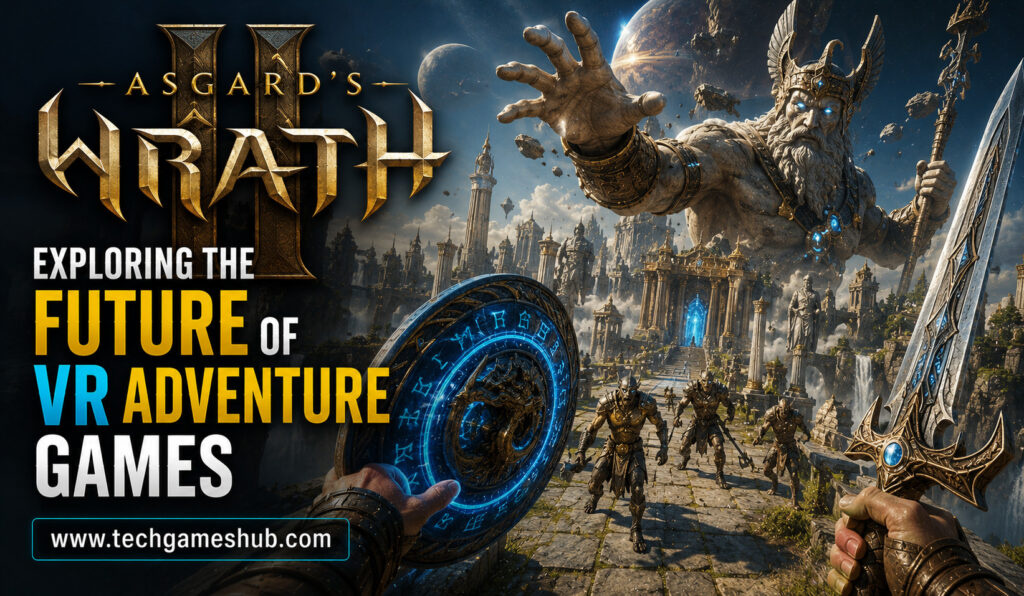
Virtual reality has spent years trying to move beyond short demonstrations and arcade-style experiences. The technology has become increasingly capable of supporting longer adventures, complex combat systems, large environments, and detailed storytelling. Asgard’s Wrath 2 is one of the clearest examples of this evolution, combining action RPG mechanics with large-scale exploration and VR-focused interaction.
Developed by Sanzaru Games and published by Oculus Studios, Asgard’s Wrath 2 launched in December 2023 for Meta Quest 2, Quest Pro, and Quest 3. The game was designed specifically around standalone VR hardware and became one of the most ambitious role-playing experiences available on the Quest platform.
What makes the game especially interesting is not simply its fantasy setting. It demonstrates how VR technology can support an adventure game with substantial exploration, physical combat, puzzles, character progression, and a large amount of content without depending on a powerful gaming PC.
A New Scale for VR Adventure Games
Early VR games often focused on short experiences because developers were still learning how to design for head-mounted displays. Asgard’s Wrath 2 takes a very different approach.
The game combines a long-form RPG structure with large environments, multiple characters, exploration, combat, puzzles, loot, and progression systems. Sanzaru originally described the game as offering around 60 hours of content, while later reviews highlighted an even larger potential playtime depending on how extensively players explore the world.
This scale matters because it challenges the idea that VR games need to be short experiences.
Instead, Asgard’s Wrath 2 demonstrates that virtual reality can support the same kind of extended adventure structure that players expect from traditional console and PC games.
Designing Combat Around VR
One of the most important differences between VR and conventional gaming is the way players interact with combat.
In a traditional action RPG, players usually press buttons to attack, block, dodge, or activate abilities. VR allows those actions to become physical gestures.
Asgard’s Wrath 2 uses motion-based combat in which players can physically swing weapons, block attacks, and interact with enemies from a first-person perspective. Sanzaru specifically emphasized gesture-based and physics-oriented combat when discussing the game’s design.
This changes the feeling of combat.
A sword is not simply an icon selected from a menu. It becomes a virtual object that the player holds and moves. The direction, timing, and physical motion of an attack can contribute to the experience.
This is one of the areas where VR can offer something fundamentally different from traditional gaming.
Physics Make the World Feel Interactive
Physics-based interaction is another important part of the game’s design.
Objects in a VR environment can feel more convincing when players can physically manipulate them. Weapons, environmental objects, puzzles, and other interactive elements become part of a world that responds to the player’s movements.
This creates a stronger connection between action and consequence.
When a player physically performs an action and immediately sees the virtual environment respond, the interaction can feel more natural than pressing a conventional controller button.
For adventure games, this technology has enormous potential because exploration can become an active process rather than simply moving a character from one waypoint to another.
Large Fantasy Environments
Asgard’s Wrath 2 is designed around large fantasy environments rather than small, isolated VR rooms.
Players can explore areas inspired by Egyptian mythology while encountering temples, landscapes, enemies, puzzles, characters, and other elements.
The scale is particularly impressive because the game runs on standalone Quest hardware. Developers had to balance environmental size and visual detail against the processing limitations of a mobile-class VR platform.
Sanzaru discussed the challenge of creating areas that feel expansive while still accounting for the limitations of Quest hardware.
This demonstrates an important lesson for the future of VR development: large worlds do not necessarily require unlimited hardware power. Clever design and optimization can create the perception of scale within technical constraints.
Standalone VR Changes Game Development
Asgard’s Wrath 2 was developed for standalone Quest hardware rather than relying on a high-end gaming PC.
That creates both advantages and limitations.
The biggest advantage is accessibility. Players do not need a wired VR setup connected to a powerful computer to experience the game. The Quest platform provides processing, tracking, display, and wireless freedom in a single headset.
For a combat-heavy VR game, removing cables and external tracking equipment can be particularly valuable. Players can move naturally without worrying about becoming tangled in wires. Sanzaru specifically identified the wireless nature of Quest hardware as an important factor for the game’s combat-focused design.
At the same time, standalone hardware has less processing power than high-end gaming PCs. Developers therefore need to optimize graphics, environments, lighting, textures, and object detail carefully.
Optimization Behind the Visual Experience
Asgard’s Wrath 2 demonstrates how optimization can compensate for hardware limitations.
The game was built using Unreal Engine 4 and was designed to run across multiple Quest generations.
This required developers to carefully manage rendering performance.
Techniques such as dynamic resolution behavior, fixed foveated rendering, level-of-detail systems, and other optimization methods help VR games maintain smooth performance.
Quest 3 later received enhanced rendering features, including higher rendering resolution and longer level-of-detail distances. A subsequent update also introduced a dedicated enhanced graphics mode with improved textures, shaders, materials, and model details.
These improvements demonstrate how software optimization can allow the same game to take advantage of more capable hardware.
VR and Character Interaction
Another important feature of Asgard’s Wrath 2 is the relationship between the player and the characters they control.
The game uses a mythology-inspired story in which the player takes on the role of a cosmic guardian and interacts with mortal heroes. This structure allows the adventure to shift between different perspectives and abilities.
In conventional games, changing characters is primarily a narrative or gameplay mechanic. In VR, changes in perspective can also affect the player’s physical experience.
Different weapons, abilities, body sizes, and interactions can make each character feel distinct.
This provides developers with a powerful tool for storytelling because gameplay mechanics and physical perspective can work together.
Exploration Becomes More Personal
Exploration is particularly well suited to virtual reality.
In Asgard’s Wrath 2, players can physically look around environments rather than controlling a fixed camera. Large structures can tower above them, while distant landscapes can create a greater sense of scale.
This is one reason VR can make familiar fantasy settings feel more immersive.
A temple is no longer simply a location shown on a television screen. It surrounds the player. A giant enemy can feel imposing because its size is perceived from a first-person perspective.
The technology therefore changes not only how players interact with the game but also how they perceive its world.
Puzzles and Environmental Interaction
Adventure games depend heavily on puzzles and environmental challenges, and VR creates interesting opportunities in this area.
Instead of selecting an option from a menu, players can physically manipulate objects, inspect environments, and use tools.
This type of interaction can make puzzles feel more intuitive because players are directly involved in solving them.
VR also allows developers to hide information in physical spaces. Players may need to look behind an object, examine an unusual structure, or physically orient themselves to understand an environmental puzzle.
These mechanics can encourage players to explore more carefully.
Balancing Immersion and Comfort
Creating a large VR adventure is not only a technical challenge. It is also a comfort challenge.
Players can experience VR differently from traditional games because artificial movement and physical movement do not always match.
Developers therefore need to consider locomotion systems, camera movement, interaction distances, and other design choices.
Asgard’s Wrath 2 demonstrates how large VR games can incorporate extensive movement while maintaining systems designed around the limitations of headset-based gameplay.
This is an important area for the future because comfort will remain one of the biggest factors determining whether players can spend hours inside virtual worlds.
Why Asgard’s Wrath 2 Is Important for VR
The importance of Asgard’s Wrath 2 extends beyond its individual gameplay features.
It demonstrates that VR can support experiences with the ambition and structure of traditional action RPGs.
Reviews and industry coverage frequently highlighted its scale, content, and technical achievement, particularly considering that it runs on standalone Quest hardware.
That is significant because one of the biggest questions surrounding VR gaming has been whether the medium can produce large, long-lasting adventures rather than mostly short experimental experiences.
Asgard’s Wrath 2 provides a strong answer: VR can support substantial adventures when developers design around the strengths and limitations of the technology.
What It Suggests About the Future
The future of VR adventure games could build on the ideas demonstrated by Asgard’s Wrath 2.
More powerful processors can support richer environments. Improved displays can increase visual clarity. Better motion tracking can make interactions more precise. Advances in artificial intelligence could create more responsive characters and enemies.
Haptic technology could also make virtual objects feel more convincing, while improved wireless hardware could make long sessions more comfortable.
The combination of these technologies could eventually allow VR adventure games to approach the scale and complexity of major traditional RPGs while maintaining the physical interaction that makes VR unique.
Conclusion
Asgard’s Wrath 2 represents an important step in the evolution of VR adventure games. Its combination of large environments, physical combat, RPG progression, puzzles, character interaction, and standalone hardware demonstrates how far virtual reality gaming has developed.
Its most important achievement is not simply visual quality. The game shows how developers can redesign familiar adventure mechanics around physical interaction and immersive perspective.
As VR hardware becomes more powerful and developers become more experienced with the medium, games may become larger, deeper, and more interactive. Asgard’s Wrath 2 offers a glimpse of that future by proving that a virtual reality headset can deliver an adventure that feels much closer to a full-scale console RPG than the short VR experiences of the past.