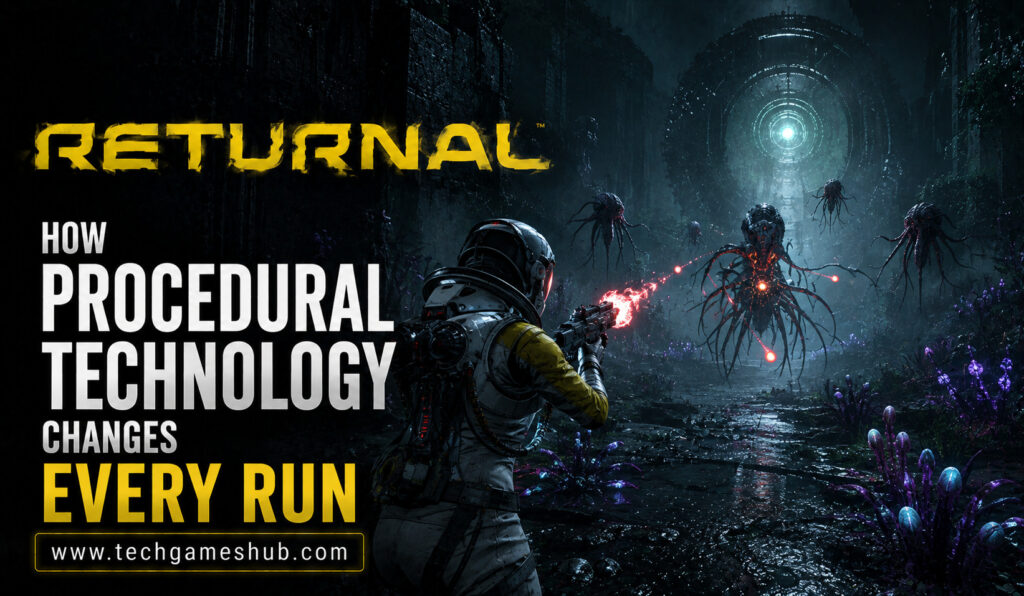
Returnal is a game built around repetition, uncertainty, and adaptation. Developed by Housemarque, the sci-fi action game places players in the role of Selene, an astronaut trapped on the alien planet Atropos. Every time she dies, the world changes, forcing her to explore familiar environments under different circumstances.
This structure is powered by procedural technology. Instead of presenting exactly the same level layout during every attempt, Returnal combines and rearranges different environments, rooms, enemies, resources, and challenges.
The result is a game where no two runs feel completely identical.
Procedural generation is not simply used to make the game look different. It affects exploration, combat, strategy, difficulty, and even the player’s relationship with failure. By constantly changing the conditions of each attempt, Returnal turns repetition into one of its most important gameplay mechanics.
What Makes Returnal’s Runs Different?
In a conventional action game, players gradually memorize environments.
After completing a level several times, they can remember where enemies appear, which corridors lead to rewards, and where important encounters happen.
Returnal intentionally disrupts this familiarity.
Atropos is divided into distinct biomes, but the specific rooms and connections players encounter can vary between runs. Different combinations of environments can produce different routes through the world.
This means players can learn the general rules of a biome without being able to memorize one perfect path through it.
That balance between familiarity and uncertainty is central to the game’s design.
Procedural Generation Creates Replayability
One of the biggest advantages of procedural technology is replayability.
If every run followed exactly the same sequence, repeated attempts could quickly become predictable. Players would eventually memorize the optimal route and enemy placements.
Returnal keeps the experience fresh by changing the arrangement of rooms and encounters.
A familiar biome can therefore feel different each time.
The player may recognize the architecture and general visual identity but still have to investigate the current layout.
This creates a useful combination of learning and uncertainty.
Players become more skilled at dealing with the world without completely eliminating its unpredictability.
The Environment Becomes a Strategic Puzzle
Procedural generation also affects how players approach exploration.
A particular run may provide useful resources early, while another may force the player to take greater risks before finding valuable equipment.
The available route can also influence the order in which players encounter challenges.
Because the environment changes, players cannot rely entirely on a memorized strategy.
Instead, they need to evaluate the current situation.
Should they explore an optional room?
Is the potential reward worth the risk?
Should they continue forward or search for more resources?
These decisions become part of the procedural experience.
Combat Remains Unpredictable
Returnal is heavily focused on fast-paced combat, and procedural technology plays an important role here as well.
Different runs can place players in different combat environments, with enemies appearing in varying combinations and locations.
This prevents combat from becoming purely memorization-based.
Players still learn enemy attack patterns, movement behaviors, and projectile types. However, the circumstances surrounding those encounters can change.
This is particularly important in a game built around bullet-hell combat.
Players need to react quickly to what is happening rather than simply remembering a fixed sequence.
Procedural Technology Supports the Bullet-Hell Design
The game’s combat can fill the screen with projectiles, enemies, movement patterns, and visual effects.
Because players cannot completely predict every encounter, they must constantly observe the battlefield.
Procedural variation strengthens this design.
Even if a player understands how an individual enemy behaves, the combination of enemies and environmental conditions may be different during the next attempt.
The challenge therefore comes from both mechanical skill and situational awareness.
Players are learning the rules while adapting to constantly changing circumstances.
Resources Can Change the Direction of a Run
Another important part of Returnal’s procedural design is resource management.
Different runs can provide different opportunities for obtaining weapons, upgrades, currency, and other useful items.
This means players cannot always expect to build exactly the same character setup.
A weapon or upgrade that appears early can influence the player’s strategy for the rest of the run.
The player may begin adapting to the tools available rather than waiting for a predetermined build.
This creates a sense of improvisation.
Risk and Reward Become More Important
Procedural worlds work especially well when players have meaningful decisions about risk.
In Returnal, optional areas and challenging encounters can provide valuable rewards.
The problem is that entering these areas can also put the current run in danger.
Because the exact circumstances change from one run to another, players have to evaluate risk based on the current state of their character.
A player with strong equipment may be willing to take bigger risks.
Someone who is already struggling may choose a safer route.
The procedural environment makes these decisions feel immediate and personal.
Death Does Not Mean the Same Thing Every Time
Death is one of the defining features of Returnal.
When Selene dies, the player begins another attempt, but the next run can unfold differently.
This changes the psychological meaning of failure.
A failed run is not simply repeating the same level from the beginning. It is an opportunity to encounter a new configuration and apply what the player has learned.
The player becomes more experienced even when the character’s immediate progress is reset.
This creates the classic roguelike relationship between failure and learning.
Players Learn Systems Instead of Memorizing Levels
The procedural design encourages players to learn general principles.
Instead of memorizing the exact location of every enemy, players learn how different enemies attack.
Instead of memorizing one route, they learn how to navigate the game’s environments.
Instead of relying on one perfect weapon combination, they learn how different weapons perform in different situations.
This distinction is important.
Procedural technology works best when it encourages mastery of systems rather than simply producing random layouts.
Returnal uses variation to test whether players have genuinely learned how the game works.
Visual Design Keeps Procedural Areas Cohesive
Procedural generation can sometimes create environments that feel disconnected or artificial.
Returnal avoids this problem by giving each biome a strong visual identity.
Different environments have their own architectural structures, landscapes, lighting, and atmosphere.
Even when the room layout changes, players can still understand where they are within the broader world.
This helps procedural generation feel intentional rather than random.
The technology creates variation while the artistic direction maintains consistency.
Technology and Storytelling Work Together
Procedural systems also support the game’s mysterious atmosphere.
Selene’s repeated journeys through Atropos reinforce the game’s themes of cycles, memory, isolation, and uncertainty.
The changing environment becomes more than a gameplay mechanic.
It reflects the feeling that Selene is trapped in a world where events repeat but never happen in exactly the same way.
This connection between mechanics and narrative is one of Returnal’s strongest qualities.
The technology helps communicate the game’s central ideas rather than simply making the game harder.
Why Procedural Generation Does Not Feel Completely Random
A common misunderstanding about procedural generation is that it means everything is randomly created.
In reality, successful procedural systems usually operate within carefully designed rules.
Returnal can rearrange rooms and encounters while still maintaining boundaries that make the game playable.
There are rules governing progression, room connections, enemy placement, rewards, and environmental structure.
The technology therefore creates controlled unpredictability.
Players experience variety without being placed into completely unreasonable situations.
Procedural Technology Encourages Adaptation
Adaptation is ultimately the most important skill in Returnal.
Players cannot control which rooms appear, what equipment becomes available, or exactly how every encounter will unfold.
What they can control is how they respond.
A strong player learns to make decisions quickly, adjust strategies, recognize threats, and use available resources effectively.
This makes each run a test of adaptation.
The game rewards players who can stay calm when their preferred strategy is no longer available.
The Future of Procedural Game Worlds
Returnal demonstrates why procedural technology remains important in modern game development.
When used carefully, procedural generation can make a game more replayable without sacrificing artistic direction.
Future games can potentially combine procedural environments with increasingly sophisticated AI, dynamic storytelling, and persistent player behavior.
Such systems could create worlds that change not only their layouts but also their characters, events, challenges, and narrative possibilities.
The challenge will be maintaining quality while increasing variation.
Returnal provides a strong example of how this balance can work.
Conclusion
Returnal uses procedural technology to turn repetition into discovery. Every run takes place within a familiar universe, but changing rooms, enemy encounters, resources, and routes ensure that players cannot simply memorize the game.
This design creates a unique relationship between skill and uncertainty.
Players become better because they understand the systems, while procedural generation continues to challenge them with new circumstances.
The result is a game where failure becomes part of learning and every new attempt feels like another experiment.
Ultimately, Returnal demonstrates that procedural technology is most powerful when it supports gameplay rather than replacing thoughtful design. By combining carefully controlled randomness with intense combat, resource management, exploration, and storytelling, the game makes every run feel like a new test of the player’s ability to adapt.