Puzzle games often rely on simple rules that become increasingly difficult as players learn to use them. Portal 2 takes this idea and builds an entire world around advanced technology, artificial intelligence, physics, and experimental science. Developed by Valve, the game combines clever environmental puzzles with memorable characters and a story centered on automated systems.
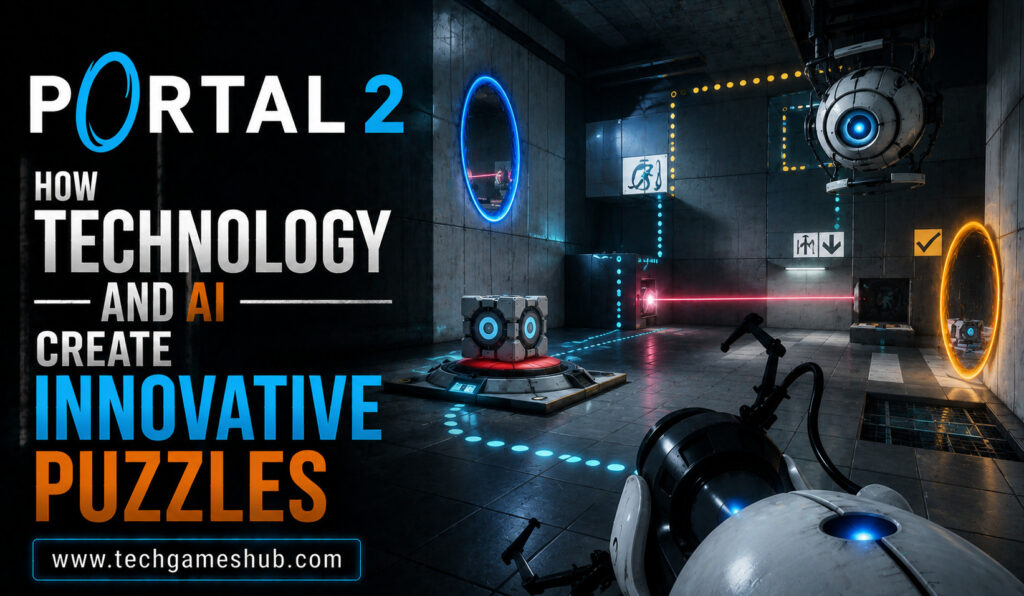
At the heart of Portal 2 is the Portal Gun, a fictional device that allows players to create linked portals on suitable surfaces. Combined with physics-based mechanics, moving platforms, lasers, buttons, gels, and intelligent machines, this technology turns ordinary rooms into complex spatial challenges.
The game’s artificial intelligence characters add another dimension. They provide instructions, create obstacles, manipulate the environment, and sometimes deliberately mislead the player. Together, technology and AI make Portal 2 one of the most recognizable examples of innovative puzzle design.
The Portal Gun Changes How Players Think
The central technology in Portal 2 is the Portal Gun.
Rather than simply opening doors or moving objects, it changes the player’s understanding of space. A portal can connect two locations that would normally be far apart, allowing players to move instantly between them.
This creates puzzles based on relationships rather than traditional paths.
A player may need to look at a room and ask where they should go, but also where they could potentially enter or exit. The solution often involves understanding angles, momentum, height, distance, and the position of multiple portals.
The technology therefore changes the basic rules of movement.
Physics Turns Technology Into a Puzzle Tool
Portal 2 does not rely only on teleportation.
Its puzzles are strongly connected to physics. Objects can fall, move, bounce, accelerate, and interact with the environment.
This makes momentum particularly important.
Players can use portals to redirect movement and gain speed or launch themselves across large gaps. A solution may require understanding how an object will travel after passing through a portal.
The result is a puzzle system that rewards experimentation.
Players learn the rules of the technology and then use those rules creatively.
AI Characters Shape the Experience
Artificial intelligence is central to Portal 2’s story.
GLaDOS, the game’s famous AI, controls much of the testing environment and interacts with the player throughout the adventure.
Her role goes beyond simply giving instructions.
She monitors the testing process, comments on the player’s actions, controls parts of the facility, and influences the story.
This creates an unusual relationship between the player and the game’s technological environment.
The facility feels like it has a personality because its systems are connected to an intelligent character.
GLaDOS Turns Puzzles Into Storytelling
GLaDOS also demonstrates how AI can be integrated into narrative design.
Instead of separating gameplay from storytelling, Portal 2 uses the puzzle rooms themselves as part of the narrative experience.
GLaDOS’s dialogue provides context, humor, tension, and character development while players solve puzzles.
The AI’s personality changes the atmosphere of the testing environment.
What could have been a series of disconnected logic challenges becomes a continuous story about technology, experimentation, control, and artificial intelligence.
Wheatley and the Risks of AI
Wheatley provides another perspective on artificial intelligence.
Initially introduced as a seemingly helpful personality core, Wheatley becomes increasingly important as the story progresses.
His development explores the consequences of giving an artificial intelligence access to greater control and responsibility.
The character provides a humorous but meaningful contrast to GLaDOS.
Together, they demonstrate that AI in Portal 2 is not simply a futuristic tool. Artificial systems can have personalities, ambitions, weaknesses, and unpredictable consequences.
Test Chambers Are Technological Laboratories
The environments in Portal 2 resemble scientific testing facilities.
Rooms are filled with machinery, automated systems, observation areas, energy devices, and experimental equipment.
This setting supports the game’s central concept.
Players are effectively participating in technological experiments where they must understand a set of physical rules and find solutions.
The test chamber becomes a controlled environment for learning.
Each new puzzle introduces or modifies a mechanic, allowing players to gradually develop their understanding.
Laser Technology Creates New Challenges
Laser-based puzzles add another layer to the technological system.
Players can redirect laser beams using specific devices and manipulate their paths to activate mechanisms.
The important part is that the laser itself is simple.
The challenge comes from understanding how it interacts with the environment.
Players must think about angles, distances, targets, and the sequence of actions needed to activate a mechanism.
This demonstrates an important principle of Portal 2’s puzzle design: a simple technological rule can create complicated problems when combined with other systems.
Conversion Gel Changes Movement
Portal 2 introduces several gels that change how players interact with surfaces.
Repulsion Gel allows characters to bounce, while Propulsion Gel increases movement speed. Conversion Gel expands the number of surfaces where portals can be created.
These technologies change the rules of the environment.
A room that previously seemed impossible to cross may become accessible after players identify where a particular gel can be used.
The game therefore keeps refreshing its puzzle vocabulary without abandoning the basic portal mechanic.
Technology Encourages Experimentation
Portal 2 is designed to teach players through experimentation.
The game usually introduces a new concept gradually, allowing players to understand what it does before combining it with other mechanics.
This creates a satisfying learning curve.
Players move from simple portal placement to increasingly complex combinations involving physics, lasers, gels, buttons, platforms, and timing.
The technology remains consistent, which is important because players can rely on the rules they have learned.
Once they understand the system, the challenge becomes finding creative ways to use it.
The Environment Becomes Part of the Puzzle
Portal 2 demonstrates that good puzzle design does not require complicated controls.
Most of the complexity comes from the environment.
Walls, floors, ceilings, platforms, gaps, switches, and objects become meaningful because of how they interact with the game’s technology.
Players must learn to examine the environment carefully.
A seemingly ordinary wall might provide the perfect location for a portal. A distant platform may become reachable by redirecting momentum.
This makes observation an essential skill.
Cooperative AI and Puzzle Design
Portal 2 also includes a cooperative campaign featuring two robotic characters.
Although the cooperative experience involves human players rather than traditional AI companions, it expands the technological puzzle concept by requiring multiple entities to coordinate.
Each player controls a robot with portal technology, allowing them to create more complex solutions.
This demonstrates how the game’s basic mechanics can scale into more sophisticated puzzle structures.
The same portal system that works for a single player becomes significantly more complicated when two players must coordinate their actions.
Technology Supports Humor and Character
One of Portal 2’s greatest achievements is the way it combines technical concepts with comedy.
Artificial intelligence, robotics, scientific testing, and futuristic machinery might sound serious, but the game’s characters give these ideas personality.
GLaDOS’s sarcasm, Wheatley’s mistakes, and the exaggerated behavior of the facility make the technology memorable.
This helps the game’s complex systems remain accessible.
Players are learning sophisticated spatial mechanics while simultaneously experiencing a comedic science-fiction story.
Why Portal 2’s Puzzle Design Still Works
Portal 2 remains influential because its technology is built around clear rules.
The Portal Gun always follows the same fundamental logic. Physics behaves consistently. Gels have recognizable effects. Lasers operate according to understandable principles.
This consistency gives players confidence.
When they fail, they can usually identify what they misunderstood and try again.
The game rarely feels unfair because success comes from learning the system rather than guessing a random answer.
The Future of AI and Technology-Based Puzzles
Portal 2 provides a strong foundation for thinking about the future of puzzle games.
More advanced artificial intelligence could create puzzles that adapt to player behavior, while physics simulations could support increasingly complex environmental interactions.
AI characters could potentially observe how players solve problems and generate new challenges based on their abilities.
Future puzzle games may also combine procedural generation, virtual environments, robotics, and intelligent systems to create challenges that feel less predetermined.
The key will remain the same: technology should create interesting decisions rather than unnecessary complexity.
Conclusion
Portal 2 shows how technology and artificial intelligence can transform simple puzzle mechanics into a deeply engaging gameplay experience. The Portal Gun changes how players understand space, physics creates opportunities for experimentation, and technologies such as lasers and gels introduce new layers of complexity.
At the same time, AI characters such as GLaDOS and Wheatley turn the technological environment into part of the story. Their personalities make the testing facility feel alive while reinforcing the game’s themes of control, experimentation, and artificial intelligence.
The result is a puzzle game where technology is not merely the setting. It is the language through which every challenge is designed.
Ultimately, Portal 2 demonstrates that innovative puzzles do not require endless mechanics. With a few well-designed technological rules, a consistent physics system, and intelligent environmental design, developers can create challenges that remain surprising, satisfying, and memorable.