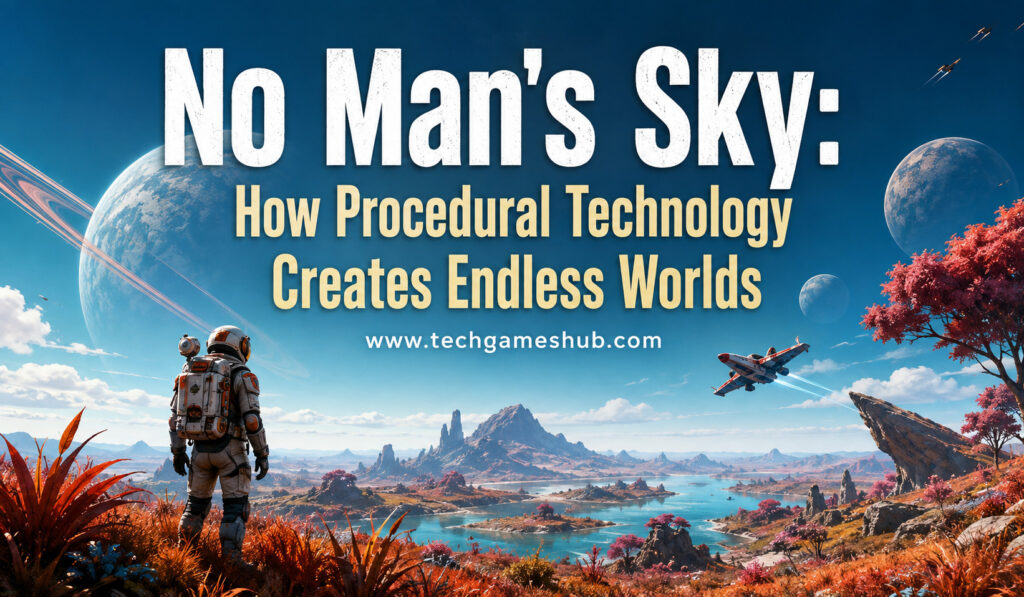
In the world of modern gaming, few ideas are as ambitious as creating an entire universe that players can explore without following a fixed path. No Man’s Sky turns that idea into reality through procedural technology, allowing its massive universe to contain planets, creatures, landscapes, resources, and environments that can feel remarkably different from one another.
Rather than designing every location manually, Hello Games uses algorithms to generate much of the game’s universe. This approach gives players the feeling that exploration has no true endpoint. Every planet can offer something new, and even familiar-looking environments can contain unexpected discoveries.
The result is more than a huge map. It is an example of how procedural generation can transform the way games are designed, explored, and experienced.
What Is Procedural Generation in No Man’s Sky?
Procedural generation is a technology that uses mathematical rules, algorithms, and predefined assets to create content dynamically. Instead of developers manually building every tree, mountain, creature, building, and planet, software determines how these elements are combined.
In No Man’s Sky, this technology is central to the game’s universe. Planets can have different climates, terrain, vegetation, wildlife, colors, resources, and atmospheric conditions. The game does not need to store a completely unique handcrafted world for every possible location.
This is one of the reasons the universe can be so enormous while remaining practical for a video game. The technology creates rules for generating environments rather than requiring developers to manually construct every possible environment.
How Algorithms Build Different Planets
The planets in No Man’s Sky are not simply random collections of objects. Procedural systems work within specific rules that determine how different elements interact.
For example, an algorithm can influence the shape of terrain, the distribution of resources, the appearance of vegetation, and the types of creatures that inhabit an environment. By changing these variables, the system can produce a wide range of worlds.
One planet might contain dramatic mountains and unusual plants, while another could feature flatter terrain and completely different environmental characteristics. These differences help make exploration feel meaningful.
Procedural technology also allows small details to contribute to the identity of a planet. The combination of terrain, lighting, colors, weather, flora, fauna, and resources can create environments that players remember even when they are generated through the same underlying technology.
Creating an Enormous Universe
One of the most impressive aspects of No Man’s Sky is the scale of its universe. A traditionally designed game would require an extraordinary amount of development time and storage to create billions of unique locations manually.
Procedural generation changes that equation.
Instead of creating every location individually, developers can create the systems responsible for producing locations. The game then uses those systems to generate environments when needed.
This allows the universe to feel vastly larger than what could reasonably be built by hand. Players can travel from planet to planet, discover new systems, and continue exploring without reaching a conventional edge of the game world.
The technology therefore does not simply make the game bigger. It changes what “world size” means in a video game.
Exploration Becomes the Main Experience
Many open-world games provide players with carefully designed maps filled with objectives, missions, characters, and collectibles. No Man’s Sky takes a different approach by making discovery itself a major part of the experience.
Because procedural generation can create unfamiliar environments, players often do not know exactly what they will encounter next.
A distant planet might contain a strange creature. A mountain range might reveal a valuable resource. An unfamiliar landscape might encourage players to land and investigate rather than simply travel through it.
This uncertainty creates a powerful exploration loop. Players travel because they want to know what exists beyond the next destination.
Procedural Technology and Wildlife
Creatures are another important part of the game’s procedural approach. Instead of limiting players to a small selection of manually designed animals, procedural systems can combine different characteristics to produce a broad variety of species.
Body shapes, colors, sizes, movement styles, and other characteristics can contribute to the appearance of creatures.
This makes wildlife an important part of planetary identity. A world populated by unusual creatures can feel completely different from another world, even if both use similar fundamental environmental systems.
The technology also creates moments of surprise. Players can encounter creatures that look unlike anything they have previously seen, which strengthens the feeling that the universe is constantly producing new experiences.
The Balance Between Randomness and Design
Procedural generation does not mean that everything is completely random. Pure randomness could easily produce environments that look chaotic or unattractive.
Instead, successful procedural systems usually operate within carefully designed rules.
Developers establish boundaries that determine what combinations are possible and how different elements should behave. The algorithm then creates variations within those boundaries.
This balance is one of the most important achievements behind No Man’s Sky. The game needs enough variation to make exploration interesting while maintaining environments that feel coherent and playable.
In this sense, procedural technology is not replacing game design. It is extending it.
Why Procedural Technology Matters for Game Development
The technology used by No Man’s Sky demonstrates how procedural generation can help developers approach large-scale game design differently.
Handcrafted content remains extremely valuable because developers can control every detail. However, manually creating enormous quantities of content requires significant time and resources.
Procedural systems can handle repetitive or large-scale content generation while developers focus on broader systems, gameplay mechanics, art direction, storytelling, and player experience.
This can make procedural generation particularly useful for games built around exploration, survival, simulation, and discovery.
As computing technology continues to improve, procedural systems may become even more sophisticated. Future games could combine procedural generation with artificial intelligence, advanced physics, and dynamic simulation to create worlds that respond more naturally to player behavior.
The Role of Technology in Player Memories
One interesting consequence of procedural generation is that players can have highly personal experiences.
Two players may explore the same game for hundreds of hours but encounter very different planets, creatures, landscapes, and discoveries. This creates stories that are not necessarily scripted by developers.
A player might remember finding a spectacular planet, surviving a dangerous environment, discovering an unusual creature, or locating a valuable resource in an unexpected location.
These experiences become personal because the game provides the framework while the player’s journey determines what they encounter.
Challenges of Creating Endless Worlds
Creating a huge procedural universe also comes with challenges.
More content does not automatically mean better content. If generated environments become repetitive, exploration can eventually lose its appeal. Players may begin to recognize recurring patterns or feel that different planets are variations of the same basic formula.
Maintaining meaningful variety is therefore one of the biggest challenges of procedural game design.
Developers must continually improve algorithms, assets, environmental systems, and gameplay mechanics to ensure that generated content remains interesting. The goal is not simply to produce more locations but to make those locations worth exploring.
The Future of Procedural Gaming
No Man’s Sky represents an important step in the evolution of procedural game technology. It shows how algorithms can support a gaming experience built around scale, exploration, and discovery.
Future procedural games could go much further. Artificial intelligence could potentially help create more sophisticated ecosystems, dynamic characters, evolving environments, and personalized experiences. Instead of simply generating landscapes, future systems may create worlds that continuously change based on what players do.
This could lead to games where no two playthroughs feel exactly alike.
Procedural generation may also become increasingly important as developers attempt to create larger and more detailed virtual environments without requiring every part of those worlds to be handcrafted.
Conclusion
No Man’s Sky demonstrates the remarkable possibilities of procedural technology in video games. By using algorithms to generate planets, landscapes, creatures, resources, and other environmental elements, the game creates a universe where exploration can continue almost indefinitely.
Its greatest achievement is not simply the enormous number of worlds available to players. It is the way technology turns exploration into a personal experience. Players are not merely moving through a predetermined map; they are discovering places that feel like their own.
As procedural generation continues to evolve alongside artificial intelligence, simulation technology, and increasingly powerful hardware, games may become even more dynamic and unpredictable. No Man’s Sky shows that when technology and creative game design work together, the concept of an endless virtual world can become much more than an idea—it can become an experience.