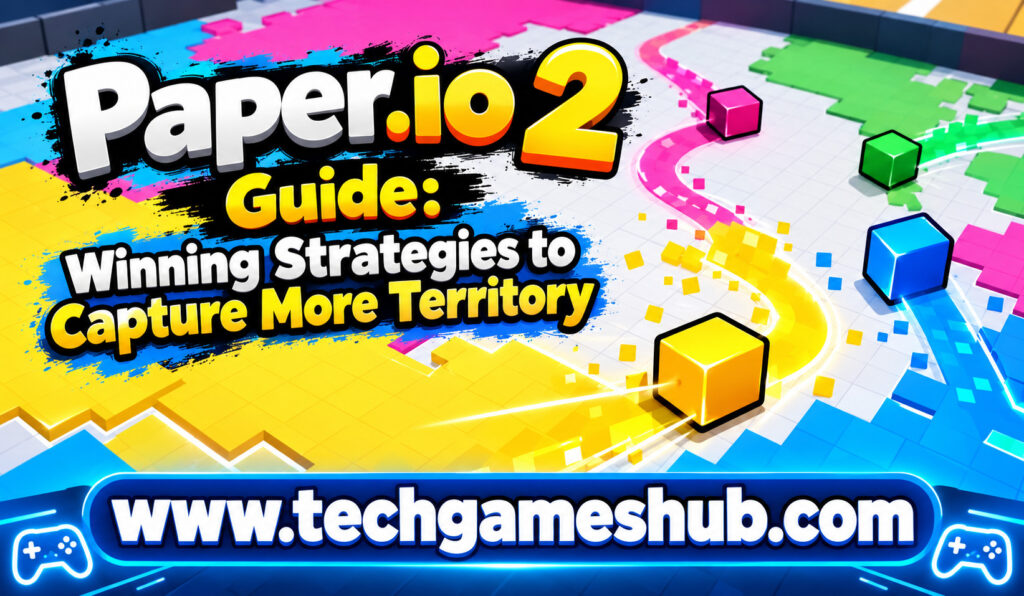
If you enjoy competitive browser games that are easy to learn but difficult to master, Paper.io 2 is worth trying. Its simple controls make it accessible to new players, but winning consistently requires smart movement, careful planning, and an understanding of when to take risks. Your objective is straightforward: capture territory, expand your colored area, and avoid getting eliminated by opponents who are trying to do the same thing.
The biggest challenge in Paper.io 2 is balancing expansion with survival. Every time you leave your existing territory, you create an exposed trail that opponents can attack. A large territory might look impressive, but one careless move can end your run. If you want to improve your performance, you need more than random movement and aggressive expansion.
This Paper.io 2 Guide explains how the game works, how to capture more territory, which mistakes you should avoid, and how to develop strategies that help you survive longer. Whether you’re playing for the first time or trying to beat your previous high score, these practical tips can help you make better decisions during every match.
What Is Paper.io 2?
Paper.io 2 is a territory-capture arcade game in which you control a colored shape moving across a shared playing field. Your objective is to expand your territory by moving outside your existing area, drawing a trail, and returning safely to your colored space.
Once you complete a successful loop, the enclosed area becomes part of your territory. Other players are competing for space, so you must defend your position while looking for opportunities to expand.
The game combines elements of strategy, timing, and quick reactions. You don’t need complicated button combinations or advanced gaming skills to start playing. Instead, your success depends on understanding the rules, choosing sensible routes, and recognizing dangerous situations before they become difficult to escape.
How Territory Capture Works
When you leave your colored territory, your movement creates an exposed trail. If you return to your territory and successfully close the loop, the enclosed area is claimed.
However, your trail creates a vulnerability. Depending on the game’s collision rules, an opponent can eliminate you by crossing your exposed line. This means every expansion attempt carries some risk.
For example, imagine that your territory covers a small section of the map. You move outward, draw a rectangle, and return to your original area. If the loop closes successfully, the enclosed space becomes yours. If an opponent reaches your trail before you return, your attempt can end in elimination.
Understanding this basic mechanic is the foundation of every successful strategy.
Best Paper.io 2 Strategies to Capture More Territory
1. Start With Small, Safe Expansions
When you begin a match, resist the temptation to capture a massive area immediately. Large loops can increase your territory quickly, but they also leave your trail exposed for longer.
Instead, start with short movements near the edge of your existing territory. Create small loops, return safely, and gradually increase your captured area.
This approach helps you learn how quickly your character moves and how opponents behave. It also gives you more opportunities to react if another player approaches.
Once you’ve secured a reasonable amount of space, you can begin attempting larger expansions when the surrounding area is relatively safe.
The goal isn’t to capture the most land in a single move. It’s to accumulate territory without putting your entire run at risk.
2. Expand Along the Edges of the Map
One useful strategy is to move toward an open edge of the playing field when your starting position makes that practical.
The map boundary can reduce the number of directions from which opponents can approach you. Rather than worrying about threats from every side, you can concentrate on the available space in front of you and the trail connecting you to your territory.
For example, if your territory is near a corner, you may be able to expand along the nearby boundary and capture a manageable section without moving deeply into a crowded area.
However, map edges aren’t completely safe. Other players can still approach your exposed trail, and an opponent may already control the surrounding area. Always check your position before beginning a loop.
3. Keep Your Exposed Trail Short
One of the most important lessons in Paper.io 2 is that a long trail creates more opportunities for opponents to attack.
When you move far away from your territory, you have to travel back before your loop can close. During that time, your exposed line becomes a potential target.
Shorter loops generally reduce the time you spend away from safety. They also make it easier to change direction or abandon an expansion plan when the situation becomes dangerous.
You don’t need to avoid every large move, but you should make each one worthwhile. Before leaving your territory, consider how much space you expect to capture and whether the potential reward justifies the extra exposure.
4. Watch Your Opponents Before Expanding
Paper.io 2 isn’t only about capturing empty space. You must also pay attention to the other players sharing the map.
Look for opponents moving close to your territory, players making long exposed runs, and areas where several colored territories meet. These situations can create opportunities, but they can also signal danger.
If another player is moving toward your trail, prioritize returning to safety rather than trying to complete an ambitious expansion.
You should also avoid assuming that an opponent is distracted simply because they are moving in another direction. Their next turn could bring them close to your exposed line.
Developing the habit of checking your surroundings before every expansion will help you make more informed decisions.
5. Choose the Right Moment to Make a Big Move
Large expansions can be valuable when you have enough space and your opponents are occupied elsewhere. However, timing is just as important as the route you choose.
Consider making a larger move when the surrounding area is open, your connection is stable, and no opponent appears close enough to threaten your trail.
Avoid attempting a major expansion when several players are clustered nearby or when your route takes you deep into contested territory.
A good strategy is to build a secure base through smaller captures first. Once you have room to maneuver, you can look for opportunities to claim a larger section of the map.
Advanced Tips for Winning More Matches
After you understand the basics, you can improve your results by paying closer attention to movement, territory shape, and opponent behavior.
Use Your Territory as a Safe Starting Point
Your existing territory provides a place to return to when completing a capture. The more thoughtfully you expand it, the more options you may have for future moves.
Try to create a shape that gives you several useful directions for expansion rather than extending into one narrow strip of land. A broader area can provide more flexibility when planning your next loop.
However, territory size alone doesn’t guarantee safety. An awkwardly shaped area can leave you surrounded by opponents or limit your ability to reach open space.
Think about how each new capture affects your next move, not just how much land it adds immediately.
Avoid Predictable Movement Patterns
If you repeatedly follow the same route, you may become easier for opponents to anticipate. Vary your expansion direction when it makes sense, and avoid making unnecessary loops that expose your trail without capturing meaningful space.
You can move toward open sections of the map, switch to smaller loops when the area becomes crowded, and return to defensive play when opponents approach.
This doesn’t mean changing direction randomly. Your movement should still have a clear purpose. The goal is to stay flexible while maintaining a safe route back to your territory.
Know When to Stop Expanding
A common mistake is continuing to chase territory when your position is already strong.
As your colored area grows, you may feel tempted to make increasingly ambitious moves. But a large territory can attract attention and make you more confident than the situation justifies.
Sometimes, the best decision is to consolidate your position by capturing smaller sections near your existing boundaries. This allows you to maintain control without taking unnecessary risks.
Remember that surviving longer gives you more opportunities to expand later.
Common Mistakes to Avoid in Paper.io 2
Even experienced players can lose a match because of a small mistake. Recognizing common problems can help you avoid repeating them.
| Mistake | Why It Is Risky | Better Approach |
| Making huge loops too early | Leaves your trail exposed for longer | Begin with manageable captures |
| Ignoring nearby opponents | Gives them opportunities to attack | Check your surroundings frequently |
| Expanding without a clear route | Can make returning to safety difficult | Plan your loop before moving |
| Chasing every opponent | Distracts you from protecting your territory | Focus on safe expansion |
| Making unnecessary moves | Creates avoidable exposure | Choose moves with a clear purpose |
| Taking risks when leading | Can undo your progress | Protect your position when necessary |
Don’t Let Greed Control Your Decisions
Capturing a large amount of territory feels rewarding, but chasing every opportunity can lead to careless decisions.
If you already have a strong position, you don’t need to risk everything for one additional section of land. Evaluate the space available, consider the distance from your safe area, and decide whether the move is worth the danger.
Learning to walk away from a risky opportunity is just as important as recognizing a good one.
How to Improve Your Paper.io 2 Skills
The fastest way to become more consistent is to practice deliberately rather than repeating the same mistakes.
Start by concentrating on survival. During your first few matches, prioritize short loops and safe returns. Pay attention to how much trail you create and how quickly you can return to your territory.
Once you’re comfortable with the controls, experiment with different expansion patterns. Try capturing territory along an edge, creating a wider base, or moving into an open section of the map. Observe which approaches work best for your starting position.
After each elimination, think about what happened. Did you travel too far from your territory? Did you overlook an opponent? Did you attempt a large capture when a smaller one would have been safer?
These questions help you identify the decisions you can improve next time.
Practice With a Clear Goal
Instead of focusing only on your final territory percentage, choose one skill to improve in each session.
For example, you might aim to complete several safe captures in a row, reduce unnecessary exposure, or become better at noticing nearby opponents.
You can also experiment with different strategies depending on whether the map is crowded or relatively open. Adapting to the situation is more valuable than relying on one fixed approach for every match.
How to Play Paper.io 2 Online
Paper.io 2 is commonly available as a browser-based game, although availability can vary by platform and region.
To get started, visit the official Paper.io website or check the game’s listing on a reputable gaming platform. Make sure you’re selecting Paper.io 2 rather than a similarly named game.
If the game is available through your browser, open it and follow the on-screen instructions. Depending on the version, you may control movement using your mouse, keyboard, or touchscreen.
You generally don’t need a high-end gaming PC for this type of lightweight arcade game. A compatible browser and a reasonably stable device should be sufficient, although performance depends on the particular version you’re using.
Be careful with unofficial websites that request unnecessary downloads or personal information. If a browser game is advertised as free, you shouldn’t need to install suspicious software to access it.
Frequently Asked Questions
1. What Is the Best Strategy in Paper.io 2?
A strong starting strategy is to capture small areas, keep your exposed trail short, and expand gradually. Watch opponents closely and attempt larger loops only when the surrounding space looks safe.
2. How Do You Capture More Territory in Paper.io 2?
Move outside your existing territory, create a loop, and return safely to close it. Plan your route before moving and focus on capturing useful sections without exposing your trail unnecessarily.
3. Why Do You Get Eliminated in Paper.io 2?
You can be eliminated when an opponent successfully attacks your exposed trail, depending on the game’s rules. Spending too much time away from your territory increases the opportunity for opponents to interfere.
4. Can You Play Paper.io 2 in Your Browser for Free?
Paper.io 2 has been available through browser-based gaming platforms. Availability and access conditions can vary, so check a reputable website for the current version.
5. Is Paper.io 2 a Multiplayer Game?
Paper.io 2 features competitive territory gameplay involving other players or opponents, depending on the version and platform. Check the particular game’s listing to understand its current multiplayer functionality.
Conclusion
Paper.io 2 is easy to understand, but winning consistently requires patience, awareness, and smart territory management. Your biggest advantage comes from knowing when to expand and when to protect the space you’ve already captured.
Use this Paper.io 2 Guide as a starting point: begin with small loops, take advantage of open areas, keep your exposed trail manageable, and watch your opponents before committing to a risky move. As your confidence grows, experiment with larger captures and different expansion patterns.
Most importantly, don’t measure success by how much territory you capture in one attempt. Focus on making safer decisions throughout the match. With regular practice and a willingness to learn from each elimination, you can improve your survival skills, capture more space, and become a more effective Paper.io 2 player.