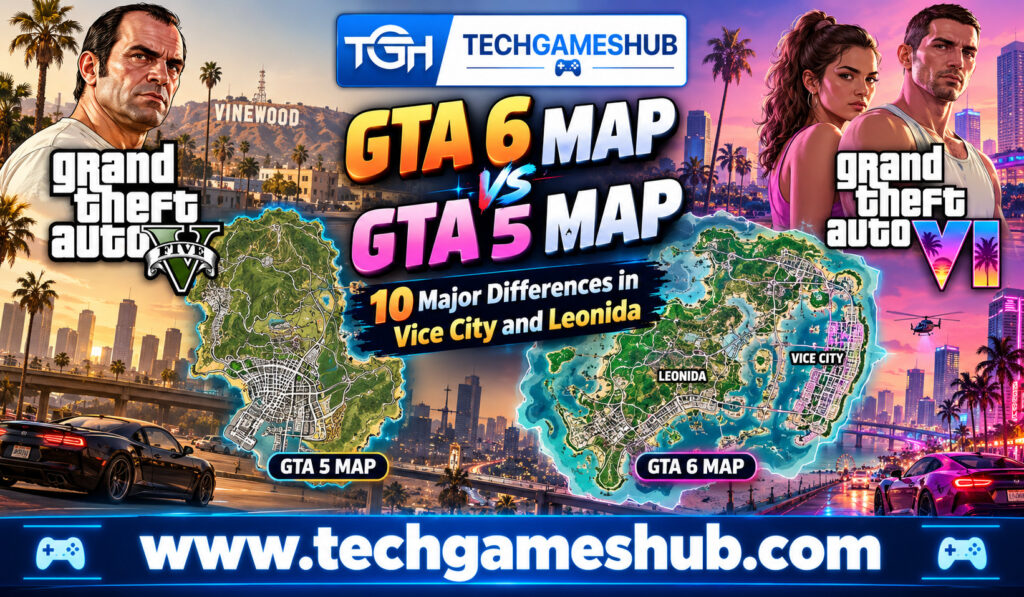
The GTA 6 map vs GTA 5 map comparison is one of the most exciting topics for Grand Theft Auto fans. GTA 5 introduced players to Los Santos and the surrounding countryside of Blaine County, creating an open world filled with busy highways, beaches, mountains, deserts, and countless activities. Now, Grand Theft Auto VI takes the series to Leonida, a fictional state inspired by Florida, with Vice City at the center of its criminal underworld.
Rockstar Games has revealed several locations and environments through official trailers, screenshots, and previews. The new setting includes much more than an updated city, offering a broader range of urban, coastal, rural, and natural landscapes. Recent reporting on Rockstar’s developer interviews also indicates that GTA 6’s world is substantially larger than GTA 5’s.
But map size is only part of the story. The real question is how the two games differ in geography, city design, exploration, and environmental variety.
In this guide, you’ll discover 10 major differences between the GTA 6 map and GTA 5 map, including Vice City, Leonida, Los Santos, Blaine County, and the potential impact of the expanded world.
GTA 6 Map vs GTA 5 Map: Quick Comparison
| Feature | GTA 5 Map | GTA 6 Map |
| Main setting | San Andreas | Leonida |
| Main city | Los Santos | Vice City |
| Real-world inspiration | Southern California | Florida |
| Rural areas | Blaine County | Multiple regions across Leonida |
| Major environments | City, desert, mountains, beaches | City, islands, wetlands, beaches, rural areas |
| Waterways | Coastline, rivers, lakes, ocean | Coastal waters, island chains, wetlands and waterways |
| Named regions | Los Santos and Blaine County are major areas | Six officially named regions |
| World scale | Large open world | Reported to be roughly twice the size of GTA 5 |
| Main attraction | Los Santos and its surrounding countryside | Vice City and the wider state of Leonida |
The GTA 6 map’s overall layout and every playable boundary have not been officially published as a complete, fully detailed map. Therefore, comparisons involving exact distances or individual locations should be treated carefully.
1. Vice City Replaces Los Santos as the Main Urban Playground
The first major difference is the city itself. GTA 5 revolves around Los Santos, Rockstar’s fictional interpretation of Los Angeles. Its urban environment includes commercial districts, residential neighborhoods, beaches, freeways, industrial areas, and entertainment hotspots.
GTA 6 returns to Vice City, a fictional city inspired by Miami. The setting features colorful architecture, palm-lined streets, beachfront areas, nightlife, and a distinctive coastal atmosphere.
What makes Vice City different?
Vice City brings a different visual identity to the series. Instead of the West Coast atmosphere associated with Los Santos, you’ll explore a modern Florida-inspired environment with tropical scenery and vibrant urban districts.
Rockstar’s official promotional material has showcased locations such as Ocean Beach and Little Cuba. These areas suggest a city with varied neighborhoods rather than a single uniform downtown.
For returning fans, Vice City also brings back a familiar name from earlier Grand Theft Auto games. However, GTA 6 presents a new modern-era interpretation, not simply a direct copy of the older Vice City map.
2. Leonida Expands Beyond a Single Major City
GTA 5 offers a large world built around Los Santos and the surrounding Blaine County countryside. You can travel from dense urban streets into deserts, mountain roads, and smaller settlements without leaving the open world.
GTA 6 takes a broader geographical approach. Leonida is the fictional state that contains Vice City and several other distinct regions.
The six officially named regions are:
- Vice City: The major urban center inspired by Miami.
- Leonida Keys: An island-chain setting inspired by the Florida Keys.
- Grassrivers: A wetland region inspired by the Everglades.
- Port Gellhorn: Another distinct destination within Leonida.
- Ambrosia: A separate region in the wider state.
- Mount Kalaga National Park: A natural area that adds variety to the setting.
These locations establish that GTA 6 is not limited to one city and its immediate countryside. The wider state provides room for different landscapes, settlements, and regional identities.
3. GTA 6 Is Reportedly Much Larger Than GTA 5
Map size is one of the biggest talking points surrounding GTA 6. GTA 5 already provides an expansive world, allowing you to drive across Los Santos, explore Blaine County, climb mountains, and travel along the coastline.
However, recent reporting on Rockstar’s developer interviews has described the GTA 6 world as roughly twice the size of GTA 5’s map. This represents a significant increase in the scale of the open world.
Does a bigger map automatically mean better gameplay?
Not necessarily. A larger map is useful only when its space offers interesting things to discover. Empty stretches of land can make travel feel repetitive, while smaller areas packed with activities, characters, and environmental details can be more engaging.
GTA 5 demonstrates how a combination of city streets, countryside, and mountain roads can create a memorable open world.
GTA 6 has the opportunity to build on that approach by connecting multiple regions across Leonida. The quality of those connections, the activities between destinations, and the variety of locations will ultimately determine how enjoyable the larger world feels.
It is also important to distinguish reported size comparisons from exact measurements. Rockstar has not published a definitive square-mile figure for the complete playable map.
4. Leonida Offers More Tropical and Coastal Environments
GTA 5 includes beaches and ocean scenery, but its overall environment is strongly influenced by Southern California. You can explore dry hills, rugged mountains, desert landscapes, and coastal neighborhoods.
GTA 6 shifts the emphasis toward Florida-inspired scenery. Its promotional material showcases tropical beaches, coastal communities, wetlands, islands, and waterways.
How the environments change exploration
The Leonida Keys and Grassrivers are particularly important to this contrast. An island-chain setting can offer a different travel experience from inland highways, while wetlands introduce scenery unlike the dry countryside surrounding Los Santos.
These environments could make exploration feel more varied as you move between regions. Water, vegetation, coastal settlements, and changing terrain also provide Rockstar with opportunities to create distinct visual experiences.
The exact distribution of every environment across the playable map remains something players will need to assess through the complete game.
5. The Leonida Keys Add an Important Island Setting
GTA 5 features a substantial coastline, but its major land-based areas are connected through roads, highways, and mountain routes. Water plays an important role in the scenery and activities, although it does not define the entire map.
In GTA 6, the Leonida Keys provide a more prominent island-chain setting inspired by the Florida Keys.
This creates a different geographical identity for the southern part of the world. Island communities, coastal roads, and surrounding water can make journeys feel different from driving between inland neighborhoods.
It also gives the game a setting where boats and other water-based transport may be particularly relevant. The trailers and previews have shown water-related activities, although the exact role of every vehicle and route should not be assumed before playing.
For players who enjoy exploring beyond city streets, the Keys are one of the most interesting elements of the new map.
6. GTA 6 Features a Broader Range of Regional Landscapes
GTA 5 divides much of its visual identity between the metropolitan environment of Los Santos and the countryside of Blaine County. These areas contain considerable variety, from developed neighborhoods to desert roads and mountain wilderness.
Leonida introduces several separately named regions, including Grassrivers, Ambrosia, Port Gellhorn, and Mount Kalaga National Park.
The significance of this difference goes beyond the number of locations. Distinct regions give Rockstar an opportunity to create places that feel different in their architecture, scenery, road layouts, and local atmosphere.
For example, a wetland journey through Grassrivers should offer a different visual experience from exploring Vice City’s busy streets. Likewise, a national park setting provides a natural contrast to industrial and residential areas.
The names and broad identities of these locations are established through official promotional material. However, their exact boundaries, size, and complete road networks should not be inferred from fan-made maps.
7. Waterways Could Play a Bigger Role in Getting Around
Water is already an important part of GTA 5. You can travel along the coast, explore the ocean, use boats, and enjoy activities involving the sea.
GTA 6’s Florida-inspired geography creates additional opportunities for waterways to influence exploration. Its coastal setting, wetlands, and island chains provide several different reasons to travel by water rather than relying exclusively on roads.
What could this mean for players?
A map with varied waterways can support different types of journeys. You might travel between coastal locations, explore areas away from major highways, or use water-based activities to break up long driving sessions.
Rockstar has showcased water-related activities in GTA 6 promotional material, including jet skiing and other outdoor pursuits. These previews establish that water is part of the experience, although they do not reveal every possible route or activity.
Compared with GTA 5, the new setting appears particularly well suited to combining urban travel with coastal and wetland exploration.
8. The Cities and Towns Have Different Identities
Los Santos is the defining urban location in GTA 5. Its commercial districts, residential neighborhoods, industrial areas, and beach communities give the city a recognizable personality.
GTA 6 uses Vice City as its main urban center but surrounds it with a broader selection of destinations across Leonida. This changes how the city fits into the overall world.
Rather than being the primary attraction within a city-and-countryside structure, Vice City is part of a larger state containing multiple regions.
That arrangement gives the game more room to contrast busy streets with smaller communities and natural environments.
For you as a player, the appeal will depend on how convincingly these places differ from one another. Unique architecture and scenery matter, but so do local activities, traffic patterns, shops, and the details that make each destination memorable.
The full extent of these differences will become clearer when the complete game is available.
9. GTA 6 Could Offer More Varied Exploration Routes
GTA 5’s road network lets you travel between the city, countryside, desert, and mountains. Highways are useful for long journeys, while smaller roads lead toward isolated settlements and scenic locations.
Leonida’s broader geographical structure creates more possibilities for varied journeys. Coastal roads, wetland areas, island routes, urban streets, and rural destinations can give different parts of the map their own travel patterns.
This variety could make choosing a route more interesting. You may prefer a highway for speed, a coastal road for scenery, or a smaller road to explore a less-developed part of the state.
However, a bigger map can also mean longer travel times. The experience will depend on road connectivity, transport options, fast-travel systems, and how much interesting content Rockstar places between major destinations.
Until the complete map and all travel systems are available, it is better to treat these gameplay implications as possibilities rather than confirmed advantages.
10. GTA 6 Emphasizes a More Detailed Open-World Experience
The final difference concerns how the map is presented and experienced. GTA 5 created an engaging open world through its city, countryside, characters, vehicles, and environmental variety.
GTA 6 builds on that foundation with a new setting, multiple regions, and a broader range of environments. Rockstar’s official trailers and subsequent previews emphasize the contrast between urban life, coastal scenery, wildlife, and the natural world.
A more expansive map also creates opportunities for environmental storytelling. Different neighborhoods and regions can communicate their character through buildings, road layouts, vegetation, and everyday activity.
Still, map size and visual detail are not the same thing. A large world needs meaningful discoveries and convincing locations to make exploration worthwhile.
The most important test will be whether Leonida feels like a connected, believable place rather than simply a larger area to drive across.
Frequently Asked Questions
1. Is the GTA 6 map bigger than the GTA 5 map?
Recent reports based on Rockstar developer interviews describe GTA 6’s world as roughly twice the size of GTA 5’s map. However, Rockstar has not published an exact square-mile measurement for the complete map.
2. Is Vice City bigger than Los Santos?
Recent coverage has reported that Vice City alone is substantially larger than Los Santos. Exact size comparisons depend on the measurements being used, so avoid treating unofficial figures as definitive measurements.
3. What state is GTA 6 set in?
GTA 6 takes place in Leonida, a fictional state inspired by Florida. Vice City, inspired by Miami, is its major urban center.
4. Will GTA 6 have more locations than GTA 5?
GTA 6 has six officially named regions: Vice City, Leonida Keys, Grassrivers, Port Gellhorn, Ambrosia, and Mount Kalaga National Park. The complete number of settlements and individual locations depends on the final playable world.
5. Can you explore the entire GTA 6 map?
The full map and its complete boundaries have not been officially published in a definitive detailed map. The extent of accessible areas and any restrictions will need to be confirmed through the released game.
Conclusion
The GTA 6 map vs GTA 5 map comparison highlights a major change in Rockstar’s approach to open-world design. GTA 5 centers on Los Santos and Blaine County, combining a sprawling city with mountains, deserts, and countryside. GTA 6 expands the setting to Leonida, with Vice City at its heart and several additional regions offering tropical, coastal, wetland, and rural environments.
The biggest differences are the return of Vice City, the wider state-level setting, the emphasis on island and water environments, and the reported increase in overall map size. Together, these changes create the potential for a more varied exploration experience.
Ultimately, the best map will not necessarily be the one with the most land. It will be the one that gives you the most interesting places to visit, routes to discover, and reasons to keep exploring. Leonida has the ingredients to deliver a distinctive new Grand Theft Auto world, while GTA 5 remains an impressive example of how a city and its surrounding countryside can work together.