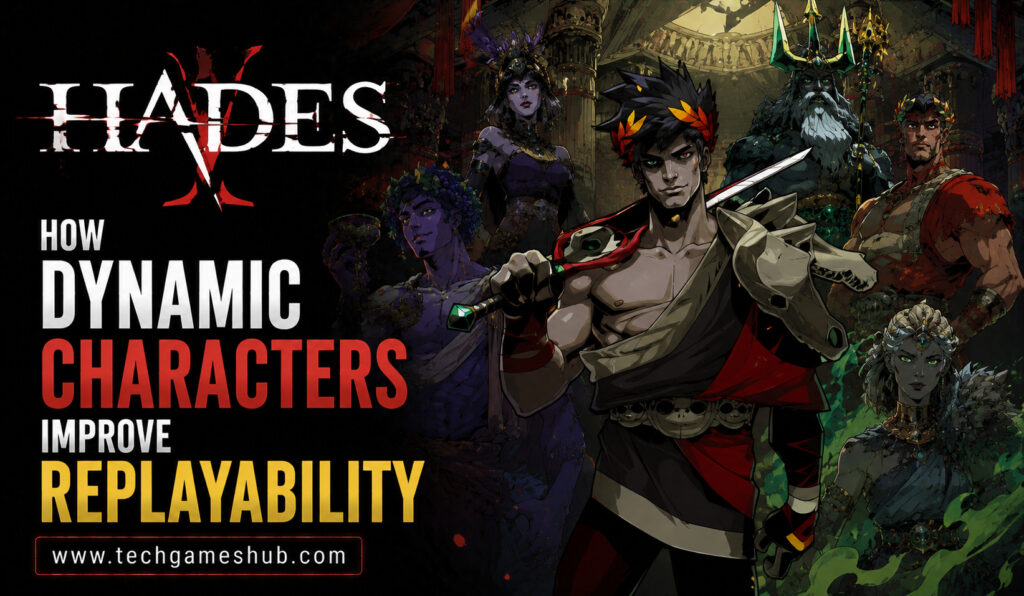
Hades is one of the strongest examples of how character design can make a game feel fresh even when players repeatedly return to the same basic gameplay loop. Developed by Supergiant Games, the action roguelike follows Zagreus as he repeatedly attempts to escape the Underworld.
On paper, repeating the same journey after every death could become predictable. However, Hades turns repetition into part of its storytelling. Characters react to Zagreus’s actions, victories, failures, relationships, and progress, creating the feeling that the world is constantly responding to the player.
This dynamic character system is one of the major reasons Hades remains engaging across dozens of runs. Combat provides the immediate challenge, but character interactions give players reasons to keep returning.
Why Repetition Works in Hades
Roguelike games are naturally built around repetition.
Players enter a run, fight through randomly arranged encounters, collect upgrades, face increasingly difficult enemies, and eventually die or reach the end. Then the process begins again.
Without additional motivation, this structure could become repetitive.
Hades solves this problem by making every return to the House of Hades potentially meaningful.
After a run, Zagreus can talk to different characters. Their dialogue can change based on what happened previously, whether Zagreus succeeded or failed, and how much progress the player has made.
The result is a gameplay loop where both combat and storytelling continue evolving.
Characters Remember Player Progress
One of the most effective features of Hades is the way characters respond to Zagreus’s ongoing journey.
A character does not always repeat the same dialogue after every run.
Instead, conversations can reflect recent events, achievements, failures, relationships, and discoveries.
This creates the impression that the characters are aware of Zagreus’s history.
Even a failed attempt can lead to new conversations.
That is important because it means failure does not necessarily feel like wasted progress. The player may return to the House of Hades without reaching the final objective but still discover new story content.
Dynamic Dialogue Keeps the World Fresh
Dialogue variation plays a major role in the game’s replayability.
Characters have extensive conversations that gradually reveal their personalities and relationships.
As the player continues playing, new dialogue can appear, preventing the social areas from feeling static.
This is particularly impressive because the player is repeating the same general cycle.
Instead of hearing the same lines after every attempt, players are encouraged to check in with characters because something new may happen.
This makes returning to the hub area feel like part of the progression system.
Zagreus Is More Than a Player Avatar
Zagreus also contributes to the game’s dynamic storytelling.
He has a distinct personality, sense of humor, motivations, and relationships with other characters.
His interactions help create a strong connection between the player and the world.
Rather than being a silent protagonist whose only purpose is to provide movement and combat, Zagreus actively participates in conversations.
This allows the game to turn player progression into character development.
The more the player explores, the more they learn about Zagreus and the people around him.
Failure Becomes Narrative Progression
One of the smartest design choices in Hades is the way it uses failure.
In many games, dying means restarting from the last checkpoint or losing some progress.
In Hades, death sends Zagreus back to the House of Hades.
That return is not simply a reset.
It is an opportunity to interact with characters, receive new dialogue, improve abilities, and uncover more of the story.
This creates a powerful loop:
Attempt → Failure or Success → Return → Conversation → Progress → New Attempt
Because the player can gain narrative information even after failing, there is always a reason to try again.
Characters Provide Motivation Beyond Combat
Combat alone can motivate players for a while, but Hades adds another layer.
Players may want to continue playing because they want to discover what a particular character will say next.
They may want to understand a relationship, unlock additional dialogue, or see how Zagreus’s story develops.
This creates multiple forms of progression.
There is mechanical progression through upgrades and abilities.
There is narrative progression through conversations.
And there is relationship progression through interactions with characters.
These systems reinforce each other.
Relationships Add Another Layer of Progress
Relationships are particularly important to the game’s long-term replayability.
Players can build connections with different characters over time.
These relationships provide additional conversations, story developments, and rewards.
The process feels gradual rather than forced.
The player continues playing normally while character relationships evolve alongside the main gameplay loop.
This makes social progression feel connected to the world rather than like a separate menu-based system.
Characters React to the Player’s Actions
The game’s characters are not completely disconnected from gameplay.
Events inside the Underworld can influence what happens when Zagreus returns.
The player may encounter a particular enemy, discover an important item, defeat a boss, or reach a new stage of the escape attempt.
These experiences can affect future conversations.
This connection between gameplay and dialogue is extremely important.
The characters feel more dynamic because their conversations are connected to what the player is actually doing.
The Gods Add Variety to Every Run
The Olympian gods also contribute to replayability.
During runs, players encounter different combinations of blessings that influence their abilities and combat style.
These gods have distinct personalities and dialogue, meaning the player’s mechanical choices are connected to character interactions.
A run can therefore feel different both mechanically and narratively.
One attempt might revolve around a particular combination of blessings, while another may introduce different gods and dialogue.
The variation keeps the experience from becoming completely predictable.
Humor Helps Repetition Feel Natural
Another reason the dynamic character system works so well is humor.
Characters frequently comment on Zagreus’s repeated attempts, failures, successes, and behavior.
This acknowledges the repetitive structure rather than pretending that it does not exist.
The game essentially makes repetition part of its personality.
Instead of asking players to ignore the fact that they are dying and restarting, Hades incorporates that fact into the world.
That makes the roguelike structure feel intentional.
Characters Make the Hub Area Important
The House of Hades acts as the emotional center of the game.
After the intensity of a run, players return to a calmer environment where they can interact with characters and process what happened.
This creates a useful contrast.
The Underworld’s combat areas are chaotic and dangerous.
The House of Hades is a place for dialogue, relationships, upgrades, and story development.
Because the characters change over time, the hub does not feel like a static menu.
It becomes part of the adventure.
Dynamic Characters Increase Emotional Investment
The longer players interact with the characters, the more meaningful their relationships become.
A character’s reaction to Zagreus can feel significant because the player has encountered that character repeatedly across many runs.
This creates emotional continuity.
Instead of experiencing the story through a single uninterrupted sequence, players gradually build relationships through repeated encounters.
That structure fits perfectly with the roguelike format.
The player is repeatedly returning to the same place, while the characters and story gradually evolve.
The Illusion of Intelligent Characters
It is important to note that Hades does not require advanced artificial intelligence for its characters to feel dynamic.
Much of the effect comes from carefully designed dialogue systems, conditions, story flags, progression triggers, and character relationships.
The game can determine which conversations are available based on what the player has done.
To the player, however, the result can feel like the characters genuinely remember and understand their journey.
This demonstrates an important principle in game design: believable responsiveness can be more important than sophisticated underlying technology.
Why Dynamic Characters Improve Replayability
Replayability is often associated with procedural levels, random enemies, or different equipment combinations.
Hades demonstrates another powerful method: changing the social experience.
The combat loop may repeat, but the player’s relationship with the characters does not remain static.
Every return can bring something new.
That means the game has two complementary sources of variation.
The procedural gameplay changes the immediate challenge, while dynamic characters change the emotional and narrative experience.
Together, they make repetition feel like progression.
A Model for Future Roguelike Games
The success of Hades provides an important lesson for developers designing replayable games.
Randomization alone is not always enough.
A game can generate different levels endlessly, but players may eventually stop caring if those changes have no emotional meaning.
By combining procedural gameplay with evolving characters, developers can give repeated actions greater purpose.
Future roguelikes could take this idea even further by using systems that dynamically adjust dialogue, relationships, and story events based on player behavior.
Conclusion
Hades shows that replayability is not only about creating different levels or enemies. It can also come from characters who evolve alongside the player.
Through changing dialogue, relationships, reactions, humor, and story progression, the game makes every return to the House of Hades feel potentially meaningful.
The player may fail to escape the Underworld, but the story does not stop.
Instead, failure creates another opportunity to learn, interact, develop relationships, and prepare for the next attempt.
That is what makes Hades such an effective roguelike. Its dynamic characters transform repetition into progression, proving that when a game remembers what the player has experienced, even the same basic gameplay loop can continue to feel fresh, personal, and rewarding.