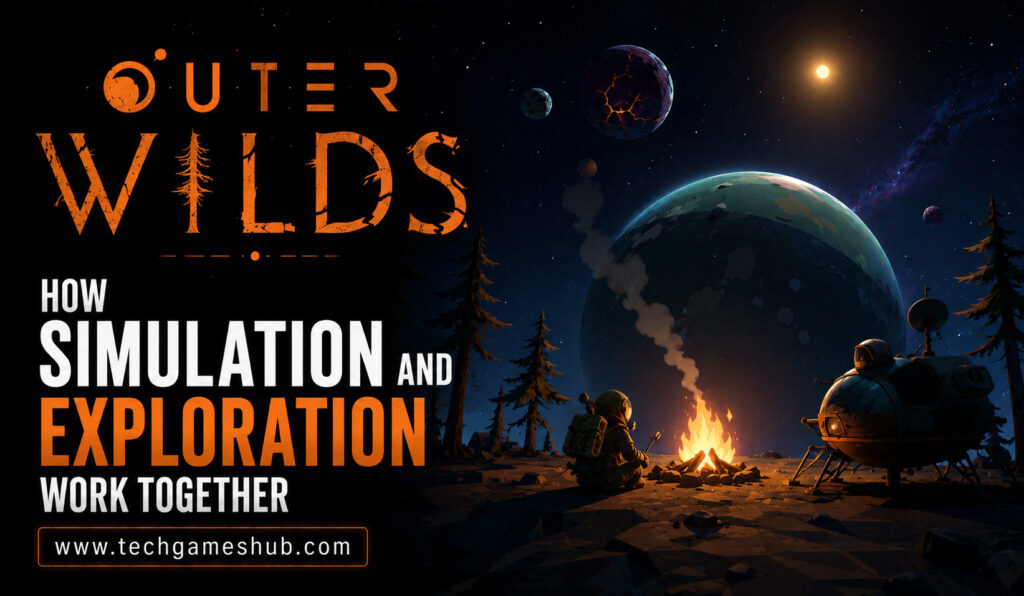
Outer Wilds is one of the most remarkable exploration games because it makes knowledge more important than traditional character progression. Instead of constantly giving players better weapons, stronger equipment, or higher statistics, the game encourages them to understand a mysterious solar system and use that knowledge to uncover its secrets.
At the heart of the experience is a carefully designed simulation. Planets move, celestial events occur, environments change, and different locations contain interconnected clues. The player is placed inside this system and allowed to explore it at their own pace.
This combination of simulation and exploration creates a game where curiosity becomes the primary form of progression. The more players understand how the universe works, the more capable they become of reaching places and solving mysteries that initially seemed impossible.
A Solar System That Feels Alive
One of the first things that makes Outer Wilds special is that its solar system does not feel like a collection of disconnected levels.
The planets and celestial bodies exist within a shared environment. They have their own locations, movements, hazards, and environmental changes.
Players can travel between these locations and observe how the system behaves.
This creates an important sense of scale. The universe is not simply waiting for the player to arrive. Events are already happening.
A player might reach a planet and discover that its environment has changed since a previous visit. Another location may become accessible or inaccessible depending on what is happening in the simulation.
The result is an exploration experience built around timing and observation.
The Time Loop Changes Exploration
The central time-loop structure gives Outer Wilds its unique rhythm.
Players have a limited period to explore before the cycle resets. At first, this may seem like a restriction, but it becomes one of the game’s most important exploration tools.
The time limit encourages experimentation.
Instead of trying to complete everything in one journey, players gradually build knowledge across multiple cycles.
A failed attempt is rarely meaningless because the player may have learned something important.
The character returns to the beginning, but the player’s knowledge remains.
This creates a fascinating distinction between character progression and player progression.
Knowledge Is the Real Upgrade
Most adventure games reward exploration with new abilities or equipment.
Outer Wilds largely rewards exploration with information.
Learning how a location works can be just as valuable as obtaining a physical item in another game.
Once players understand a planetary hazard, discover a hidden route, or learn an important piece of information, they can use that knowledge during future attempts.
This makes the player more powerful without changing the protagonist’s basic abilities.
The progression is intellectual rather than numerical.
Simulation Creates Natural Puzzles
The game’s simulation also helps turn environmental behavior into puzzles.
Instead of placing a conventional locked door in front of the player and requiring a key, Outer Wilds often encourages players to understand how an environment operates.
A particular location may only become accessible under certain circumstances. An environmental event may reveal a path temporarily. A planetary process may change the landscape over time.
The solution is therefore not always “find the key.”
Sometimes the solution is “understand what is happening.”
This is one of the most effective ways the game connects simulation with exploration.
Planets Have Their Own Identities
Each major location in Outer Wilds has distinct environmental characteristics.
Players are encouraged to learn these differences because they influence exploration.
One planet may contain dangerous terrain, while another may have constantly changing conditions. Elsewhere, environmental structures can reveal information about the history of the solar system.
These differences make every destination feel worth investigating.
More importantly, the player gradually develops a mental map of how the universe works.
Environmental Storytelling Drives Discovery
The game’s story is closely connected to exploration.
Players discover information through locations, ruins, writings, structures, and environmental clues. Instead of receiving the entire story through long cinematic sequences, they reconstruct it from fragments.
This structure makes knowledge feel earned.
When players connect two previously unrelated discoveries, they experience a sense of genuine understanding.
The simulation strengthens this storytelling approach because the locations themselves often provide clues about what happened in the past and why the current environment behaves the way it does.
Exploration Requires Observation
Outer Wilds rewards players who pay attention.
A small environmental detail can become important later. A strange structure may provide information about another location. An event that initially looks like background scenery may eventually reveal a crucial part of the game’s larger mystery.
This encourages a different style of exploration.
Players are not simply searching for treasure.
They are studying the world.
That makes the experience closer to scientific investigation than traditional adventure gameplay.
Simulation and Player Freedom
Another important feature is the freedom players have to decide where to explore.
The game does not always force players through a strict sequence.
A player may become interested in one planet and spend several cycles investigating it. Another player may follow a completely different chain of clues.
Because information is interconnected, different routes can still eventually contribute to the same larger understanding.
This gives exploration a natural feeling.
The game provides a universe filled with mysteries, but players decide which mystery to investigate first.
Physics Adds to the Exploration Experience
The game’s movement and physics systems also contribute to the sense of exploration.
Space travel is not treated as simply selecting a destination from a menu. Players have to navigate through space and account for movement and positioning.
This gives travel a physical quality.
The player begins to understand that movement has consequences and that the solar system is a collection of objects moving through space rather than a series of static maps.
These mechanics reinforce the game’s simulation-focused design.
Failure Becomes a Learning Tool
Because the time loop resets the world, failure becomes less punishing than it might initially appear.
A player may make a mistake while exploring, run out of time, or die in a dangerous environment.
But the knowledge gained from that attempt remains useful.
This encourages experimentation.
Players can try something risky because even failure may reveal valuable information.
The game therefore turns failure into part of the exploration process rather than treating it purely as punishment.
The Universe Creates Emergent Moments
Simulation can also create memorable moments that feel personal because they happen during the player’s own journey.
A player may arrive somewhere at a particular moment and witness an environmental event.
Another player may discover the same event under different circumstances.
These moments can feel less like scripted scenes and more like observations made inside a functioning universe.
That distinction is important.
The game is not simply telling players what happens. It is giving them a system to observe.
Why Simulation Makes Exploration More Meaningful
Without the simulation, exploration would be much less powerful.
If planets were static environments, there would be fewer reasons to revisit locations. If important discoveries were always available immediately, players would not need to understand timing or environmental behavior.
The simulation creates relationships between places, events, and information.
A discovery in one location can change how players interpret another.
This makes exploration cumulative.
Every new piece of knowledge changes the way the player sees the universe.
A Different Philosophy of Game Progression
Outer Wilds demonstrates that progression does not always need to be measured through statistics.
Players become better because they understand more.
A location that was confusing earlier can become obvious later. A seemingly impossible puzzle can become straightforward once the player discovers the right information.
This is a powerful design philosophy because it respects the player’s ability to learn.
The game does not necessarily need to make the character stronger.
It makes the player smarter.
Conclusion
Outer Wilds shows how simulation and exploration can work together to create an experience unlike conventional adventure games. Its solar system operates as an interconnected environment where time, movement, planetary conditions, and environmental events influence what players can discover.
The time loop reinforces this design by allowing players to experiment repeatedly while keeping the knowledge they gain.
Instead of collecting increasingly powerful equipment, players collect understanding.
That makes every discovery meaningful. A new piece of information can change how players approach an entire planet or reinterpret something they encountered hours earlier.
Ultimately, Outer Wilds demonstrates that one of the most powerful progression systems in gaming can be knowledge itself. By combining a dynamic simulation with open-ended exploration and environmental storytelling, the game turns curiosity into gameplay and transforms the act of learning about a virtual universe into the adventure itself.