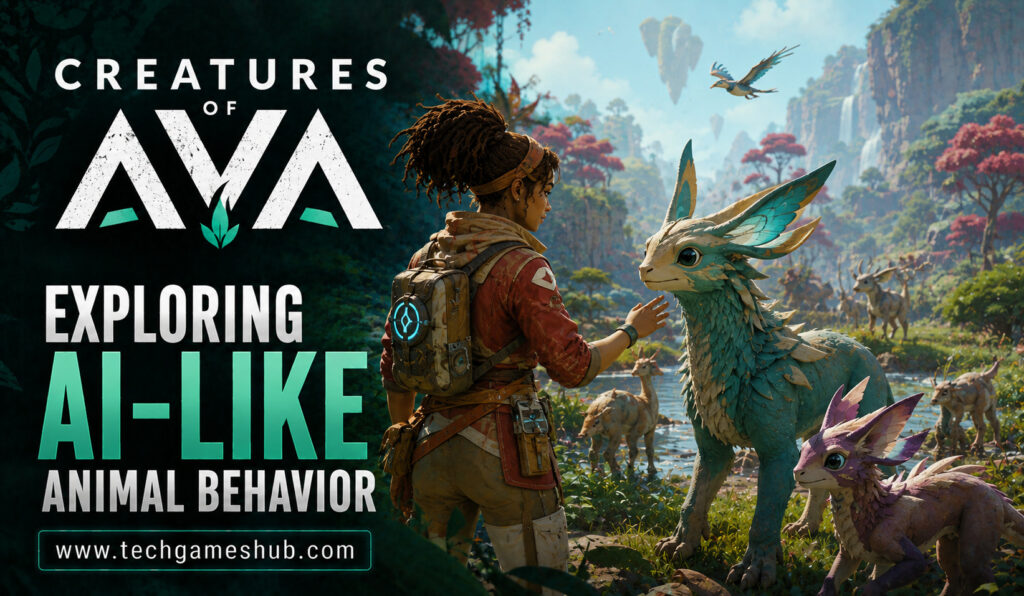
Creatures of Ava is an adventure game that puts animals at the center of its gameplay. Rather than presenting creatures as simple collectibles or enemies, the game focuses on observing, interacting with, rescuing, and understanding them. This approach creates an experience where animal behavior becomes an important part of exploration.
Set on the mysterious planet Ava, the game follows Vic, a young explorer who encounters a wide variety of creatures while investigating a dangerous infection spreading across the planet. Players travel through different environments, discover new species, and learn how the creatures behave.
While the animals are fictional, their behavior can feel surprisingly dynamic. Their reactions to the environment and the player create the impression of an AI-driven ecosystem, showing how modern games can use behavioral systems to make virtual wildlife feel more believable.
Animals Are Central to the Gameplay
In many adventure games, wildlife exists primarily to make environments look alive. Animals may wander around, run away, or provide resources, but they are usually secondary to the main gameplay.
Creatures of Ava takes a different approach.
The creatures are closely connected to exploration and progression. Players need to understand different species and interact with them as they move through Ava’s environments.
This makes observing animals more meaningful.
Instead of immediately treating a creature as something to defeat, the game encourages players to understand it. That creates a relationship between exploration and animal behavior.
AI-Like Behavior Makes Creatures Feel Alive
The most interesting aspect of the game’s wildlife is the way creatures can respond to their surroundings.
Animals can display different reactions depending on what is happening around them. Their movement, behavior, and interactions contribute to the impression that they are responding to the world rather than simply following a fixed animation.
This type of AI-like behavior does not necessarily mean that every creature is using extremely complicated artificial intelligence. Often, believable behavior comes from combining relatively simple systems.
Movement patterns, environmental reactions, proximity detection, animations, and scripted behaviors can work together to create convincing virtual animals.
For players, the result matters more than the underlying technology: the creatures appear to have lives of their own.
A World Designed Around Wildlife
A major strength of Creatures of Ava is that the environment is closely connected to its animals.
Ava contains different regions with distinctive landscapes and ecosystems. As players explore these areas, they encounter different species adapted to their surroundings.
This relationship between environment and creatures helps make exploration feel meaningful.
Instead of simply moving through visually different levels, players are encouraged to notice how wildlife behaves in each location.
The environment becomes more than scenery. It becomes part of the animals’ behavior.
Understanding Creatures Instead of Fighting Them
One of the game’s most distinctive ideas is its focus on helping creatures rather than simply eliminating them.
Players can encounter animals affected by the mysterious infection and use tools to assist them.
This changes the traditional relationship between player and wildlife.
In an action game, discovering a dangerous creature may immediately lead to combat. In Creatures of Ava, players are often encouraged to investigate the situation and determine how they can help.
That creates a calmer style of interaction while still giving animal behavior an important gameplay role.
Animal Reactions Support Exploration
Exploration becomes more engaging when players have reasons to pay attention to wildlife.
A creature’s movement can provide clues about its environment. Its reaction to the player may suggest whether the animal is comfortable or threatened.
These small interactions contribute to the feeling that Ava is an ecosystem rather than a collection of disconnected levels.
The player becomes an observer as well as an explorer.
This approach is particularly effective because the creatures are not simply decorative. Their behavior contributes to the overall atmosphere of the game.
AI and Creature Personalities
Another important part of believable animal behavior is personality.
Different species can have distinct appearances, movements, sounds, and behaviors. These differences make individual creatures easier to recognize and give the world more variety.
A large creature may behave differently from a small, agile species. Some animals may be curious or approachable, while others may be more cautious.
Even relatively simple differences can make virtual wildlife feel less repetitive.
When players begin to recognize these behavioral patterns, they can make decisions based on experience.
That is one of the basic principles behind convincing game AI: behavior should communicate information.
The Infection Changes the Relationship With Wildlife
The infection affecting Ava’s creatures adds another layer to the animal-focused gameplay.
Instead of viewing every unusual behavior as a natural part of the ecosystem, players also have to consider whether the infection is affecting the creature.
This creates a narrative connection between exploration and wildlife.
The player is not simply cataloging alien animals. They are witnessing a world under environmental pressure.
The condition of the creatures therefore becomes part of the story.
Creature Rescue Creates Emotional Investment
The focus on rescuing animals also changes how players perceive them.
When creatures are treated as important characters rather than disposable gameplay objects, players have more reason to care about what happens to them.
Helping a creature can feel different from completing a standard objective because the player has observed the animal and interacted with it.
This emotional connection is supported by the game’s use of creature behavior.
An animal that reacts naturally to the player can feel more memorable than an object that simply exists in the environment.
How Game AI Creates Believable Wildlife
Creating believable animals in a video game involves more than giving them random movement.
Developers need to consider how creatures move, react, communicate, navigate spaces, and respond to the player.
A useful behavioral system can combine several layers.
First, the creature needs basic movement and navigation. Then it can have reactions to nearby objects, characters, or environmental conditions. Animations and sound can reinforce those reactions.
Finally, designers can add species-specific behaviors that distinguish one creature from another.
When these systems work together, players may interpret the result as intelligence even when the underlying AI is relatively straightforward.
AI-Like Behavior Improves Immersion
Immersion is not created only by high-resolution graphics.
A beautifully designed environment can still feel lifeless if every creature behaves like a moving decoration.
Interactive wildlife can solve that problem.
When animals move naturally, respond to the player, and behave differently across situations, the environment becomes more convincing.
This is especially important for a game like Creatures of Ava, where wildlife is central to the experience.
The more believable the creatures feel, the more convincing the planet becomes.
Exploration Becomes More Personal
Because the player interacts with wildlife throughout the journey, exploration can become a personal experience.
Two players may notice different creatures, remember different encounters, or develop preferences for particular species.
Even when the main storyline remains the same, these smaller interactions can make individual playthroughs feel different.
This is another advantage of using behavioral systems.
Not every memorable moment needs to be a major scripted event. Sometimes a simple interaction with an animal can become the moment that a player remembers.
The Future of AI-Driven Wildlife in Games
Games are increasingly exploring ways to make virtual environments more dynamic.
Future wildlife systems could potentially allow animals to respond to changing weather, food availability, predators, player activity, and other creatures in increasingly sophisticated ways.
Rather than simply spawning animals when the player enters an area, developers can build ecosystems where creatures have more persistent behaviors and relationships.
Creatures of Ava provides an interesting example of this direction because it makes interaction with fictional wildlife a core part of its identity.
The game demonstrates that AI-like behavior can support not only combat but also empathy, exploration, discovery, and storytelling.
Conclusion
Creatures of Ava shows how animal behavior can become an important part of game design. Its fictional creatures help make the planet feel alive while giving players meaningful reasons to observe, interact with, and protect wildlife.
The game’s approach demonstrates that artificial intelligence does not always have to be about making enemies more difficult. Behavioral systems can also create curiosity and emotional connection.
By combining creature movement, reactions, personalities, environmental interaction, and rescue-focused gameplay, Creatures of Ava creates a world where wildlife feels like more than background decoration.
The result is an adventure built around discovery and empathy, showing how AI-like animal behavior can make virtual ecosystems more immersive and memorable.