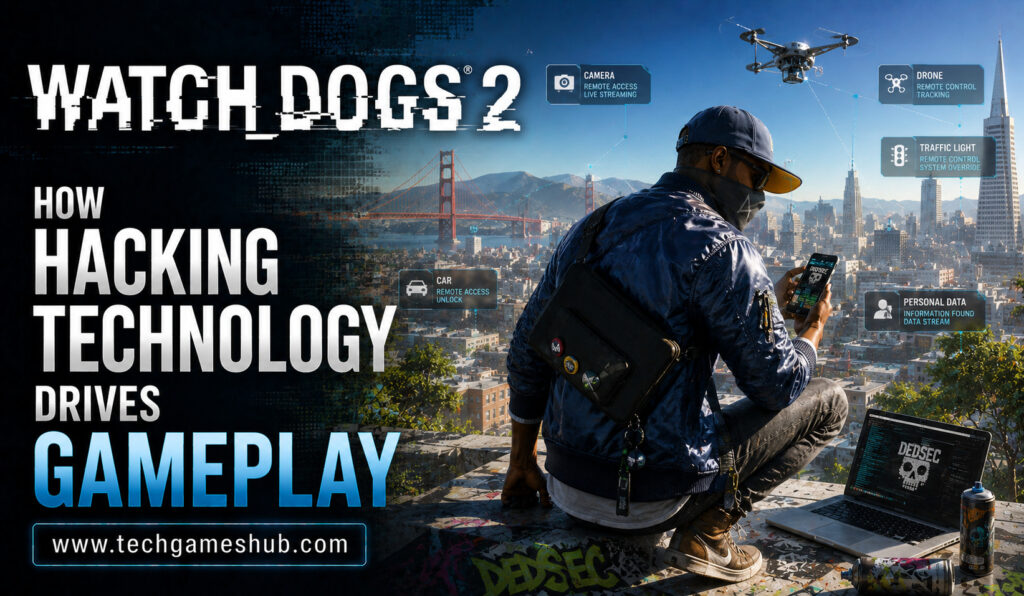
Technology has become one of the defining elements of modern open-world games, but few titles make it as central to gameplay as Watch Dogs 2. Developed by Ubisoft, the game places hacking at the heart of exploration, missions, combat, transportation, and problem-solving. Instead of treating technology as a background feature, Watch Dogs 2 turns connected devices and digital infrastructure into tools that players can manipulate.
Set in a fictionalized version of the San Francisco Bay Area, the game follows Marcus Holloway and the hacking group DedSec as they challenge corporations, surveillance systems, and powerful technological networks. Its world is filled with smartphones, vehicles, security cameras, drones, computers, automated systems, and connected infrastructure.
This technology-driven design gives players unusual freedom. A mission can often be approached through stealth, remote hacking, environmental manipulation, or direct confrontation. The result is an open-world experience where information and technology can be just as valuable as weapons.
Hacking Becomes a Core Gameplay Mechanic
The most important feature of Watch Dogs 2 is its hacking system.
Marcus can interact with many connected devices throughout the city. Players can manipulate objects remotely, access information, distract enemies, control certain environmental elements, and create opportunities without physically approaching their targets.
This changes the traditional open-world gameplay formula.
In a conventional action game, players may need to walk toward an objective and fight their way through obstacles. In Watch Dogs 2, technology often provides alternative solutions.
A security system can become a weakness. A vehicle can become a distraction. A camera can provide information from a safe distance.
Hacking therefore becomes a form of problem-solving rather than simply an additional ability.
The City Becomes a Digital Playground
San Francisco is designed around the idea of a highly connected modern city.
Buildings, vehicles, pedestrians, businesses, security systems, and digital services all contribute to the game’s technological environment.
This creates a world where Marcus can interact with more than just characters and physical objects.
The city itself becomes a network.
Players can move through streets while observing cameras, connected devices, vehicles, and other systems that can potentially be manipulated.
This approach gives exploration a different purpose.
Walking through the city is not only about finding collectibles or reaching missions. Players can also look for technological opportunities.
Remote Hacking Creates Distance-Based Gameplay
One of the biggest advantages of Marcus’s hacking abilities is the ability to interact with systems from a distance.
Players can use cameras to observe locations before entering them. They can investigate security arrangements remotely and identify potential threats.
This encourages preparation.
Instead of entering an area without information, players can first examine the environment and determine how the different systems are connected.
This creates a gameplay loop based on observation and planning.
The player gathers information, identifies weaknesses, chooses an approach, and then executes the plan.
Hacking Changes Stealth
Watch Dogs 2 uses technology to expand traditional stealth mechanics.
Marcus does not always need to sneak directly behind an enemy. He can manipulate the environment to create distractions or create paths that reduce the need for direct confrontation.
Security cameras can provide useful information, while remotely controlled devices can help Marcus interact with areas he cannot safely reach.
This makes stealth less dependent on physical movement alone.
The player is effectively controlling the environment from a distance.
Drones Expand Exploration
Drones are particularly important to the game’s technology-focused design.
Marcus can use drones to explore areas, observe targets, and interact with certain systems.
This creates a second perspective on the world.
Instead of being limited to what Marcus can physically see, players can send a drone into locations that may be difficult or dangerous to enter.
The drone becomes a scouting tool, allowing players to understand the environment before committing to a particular strategy.
The Jumper Encourages Creative Problem-Solving
Another useful technological tool is the RC Jumper.
This small remote-controlled device can move through restricted areas and interact with objects.
Its compact size makes it useful for situations where Marcus cannot safely enter.
The Jumper reinforces one of Watch Dogs 2’s central ideas: technology can allow players to solve physical problems without directly confronting them.
A locked or heavily guarded location may become accessible through remote control.
Vehicles Become Part of the Hacking System
Watch Dogs 2 also connects hacking with transportation.
Vehicles can be manipulated in various situations, creating opportunities for distractions, escapes, or environmental interactions.
This is particularly effective in an open-world setting because traffic is constantly moving through the city.
A passing vehicle can suddenly become part of a player’s plan.
This creates emergent moments that would be difficult to produce in a more traditional level-based game.
Environmental Hacking Adds Tactical Options
The city contains numerous environmental elements that can be manipulated.
Players can use technological systems to create distractions, influence movement, or change the conditions around a mission.
This turns the environment into a tactical resource.
Instead of seeing a location as a fixed collection of buildings and objects, players can begin asking what can be controlled.
That mindset is one of the most important aspects of the game’s design.
Hacking Can Replace Direct Combat
Watch Dogs 2 gives players the ability to avoid direct combat in many situations.
This is important because Marcus is not designed as a conventional military character.
He is a hacker.
His technological abilities provide alternatives to traditional firefights.
Players can use stealth, remote devices, distractions, and environmental systems to accomplish objectives while minimizing confrontation.
This makes the hacking mechanics closely connected to the character’s identity.
The Skill System Expands Technological Abilities
As players progress, Marcus gains access to additional hacking-related skills.
These abilities expand the range of actions available during missions and exploration.
The progression system therefore encourages experimentation.
Players can develop tools that support different playstyles, such as stealth-focused approaches or more aggressive technological tactics.
This means progression is not simply about becoming stronger.
It is about gaining new ways to interact with the world.
Technology Makes Missions Less Linear
One of the strongest effects of the hacking system is its influence on mission design.
Objectives can often be approached through multiple routes.
Players might infiltrate a building physically, use remote devices, manipulate security systems, or combine several approaches.
This creates a sense of freedom.
The game does not always require players to follow one specific solution.
Instead, it provides a technological sandbox and asks players to determine how they want to use it.
AI and NPC Behavior Support the Hacking System
The game’s NPCs also contribute to its dynamic gameplay.
Guards can respond to suspicious activity, investigate disturbances, and react when something goes wrong.
This means hacking actions can have consequences.
A player might successfully manipulate a system but still need to deal with the resulting attention.
The interaction between hacking and NPC behavior makes missions feel less predictable.
Technology creates an opportunity, while AI determines how the surrounding world responds.
Hacking and Information Control
Watch Dogs 2 also explores the importance of digital information.
The story focuses heavily on surveillance, data collection, privacy, corporate influence, and the power of connected technology.
These themes are reflected in gameplay.
Marcus’s ability to access information gives him power over systems that ordinary citizens cannot control.
The game therefore connects its mechanics with its narrative.
Hacking is not just a gameplay gimmick. It represents the larger conflict between individuals and powerful technological networks.
Smart Cities and Their Vulnerabilities
One of Watch Dogs 2’s most interesting ideas is the concept of a connected city.
Smart-city technologies can improve transportation, communication, security, and public services.
However, connecting more systems also creates more potential vulnerabilities.
The game exaggerates these possibilities for entertainment, but the underlying concept remains relevant.
As real cities increasingly adopt connected infrastructure, questions about cybersecurity, privacy, and centralized control are becoming more important.
Watch Dogs 2 turns those concerns into an interactive science-fiction-inspired playground.
Emergent Gameplay Makes Hacking Memorable
Because hacking interacts with the open world, unexpected situations can occur.
A player may manipulate a vehicle at exactly the right moment, create an accidental distraction, trigger an environmental reaction, or discover an unusual solution to a mission.
These moments feel different from heavily scripted sequences.
They emerge from the interaction between systems.
This is one of the biggest strengths of Watch Dogs 2.
Technology Encourages Experimentation
The game’s hacking tools are most enjoyable when players experiment with them.
Rather than asking, “What is the intended solution?” players can ask, “What can I control here?”
That small change in thinking opens up many possibilities.
A camera can reveal information. A drone can reach a difficult location. A vehicle can become a distraction. A security system can be manipulated.
The game rewards curiosity because technological systems often provide unexpected solutions.
The Future of Hacking-Based Gameplay
Watch Dogs 2 demonstrates the potential of technology-driven open-world design.
Future games could expand this concept with more sophisticated AI, interconnected environments, dynamic cybersecurity systems, smarter NPC reactions, and larger networks of simulated devices.
Hacking could become even more integrated into missions, allowing players to manipulate entire ecosystems of digital and physical systems.
The challenge for developers will be making these systems accessible while preserving the sense of experimentation that makes them enjoyable.
Conclusion
Watch Dogs 2 demonstrates how hacking technology can completely reshape open-world gameplay. By giving players control over cameras, drones, vehicles, security systems, and other connected devices, the game turns technology into a powerful gameplay language.
Its greatest strength is the freedom this creates. Players can gather information, manipulate environments, avoid combat, create distractions, and solve missions in ways that match their preferred playstyle.
At the same time, the game’s focus on surveillance and connected infrastructure gives its mechanics a strong narrative purpose. The technology players use is directly connected to the game’s themes of privacy, data, corporate power, and smart-city systems.
Ultimately, Watch Dogs 2 shows that hacking can be much more than a mini-game or futuristic gimmick. When digital technology is deeply integrated into exploration, stealth, combat, and storytelling, it can transform an open-world game into a genuine technological sandbox.