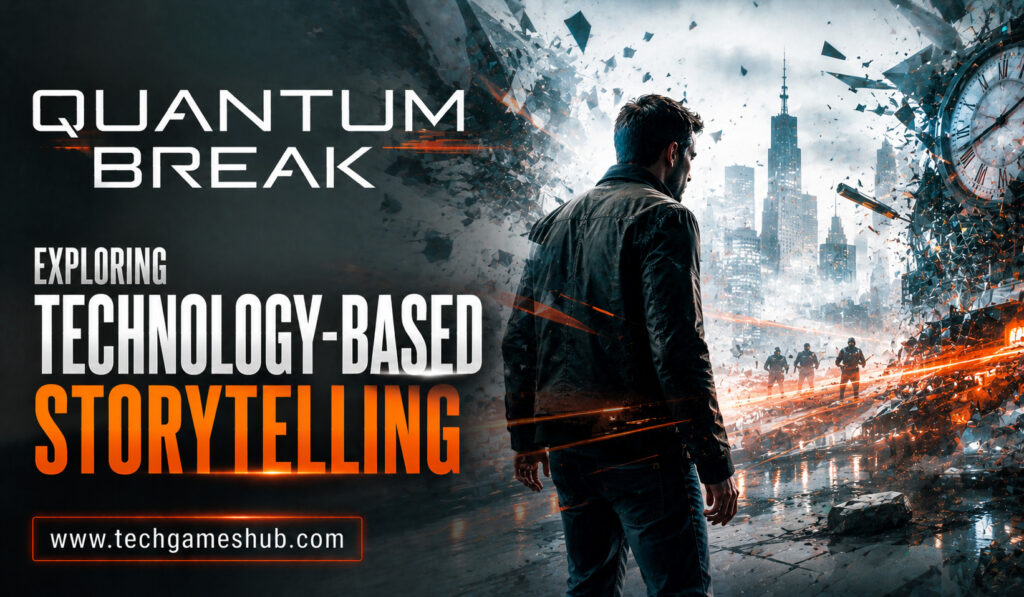
Video games have always experimented with ways to combine storytelling and interactive gameplay, but Quantum Break takes a particularly ambitious approach by connecting time manipulation, advanced technology, cinematic presentation, and player choice. Developed by Remedy Entertainment, the game blends third-person action with a science-fiction narrative centered on a failed experiment that destabilizes time itself.
Technology is not simply a visual feature in Quantum Break. It drives the central conflict, shapes the gameplay mechanics, influences the story, and provides the foundation for the game’s unusual television-style presentation. By combining interactive gameplay with live-action episodes and branching decisions, Quantum Break demonstrates how technology can become part of the storytelling structure itself.
A Story Built Around Time Technology
The central concept of Quantum Break begins with an experiment involving time travel and manipulation. A scientific breakthrough creates a catastrophic event that causes time to behave unpredictably.
The protagonist, Jack Joyce, gains the ability to interact with these temporal effects.
This creates a story where technology and science are directly connected to the world’s crisis.
Instead of using time travel simply as a science-fiction background, the game makes it part of the central gameplay and narrative systems. The consequences of the experiment affect characters, environments, and the future of the fictional world.
Technology therefore becomes the reason the story exists.
Time Powers Become Gameplay Mechanics
Jack’s abilities are one of the clearest examples of technology-inspired storytelling in Quantum Break.
He can manipulate aspects of time during combat, creating abilities that allow him to move quickly, evade attacks, disrupt enemies, and interact with unstable environments.
These powers are not simply special effects.
They influence how players approach combat encounters.
Players can combine different time-based abilities to create tactical advantages. Instead of relying only on conventional weapons, they can manipulate the battlefield itself.
This makes the game’s central science-fiction idea directly playable.
Technology Changes the Way Combat Works
Quantum Break’s combat system demonstrates how a technological concept can reshape familiar gameplay.
Third-person shooting is combined with time manipulation, allowing players to temporarily alter the conditions of an encounter.
Enemies may become easier to avoid or attack when time-based abilities are used effectively.
This creates a combat style where timing is just as important as accuracy.
Players need to understand not only where enemies are positioned but also when to use their abilities.
The result is a gameplay system that reflects the game’s larger focus on unstable time.
The World Reacts to Temporal Disruption
One of Quantum Break’s most interesting technological ideas is that time itself can become unstable.
Certain areas experience moments where time appears to freeze, distort, or behave abnormally.
These sequences allow the game to create unusual environmental situations.
Objects may remain suspended, movement can become unpredictable, and familiar spaces can appear dramatically different.
These effects are important because they make the consequences of the game’s technology visible.
Players do not simply hear that time has been damaged. They experience the effects while moving through the world.
Live-Action Episodes Expand the Story
Quantum Break is particularly notable for incorporating live-action television-style episodes into the game.
After certain gameplay sections, players watch cinematic episodes that continue the narrative.
This structure creates a hybrid form of entertainment.
The game combines interactive sequences with professionally produced live-action storytelling, allowing the narrative to shift between two different formats.
The technology behind the game’s presentation supports this unusual structure.
Instead of keeping all storytelling inside traditional cutscenes, Quantum Break uses live-action footage to expand the world and explore characters from different perspectives.
Player Choices Influence the Narrative
Another important element of Quantum Break’s storytelling is player choice.
At certain points, players make decisions that influence how the story develops.
These choices are connected to the game’s larger conflict and can affect subsequent events.
This creates a sense of participation.
Players are not simply watching a science-fiction story unfold. They are making decisions that influence its direction.
The technology-based premise makes these choices especially interesting because the narrative itself is concerned with cause, effect, and different possible outcomes.
The Junction System
The game’s major decisions are connected to a system known as Junctions.
These moments allow players to make choices from the perspective of another important character, Paul Serene.
The resulting decisions influence the direction of the story and can change certain elements of later episodes.
This structure gives Quantum Break a branching quality without completely abandoning its central narrative.
It also reinforces the idea that different choices can lead to different consequences.
Technology and Narrative Perspective
Quantum Break uses technology to explore more than time travel.
It also examines how people respond when scientific discoveries become dangerous.
Characters have different attitudes toward technology, power, and control.
Some see technological breakthroughs as opportunities, while others view them as threats that must be managed.
These conflicting perspectives create much of the game’s dramatic tension.
The story therefore explores the human consequences of technological advancement rather than focusing only on the science itself.
Monarch Solutions and Corporate Technology
Monarch Solutions is another important part of the game’s technological world.
The organization possesses advanced technology and resources that influence the conflict surrounding the time experiment.
Its presence introduces questions about corporate power and technological control.
When advanced scientific discoveries become concentrated within powerful organizations, the consequences can extend beyond the laboratory.
Quantum Break uses this fictional setting to explore what might happen when technology capable of changing reality becomes connected to institutional power.
Technology Creates Visual Storytelling Opportunities
The game’s time-based technology also influences its visual design.
Temporal distortions allow developers to create unusual environments that would be difficult to represent in a conventional action game.
Buildings, objects, and landscapes can become frozen or disrupted by temporal effects.
These visual moments reinforce the narrative while also creating memorable gameplay sequences.
Technology therefore contributes to the game’s visual identity.
The world looks different because the underlying rules of reality have changed.
The Relationship Between Science and Uncertainty
Quantum Break does not treat scientific technology as completely predictable.
The time experiment produces consequences that its creators cannot fully control.
This uncertainty is central to the story.
The characters are forced to deal with a technology that has become more powerful and dangerous than expected.
The game uses this situation to explore a familiar science-fiction idea: scientific progress can produce enormous benefits, but experimentation also carries risks.
Technology Makes the Story Interactive
One of the strongest features of Quantum Break is how closely its technology-focused narrative is connected to gameplay.
The story is about time manipulation, and players manipulate time during combat.
The story is about changing outcomes, and players make choices that affect the narrative.
The story is about unstable reality, and players move through environments affected by temporal disruption.
This connection makes the game’s technology feel meaningful.
The player is not simply watching the concept. They are actively using it.
The Role of Cinematic Presentation
Quantum Break’s cinematic presentation also demonstrates how technology can blur the boundary between games and television.
The live-action episodes provide a traditional visual storytelling format, while gameplay gives players control over the main character.
This combination allows the developers to explore different storytelling rhythms.
Gameplay can focus on action and interaction, while live-action sequences can spend more time developing characters and relationships.
The two formats work together to create a larger narrative experience.
How Quantum Break Influences Future Game Design
Quantum Break provides an interesting example of how technology can support experimental storytelling.
Future games could combine interactive gameplay with live-action footage, branching narratives, procedural storytelling, virtual production, or AI-generated characters.
Advanced technology could allow games to adapt stories more dynamically to player decisions.
Characters could potentially respond to player behavior in more sophisticated ways, while narrative systems could create different versions of events based on individual choices.
Quantum Break’s approach demonstrates that games do not have to follow a single storytelling format.
Conclusion
Quantum Break demonstrates how technology can become the foundation of interactive storytelling. Its time-manipulation mechanics influence combat, exploration, visual design, and narrative structure, while live-action episodes and player choices create a hybrid experience between video games and television.
The game’s greatest strength is the connection between its story and gameplay. Players do not simply hear about unstable time they experience it. They do not merely watch characters make important decisions they participate in choices that influence the narrative.
By combining science fiction, advanced technology, cinematic presentation, and interactive decision-making, Quantum Break shows how games can use technology to tell stories in ways that traditional media cannot.
Ultimately, the game presents technology not just as a subject of science fiction, but as a storytelling tool capable of changing how players experience cause, consequence, and narrative itself.