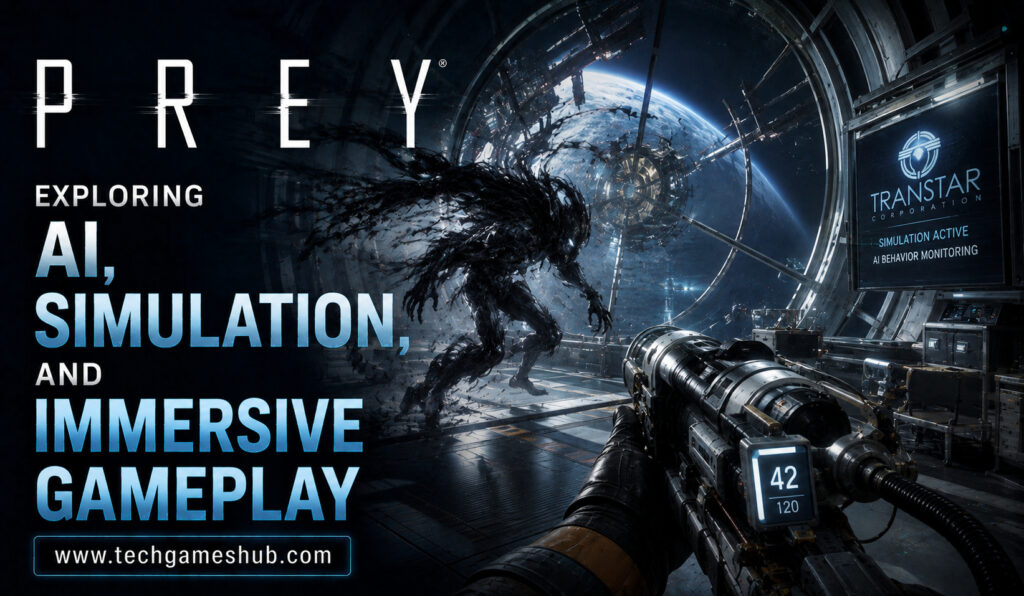
Immersive games are at their best when they give players more than a fixed path through a story. They create systems that interact with one another and allow players to solve problems in unexpected ways. Prey, developed by Arkane Studios, is an excellent example of this approach. Set aboard the Talos I space station, the game combines science fiction, artificial intelligence, simulation, environmental interaction, and psychological horror to create an experience where technology is closely connected to gameplay.
From the station’s advanced systems to the mysterious Mimic creatures, Prey constantly asks players to question what is real, what is artificial, and how technology can change the boundaries of human capability.
Talos I Is More Than a Space Station
The setting of Prey is one of its greatest strengths. Talos I is a massive research facility filled with laboratories, offices, maintenance areas, living quarters, security systems, and technological infrastructure.
Instead of functioning as a collection of disconnected levels, the station feels like one interconnected environment.
Players can revisit locations, discover alternative routes, unlock previously inaccessible areas, and use the station’s systems in different ways.
Technology is responsible for much of this design.
Doors, terminals, security systems, elevators, turrets, fabrication equipment, and other devices become interactive parts of the environment.
This makes Talos I feel like a functioning technological facility rather than a traditional video game level.
AI Creates an Uncertain Environment
Artificial intelligence is an important part of Prey’s story and atmosphere.
The player interacts with advanced AI systems, automated security equipment, and computer-controlled technologies throughout the station.
However, the game does not present AI as a simple helper.
Technology can become unreliable, compromised, or difficult to understand, particularly as the player uncovers more information about the crisis aboard Talos I.
This uncertainty strengthens the game’s atmosphere.
Players cannot always assume that every technological system is safe or operating exactly as intended.
The Role of January
January is one of the most recognizable AI characters in Prey.
The AI provides Morgan Yu with information, guidance, and assistance during the journey through Talos I.
However, January’s role is more complicated than that of a traditional digital assistant.
Its presence raises questions about programming, memory, identity, and trust.
Players must decide how much they can rely on the information they receive while attempting to understand what happened aboard the station.
This makes AI part of the game’s narrative mystery rather than merely a convenient gameplay feature.
The Typhon Challenge Human Perception
The Typhon are central to Prey’s gameplay and technological themes.
These alien organisms have unusual abilities, but the Mimics are particularly important because they can disguise themselves as ordinary objects.
A chair, cup, box, or other piece of furniture may suddenly become a hostile creature.
This mechanic changes how players perceive the environment.
Instead of automatically trusting what they see, players begin to question ordinary objects.
The result is a powerful form of psychological tension.
Technology may help players identify threats, but observation and intuition remain important.
Simulation and Environmental Interaction
Prey’s gameplay is built around simulation-like systems.
Objects in the environment can often be manipulated, moved, destroyed, or repurposed.
Players can use tools and abilities to interact with the environment in creative ways.
For example, an obstacle blocking a path does not necessarily have to be overcome through a single intended solution. Players may find alternative routes or use technological abilities to change the situation.
This creates a feeling of freedom.
The game encourages players to think about what the environment allows rather than simply looking for a highlighted objective marker.
The GLOO Cannon and Creative Problem Solving
The GLOO Cannon is one of Prey’s most recognizable tools.
It can temporarily immobilize enemies and create unusual possibilities during exploration.
Players can use GLOO to block hazards, create temporary paths, or reach locations that might otherwise be difficult to access.
This demonstrates how a single piece of technology can support both combat and exploration.
The GLOO Cannon is therefore more than a weapon. It becomes a tool for solving environmental problems.
Neuromods Change Human Capabilities
Neuromods are another major technological system in Prey.
They allow Morgan to develop new abilities and specialize in different areas.
Players can improve combat capabilities, engineering skills, scientific knowledge, hacking, physical strength, and other attributes.
This progression system creates meaningful choices.
A player focused on engineering may approach obstacles differently from someone who invests heavily in combat abilities.
Technology therefore influences not only the world but also the player’s identity within it.
The Question of Human Enhancement
Neuromods also raise philosophical questions.
If technology can change the capabilities of the human brain, where should the boundary between natural ability and artificial enhancement exist?
Prey uses this concept to explore identity and memory.
The technology does not simply make Morgan stronger. It becomes part of the game’s larger questions about what it means to remain human when technology can alter perception and capability.
This makes progression feel connected to the story rather than being purely mechanical.
Fabrication Makes Resources More Valuable
Prey’s fabrication systems allow players to transform collected materials into useful equipment.
This adds an economic and technological layer to exploration.
Objects found throughout Talos I can have practical value because they may provide materials needed for crafting.
Players therefore begin to look at the environment differently.
An ordinary object is no longer simply scenery. It may represent future resources.
This approach makes exploration more rewarding because almost everything can potentially contribute to survival.
Turrets and Security Systems
Automated turrets provide another example of technology influencing gameplay.
Players can use security systems to defend themselves against threats, but the presence of hostile creatures and unpredictable situations means that automated defenses cannot always be treated as completely reliable.
This uncertainty adds tension.
Technology can provide protection, but players still need to assess the situation and understand the risks.
The game repeatedly reinforces the idea that advanced systems are useful but never entirely beyond question.
Simulation Encourages Player Creativity
One of Prey’s biggest strengths is the number of ways players can approach problems.
The game does not always provide one obvious solution.
A locked door might be opened through hacking, an alternative route, a keycard, or a different ability. An enemy encounter might be handled through direct combat, stealth, environmental manipulation, or technological tools.
This design creates a strong sense of player agency.
The systems interact in ways that allow players to create their own solutions.
AI and Immersive Storytelling
Prey also demonstrates how AI can support storytelling.
The behavior and presence of artificial systems contribute to the atmosphere of Talos I.
Computer terminals, automated announcements, security devices, and digital assistants make the station feel operational.
At the same time, the breakdown of those systems makes the environment feel increasingly unstable.
The technology therefore tells part of the story without requiring constant exposition.
Players can understand that something has gone wrong simply by observing how the station’s systems behave.
Technology and Psychological Horror
The combination of technology and simulation makes Prey particularly effective as a horror experience.
The player is surrounded by advanced equipment, but that equipment cannot always guarantee safety.
A familiar environment can suddenly become threatening.
A normal object can be an enemy.
A computer system can provide useful information or create uncertainty.
A seemingly secure room may contain hidden dangers.
Technology therefore contributes directly to the game’s psychological tension.
Why Simulation Matters to Immersive Games
Prey demonstrates why simulation-based design can make games feel more immersive.
When objects, characters, technologies, and abilities interact according to consistent rules, players can begin to predict possibilities.
They learn how the world works and then experiment within those systems.
This is different from simply following scripted events.
The player becomes an active problem solver rather than a passive participant.
The Future of AI and Simulation in Games
Prey offers an interesting model for future immersive games.
Advanced AI could allow characters to respond more dynamically to player behavior, while improved simulations could create environments with more complex interactions.
Future games could combine AI with physics, procedural systems, environmental reactions, and adaptive storytelling.
Instead of presenting players with a limited set of predetermined solutions, developers could create worlds where unexpected combinations of systems generate new possibilities.
This could make games feel increasingly reactive and unpredictable.
Conclusion
Prey demonstrates how AI, simulation, and technology can work together to create deeply immersive gameplay. Talos I functions as an interconnected technological environment, while AI systems, Mimics, Neuromods, fabrication tools, security devices, and environmental mechanics give players multiple ways to interact with the world.
Its greatest strength is the freedom it provides. Players are encouraged to observe, experiment, adapt, and use technology creatively instead of relying on a single solution.
At the same time, the game’s technological systems support its larger themes of identity, artificial intelligence, human enhancement, and uncertainty.
Ultimately, Prey shows that the most immersive game worlds are not necessarily those with the most technology. They are the ones where technology interacts meaningfully with the environment, the story, and the player’s decisions.