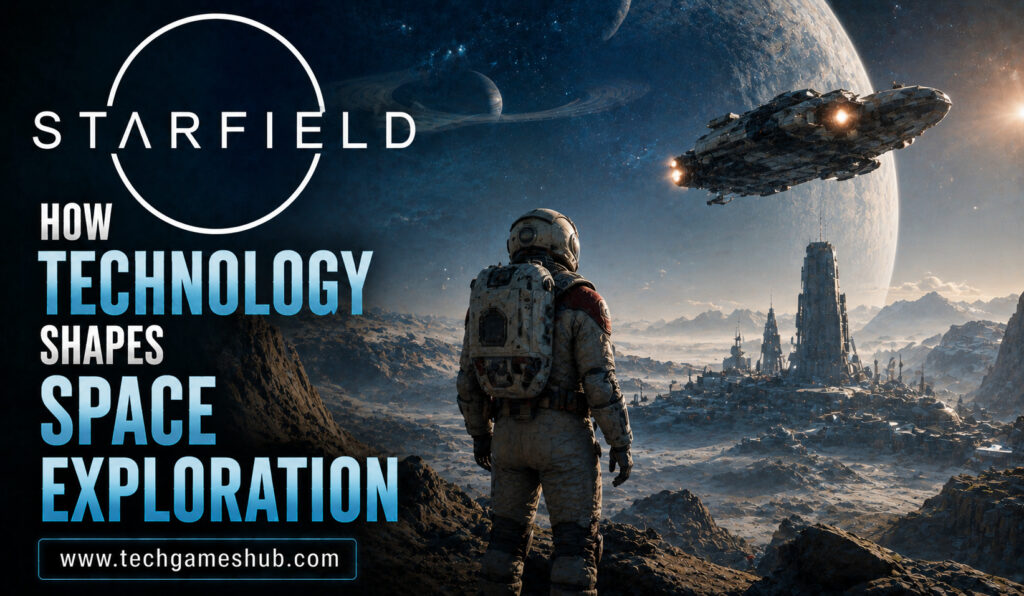
Space exploration has always been one of science fiction’s most fascinating ideas, but Starfield turns that concept into the foundation of a massive role-playing experience. Developed by Bethesda Game Studios, the game presents a future where humanity has expanded beyond Earth and established settlements, research stations, colonies, and outposts across numerous worlds.
Technology is what makes this expansion possible. Spaceships, grav drives, scanning systems, spacesuits, weapons, resource-processing tools, robotics, and automated facilities all influence how players explore the galaxy. Rather than treating futuristic technology as simple decoration, Starfield connects it with exploration, survival, combat, resource gathering, and character progression.
The result is a space adventure where technology constantly changes what players can discover and how they interact with distant worlds.
A Future Built Around Space Travel
Starfield takes place in a future where humanity has developed the ability to travel between star systems. This technological achievement dramatically changes civilization.
Instead of being restricted to Earth or nearby planets, humans can establish communities across a large region of space known as the Settled Systems.
This expansion creates new opportunities for exploration and conflict. Different factions develop their own interests, while corporations, settlers, researchers, pirates, and explorers compete for resources and territory.
Technology makes this civilization possible.
Without advanced propulsion and life-support systems, the settlements scattered across space would not exist.
The Grav Drive Changes Exploration
One of the most important technologies in Starfield is the grav drive.
It allows spacecraft to travel between star systems, making interstellar exploration practical within the game’s universe.
This technology changes the scale of the game world.
Players can move from one star system to another and explore planets, moons, stations, and other locations. The grav drive effectively transforms the galaxy from an unreachable concept into a navigable environment.
It also influences the game’s storytelling because humanity’s ability to travel through space creates the conditions for the major civilizations and conflicts found throughout the Settled Systems.
Spaceships as Tools for Exploration
Starships are central to Starfield’s gameplay.
A ship is not simply transportation between missions. It can function as a mobile base, cargo carrier, combat platform, and exploration tool.
Players can modify ships to improve their capabilities according to their preferred playstyle.
Some may prioritize cargo capacity, while others may focus on speed, shields, weapons, or long-distance travel.
This makes ship technology closely connected to player choice.
The design of a ship can influence what kinds of activities players can pursue efficiently.
Ship Customization and Strategic Choices
Starfield’s ship-building systems allow players to experiment with different configurations.
Players can modify components, layouts, weapons, engines, and other systems.
This creates an engineering-like aspect to space exploration.
A ship designed for combat may perform differently from one designed primarily for cargo transportation. A player interested in exploration may value different characteristics than someone focused on space battles.
These choices demonstrate how technology can influence gameplay without forcing every player into the same experience.
Scanning Technology Reveals Alien Worlds
Exploration in Starfield depends heavily on scanning technology.
Players can scan planets, moons, resources, flora, fauna, and other environmental features.
This makes information gathering an important part of exploration.
Instead of simply landing on a planet and wandering without direction, players can use technological tools to understand what the world contains.
Scanning can reveal resources and biological information, helping players decide whether further exploration is worthwhile.
Technology therefore acts as the player’s connection to environments that would otherwise be unfamiliar.
Planetary Exploration and Environmental Technology
Many planets and moons in Starfield contain harsh environments.
Extreme temperatures, atmospheric conditions, radiation, and other hazards can affect exploration.
Spacesuits and protective equipment help players survive these environments.
This creates a direct relationship between technology and exploration.
The right equipment can allow players to spend more time investigating a location, while inadequate protection can make certain environments more difficult.
Technology therefore determines not only where players can go but also how comfortably they can operate there.
Resource Gathering Drives Exploration
Natural resources are another major reason to explore planets.
Players can discover minerals and other materials that are useful for crafting, research, upgrades, and construction.
Scanning helps identify valuable resources, while specialized equipment allows players to collect them.
This creates a gameplay cycle in which technology encourages exploration and exploration provides materials for technological development.
The relationship is circular.
Players explore to find resources, use those resources to improve their capabilities, and then use improved technology to explore more effectively.
Outposts Expand Human Presence
Starfield also allows players to establish outposts on different worlds.
These facilities can support resource extraction, storage, crafting, and other activities.
Outposts demonstrate how technology allows humans to survive and operate far away from established settlements.
The concept also adds another layer to space exploration.
A remote planet does not have to remain a temporary destination. With enough infrastructure, players can turn it into a useful base of operations.
This makes technology a tool for transforming unfamiliar environments into functional spaces.
Robotics and Automation
Automation plays an important role in the game’s futuristic setting.
Robotic systems can assist with industrial processes and resource management, reflecting a future where machines support human expansion across the galaxy.
Automation is particularly useful in locations where human labor would be difficult or inefficient.
This also reinforces the game’s broader theme of technological dependence.
Humanity’s ability to explore and colonize space is supported by machines capable of performing specialized tasks.
Technology Influences Combat
Space exploration in Starfield is not always peaceful.
Players can encounter hostile creatures, pirates, mercenaries, and other threats.
Weapons and protective technology therefore become essential.
The game’s variety of futuristic firearms and equipment allows players to approach combat in different ways.
Technology supports multiple combat styles, including long-range attacks, close-range engagements, and specialized equipment.
This makes technological progression important not only for exploration but also for survival.
Space Combat and Ship Technology
Ship technology becomes especially important during space battles.
Weapons, shields, engines, and ship systems influence how players perform in combat.
Players need to manage their ship effectively while responding to enemy movements.
This makes space combat an extension of the game’s broader technology systems.
A ship that is highly effective at exploration may not necessarily be optimized for combat, forcing players to make choices about their priorities.
Technology Connects Exploration With Progression
One of Starfield’s strongest technological ideas is the relationship between exploration and character development.
Research, crafting, ship customization, equipment upgrades, and resource collection all encourage players to explore more of the universe.
As players discover new resources and technologies, they gain access to additional possibilities.
This creates a sense of progression that is directly connected to curiosity.
Exploring a distant planet is not only about discovering something visually interesting. It may also provide resources or knowledge that improves future capabilities.
Technology and the Mystery of the Universe
Although Starfield is heavily focused on scientific and technological ideas, it also leaves room for mystery.
Players encounter strange locations, unusual phenomena, and discoveries that challenge their understanding of humanity’s place in the universe.
This combination of technology and mystery is important to the game’s identity.
Technology gives humanity the ability to travel farther than ever before, but greater exploration can also reveal questions that technology cannot immediately answer.
The farther players travel, the more they are reminded that the universe remains enormous and largely unknown.
A Different Vision of Space Exploration
Starfield does not present space exploration solely as high-speed action.
It often emphasizes preparation, scanning, resource gathering, ship management, and gradual discovery.
This creates a slower and more methodical approach to exploring the galaxy.
Technology supports that style by giving players tools to study environments and manage their journeys.
For players who enjoy the idea of being a space explorer rather than simply a space warrior, these systems can make the universe feel more immersive.
The Future of Technology-Driven Space Games
Starfield demonstrates how technology can serve as the foundation for large-scale space exploration.
Future games could make these systems even more dynamic by introducing more advanced planetary ecosystems, smarter spacecraft automation, procedural technologies, realistic resource networks, and AI-driven settlements.
Technology could eventually influence not just what players can explore but how entire planetary societies develop.
Such systems could make space games feel increasingly like living simulations.
Conclusion
Starfield demonstrates how technology shapes almost every aspect of futuristic space exploration. Grav drives make interstellar travel possible, spacecraft provide mobility and customization, scanners reveal planetary environments, spacesuits enable survival, and resource technologies support expansion.
These systems are connected through a larger progression loop. Players explore planets to discover resources and information, use those discoveries to improve their technology, and then use improved technology to travel deeper into the galaxy.
The game’s most interesting idea is that technology does not eliminate the mystery of space. Instead, it gives humanity the ability to reach farther into the unknown.
Ultimately, Starfield presents exploration as a combination of curiosity, engineering, preparation, and discovery—showing how technological progress can expand humanity’s horizons while reminding players how much of the universe remains unexplored.