Modern cities increasingly depend on connected technology. Traffic systems, surveillance cameras, public networks, smartphones, digital payments, and automated infrastructure can make urban life more convenient, but they can also create new security and privacy concerns. Watch Dogs turns these ideas into the foundation of an open-world action game, imagining a city where digital systems are deeply connected and can be manipulated through technology.
Developed by Ubisoft, Watch Dogs explores the relationship between hacking, surveillance, personal data, and smart-city infrastructure. Its gameplay transforms connected technology into a strategic tool, allowing players to interact with the environment in ways that go far beyond traditional open-world mechanics.
The result is a game that uses technology not simply as a visual theme, but as one of the main systems controlling how players explore and interact with the city.
A City Controlled by Technology
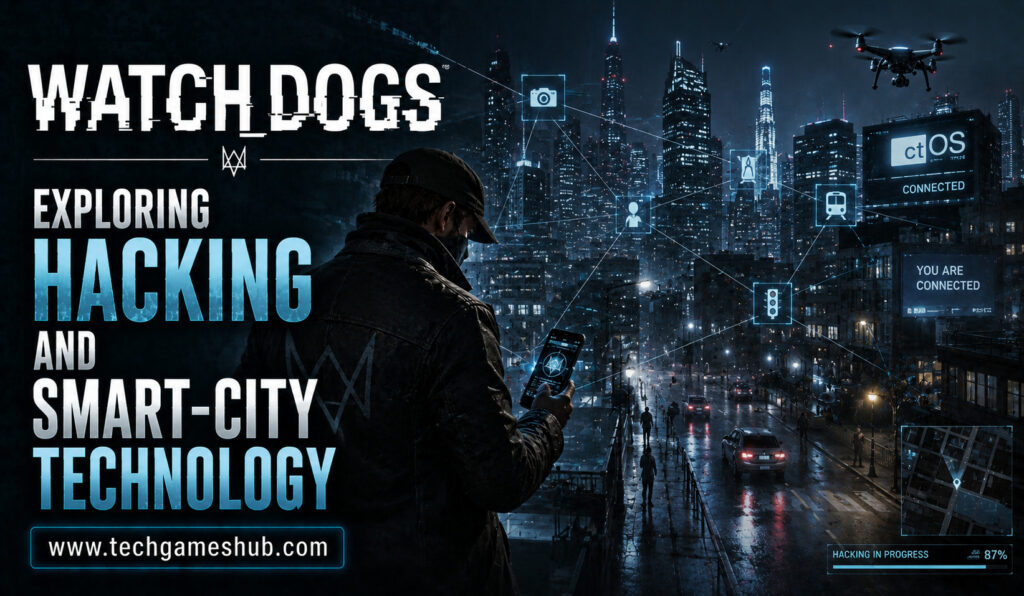
The world of Watch Dogs is built around the idea of a connected urban network. Chicago is presented as a technologically advanced city where many services are linked through a centralized system known as ctOS.
This fictional smart-city platform connects infrastructure and digital services across the urban environment.
Traffic lights, surveillance cameras, communication systems, security equipment, and other devices can be accessed through the network. The concept creates an environment where technology is constantly operating in the background.
For players, this means the city becomes more interactive.
Instead of simply walking or driving through streets, they can use connected systems to influence what happens around them.
Hacking Becomes a Gameplay Mechanic
Traditional open-world games often give players weapons and vehicles as their primary tools. Watch Dogs adds hacking to this formula.
The protagonist, Aiden Pearce, can interact with connected devices using his smartphone and digital access.
This allows players to manipulate certain elements of the environment.
Traffic lights can be changed, security systems can be interfered with, and cameras can provide different perspectives on an area. These abilities turn the city itself into a potential resource.
Hacking therefore becomes more than a narrative concept. It is integrated directly into gameplay.
Smart-City Technology Creates Strategic Possibilities
The biggest strength of Watch Dogs’ technology-focused design is the freedom it gives players to approach situations differently.
A player might enter an area directly, use environmental objects to create distractions, observe enemies through cameras, or manipulate infrastructure before making a move.
This encourages strategic thinking.
The player is not always required to confront every problem through direct combat. Connected technology can provide alternative solutions.
That idea reflects one of the game’s central themes: when everyday infrastructure becomes digital, access to technology can become a form of power.
Surveillance Changes How Players See the City
Surveillance is another important part of Watch Dogs.
Security cameras are spread throughout the city, and players can access them to observe locations from a distance.
This creates a different relationship with the environment.
Instead of physically entering an area to understand what is happening, players can sometimes use digital surveillance to gather information first.
This concept also connects directly to the game’s story.
A technologically connected city can provide convenience and security, but the same systems can potentially be used to monitor people.
Watch Dogs uses this contradiction to explore the consequences of widespread surveillance.
Personal Data as a Source of Information
The game’s technological world also emphasizes personal information.
People in the city leave behind digital traces through their connected lives. The protagonist can access certain information about individuals, revealing details about their identities and activities.
This fictional system highlights an increasingly familiar concern in modern society: personal information can have significant value.
The ability to collect and analyze data can provide insight into people’s behavior, but it also raises questions about privacy and consent.
Watch Dogs uses gameplay to make these abstract ideas more tangible.
Instead of simply hearing about data privacy, players experience what it might feel like to have access to large amounts of personal information.
Technology Changes Open-World Exploration
The smart-city concept also changes how players explore the environment.
Buildings, intersections, cameras, vehicles, and electronic systems can become interactive elements.
A location that might otherwise be ordinary can become strategically important because of the technology connected to it.
This makes the city feel less like a static backdrop and more like a network of opportunities.
Players begin to look at urban environments differently. A traffic light is not just part of the scenery. A security camera is not merely decoration. A connected device may become useful depending on the situation.
Traffic Systems Become Strategic Tools
One of the most recognizable examples of smart-city technology in Watch Dogs is traffic control.
Players can manipulate certain traffic systems to affect the movement of vehicles.
This can create opportunities during pursuits or provide ways to disrupt opponents.
The mechanic demonstrates how infrastructure designed for everyday urban life can become part of a larger strategic system.
It also reinforces the game’s broader idea that controlling information and infrastructure can be just as powerful as controlling physical objects.
Technology and Vehicle Chases
Vehicle chases become particularly interesting when hacking is involved.
Instead of relying only on driving skills, players can interact with parts of the environment to create obstacles or disruptions.
This can change the flow of a pursuit within seconds.
The city therefore becomes part of the chase itself.
A player who understands how to use connected infrastructure can potentially turn an ordinary street into a tactical advantage.
This integration of technology and movement helps distinguish Watch Dogs from more conventional open-world action games.
Hacking Supports Multiple Playstyles
Watch Dogs allows players to approach many situations according to their preferred style.
Some may prefer direct combat, while others can focus more heavily on surveillance, environmental manipulation, and stealth.
Technology supports both approaches.
A player who likes planning can spend time observing an area through cameras and identifying opportunities before acting. Another player may move quickly and use hacking abilities during a confrontation.
This flexibility makes the game’s technology feel meaningful rather than decorative.
The Risks of a Connected City
Although smart-city technology provides major advantages, Watch Dogs also emphasizes its potential risks.
A centralized system can become extremely powerful when it controls large parts of urban infrastructure.
If such a system is compromised, the consequences could potentially affect thousands or millions of people.
This raises questions about cybersecurity, system dependency, centralized control, and digital privacy.
The game exaggerates these concepts for entertainment, but its underlying themes remain relevant to discussions about real-world smart cities.
As cities adopt more connected technologies, questions about who controls infrastructure and how data is protected become increasingly important.
Watch Dogs and the Future of Smart Cities
The game’s vision of a connected city is fictional, but some of its concepts resemble technologies that exist today.
Modern cities use connected traffic systems, surveillance networks, digital services, smart utilities, mobile applications, and increasingly sophisticated data platforms.
However, real smart-city systems generally include security measures, access controls, regulations, and technical safeguards that differ significantly from the game’s fictional hacking mechanics.
Watch Dogs should therefore be viewed as an imaginative exploration rather than a realistic guide to hacking.
Its value lies in asking what could happen when urban life becomes increasingly dependent on connected systems.
Why the Technology Still Matters
The most interesting part of Watch Dogs is not necessarily the individual hacking mechanics. It is the way technology changes the player’s relationship with the city.
The urban environment becomes something that can be observed, analyzed, manipulated, and strategically used.
This creates a different kind of open-world experience.
The player is not simply navigating a city. They are interacting with its digital infrastructure.
That concept has influenced how games can portray technology as part of everyday environments.
The Future of Hacking in Games
Future open-world games could take these ideas even further.
More advanced simulations could create cities where artificial intelligence, smart transportation, automated buildings, connected devices, and digital identities interact dynamically.
Players might influence entire urban systems rather than individual devices.
Such systems could create new forms of gameplay centered on information, strategy, investigation, and digital decision-making.
The challenge for developers will be maintaining fun and accessibility while making technological systems feel believable.
Conclusion
Watch Dogs uses hacking and smart-city technology to create a distinctive open-world experience. Its connected Chicago environment transforms everyday infrastructure into an interactive gameplay system.
Surveillance cameras provide information, traffic systems can influence movement, personal data becomes a source of insight, and connected devices create opportunities for stealth and strategy.
Beyond its action gameplay, the game also explores larger questions about privacy, centralized technology, cybersecurity, and the risks of increasingly connected cities.
Its fictional vision may exaggerate what smart-city systems can do, but that exaggeration helps make an important idea easy to understand: the more connected a city becomes, the more powerful and potentially more vulnerable its technology can become.