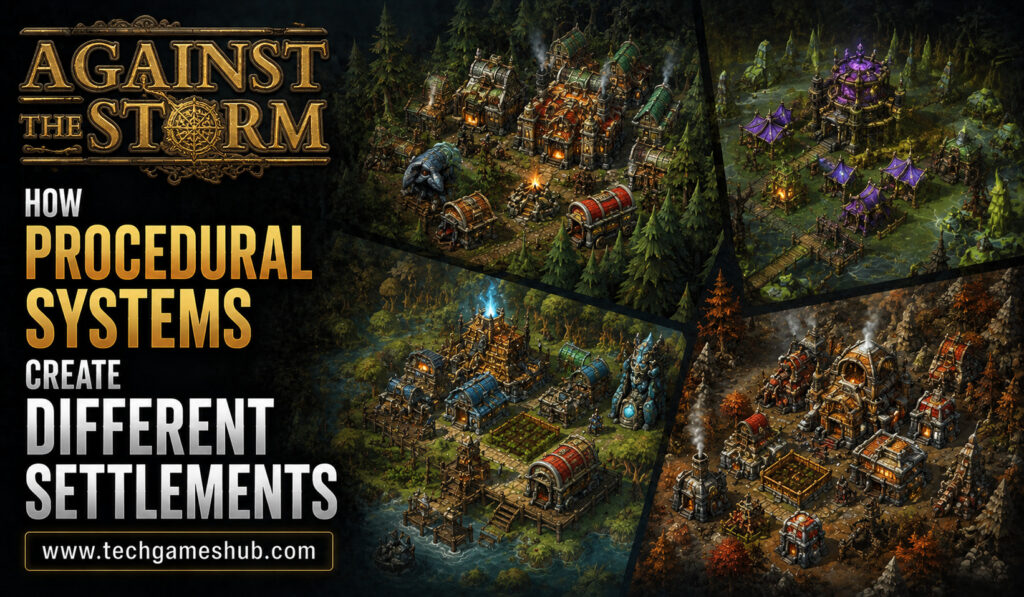
City-building games often give players a blank map and ask them to create a successful settlement from the ground up. Against the Storm takes a different approach. Instead of building one permanent city, the game asks players to establish a series of settlements across a dangerous wilderness, with each settlement presenting different environmental conditions, resources, species, objectives, and challenges.
This design is made possible by a combination of procedural generation, simulation systems, resource management, and adaptive gameplay mechanics. Each new settlement can feel different because the game continuously changes the conditions under which players must make decisions.
Rather than relying entirely on a fixed campaign structure, Against the Storm creates variety through systems that interact with one another. This makes procedural technology an important part of the game’s strategic identity.
What Makes Against the Storm Different?
Against the Storm combines city-building with roguelite progression.
Players establish settlements in a wilderness controlled by the mysterious Blightstorm. A settlement is not designed to survive forever. Instead, players work toward specific objectives before eventually leaving and taking accumulated progress into future settlements.
This changes the traditional city-builder formula.
In a conventional city-building game, players may spend hours developing the same city. Against the Storm encourages players to repeatedly solve new settlement problems.
The result is a gameplay loop built around adaptation.
Every new location can require a different approach.
Procedural Generation Creates Fresh Maps
Procedural generation is one of the key technologies behind this variety.
Instead of manually designing every possible settlement layout, the game can combine different terrain types, resource distributions, points of interest, challenges, and settlement conditions.
This means the player cannot always rely on the same opening strategy.
One settlement might provide abundant wood but limited food resources. Another could contain valuable materials but require more careful planning around production.
Because the starting conditions change, players must examine the environment before committing to a development plan.
Resources Are Distributed Differently
Resource availability is one of the biggest factors that changes each settlement.
Players need materials for construction, food for population needs, fuel, production chains, and other requirements.
Procedurally generated maps can alter the availability and location of important resources.
This creates immediate strategic questions.
Should the player prioritize gathering basic materials?
Should they establish food production quickly?
Should they explore the surrounding wilderness for alternative resources?
A strategy that is highly effective on one map may be much less useful on another.
Different Species Change Settlement Management
Against the Storm includes different fantasy species with their own preferences and strengths.
This adds another variable to procedural gameplay.
The population of a settlement can influence which buildings, production chains, services, and conditions are most valuable.
A settlement with a different population mix may therefore encourage a different development strategy.
This means procedural generation does not need to randomly change every system.
Even a relatively small change in population composition can alter the optimal approach.
Production Chains Create Strategic Choices
Many resources in Against the Storm are connected through production chains.
Basic materials can be transformed into more advanced goods, which can then be used to satisfy population needs or complete objectives.
This creates an economic puzzle.
Players must decide which production chains are worth developing and which can be ignored.
Because the map, resources, population, and objectives change, the most efficient production strategy can change as well.
The player is constantly asking what the settlement needs right now and what it may need later.
Buildings Offer Multiple Possibilities
Instead of having one fixed building available for every economic purpose, the game provides choices that can shape the direction of a settlement.
Players may have access to different production options and must decide which ones best fit the current situation.
This system works particularly well with procedural generation.
If every settlement offered exactly the same buildings and resources, procedural maps would have less strategic impact.
By combining random conditions with meaningful choices, the game makes each settlement feel like a new problem.
Events Add Uncertainty
Settlements can also encounter events that disrupt established plans.
These events may introduce new objectives, risks, rewards, or resource requirements.
The important point is that players cannot always know exactly what will happen next.
This creates uncertainty without making the game completely random.
Players still control the major direction of their settlement, but unexpected events can force them to adjust.
This is one of the strengths of procedural design: predictable systems can interact to produce unpredictable situations.
The Blightstorm Shapes the Campaign
The dangerous environment surrounding the settlements is not simply decorative.
The Blightstorm creates pressure that influences the broader campaign.
Players cannot treat every settlement as a permanent project.
Instead, they must work efficiently and complete objectives before conditions become too dangerous.
This changes the player’s relationship with time.
In a traditional city builder, growth is often the primary goal. In Against the Storm, efficiency and adaptation are equally important.
Reputation Creates Another Strategic Layer
Reputation plays an important role in determining whether a settlement succeeds.
Players must satisfy different population groups and complete objectives while managing overall settlement stability.
This means economic growth alone is not enough.
A settlement can have strong production but still struggle if its inhabitants are unhappy or if important goals are ignored.
Procedural conditions can change which strategies are most effective for maintaining reputation.
The Queen’s Impatience Adds Pressure
The settlement system also includes a broader campaign pressure represented through the Queen’s impatience.
This prevents players from simply waiting indefinitely for the perfect combination of resources and buildings.
The player must make progress.
This creates an interesting relationship with procedural generation.
Random conditions may make a settlement more difficult, but the player still needs to find a way forward.
Instead of restarting whenever conditions are inconvenient, successful players learn to adapt.
Procedural Generation Encourages Flexible Thinking
One of the most important skills Against the Storm teaches is flexibility.
Players cannot depend entirely on memorized build orders.
They need to evaluate the current map, available resources, population needs, production options, and objectives.
This makes the game less about repeating a perfect strategy and more about recognizing opportunities.
For example, a player may normally prefer a particular food production chain. If the required resources are unavailable, they must find an alternative.
The procedural system therefore encourages strategic creativity.
Failure Becomes Part of Learning
Because the game is built around repeated settlements, failure does not necessarily feel like the end of the experience.
A failed settlement can teach the player something about resource management, production priorities, population needs, or strategic timing.
Future settlements can then be approached with greater knowledge.
This creates a natural learning cycle.
Players become better not because they memorize one ideal strategy but because they learn how to respond to different circumstances.
Procedural Systems Create Emergent Stories
One of the most interesting effects of procedural generation is the creation of emergent stories.
A settlement may begin with an apparently poor combination of resources and population needs. The player might then discover an unexpected production opportunity, survive a dangerous event, and eventually complete the settlement’s objectives.
Another settlement may develop in a completely different direction.
These stories are not necessarily scripted.
They emerge from the interaction between procedural maps, game rules, player decisions, and changing conditions.
This makes each settlement feel like its own strategic experiment.
Why Randomness Does Not Mean Chaos
Good procedural design requires more than randomness.
If everything were completely unpredictable, players would have little control over the outcome.
Against the Storm works because its procedural systems operate within understandable rules.
Players know what resources do, how production chains work, what population groups need, and how settlement systems interact.
The uncertainty comes from the combination of these elements.
This creates a useful balance between familiarity and surprise.
Replayability Through Systemic Variety
Procedural generation is particularly valuable for replayability.
Once a player understands the basic mechanics, manually designed scenarios can eventually become predictable.
Procedural systems reduce this problem by changing the conditions of future settlements.
The player can continue discovering new combinations of resources, buildings, species, events, and objectives.
This gives the game long-term variety without requiring every scenario to be completely handcrafted.
AI and Simulation Behind the Settlement
Although procedural generation is central to the experience, simulation technology also plays an important role.
The game needs to track workers, production, resource consumption, population needs, construction, exploration, and other systems simultaneously.
These systems interact continuously.
A worker assigned to one task cannot perform another. A shortage in one resource can affect production elsewhere. A new building can change the efficiency of an entire production chain.
This creates a living economic system rather than a collection of disconnected mechanics.
The Importance of Adaptation
Against the Storm ultimately rewards players who can adapt.
The best strategy is rarely about following a fixed sequence from beginning to end.
Instead, players need to constantly evaluate their situation.
What resources are available?
Which needs are becoming urgent?
Which buildings provide the greatest value?
Which objectives should be completed first?
Is it worth exploring deeper into the wilderness?
These questions change from settlement to settlement.
Procedural systems make the answers different each time.
The Future of Procedural Strategy Games
Against the Storm demonstrates how procedural generation can be used for more than simply creating random maps.
Future strategy games could combine procedural generation with increasingly sophisticated simulation and AI systems to create worlds that respond to player behavior.
Settlements could develop unique economies, populations could react more dynamically, and environmental conditions could evolve based on previous decisions.
Such systems could make strategy games feel less like a sequence of predefined scenarios and more like continuously evolving simulations.
Conclusion
Against the Storm shows how procedural systems can transform the traditional city-building formula. Instead of asking players to develop one permanent settlement using a predictable set of resources, the game repeatedly places them in new environments with different conditions and strategic possibilities.
Procedural generation changes maps and resources, while population systems, production chains, events, objectives, and environmental pressure create additional layers of variation.
The result is a strategy game where adaptability is more important than memorization.
Every settlement becomes a new puzzle. Players must examine their surroundings, understand available resources, respond to unexpected events, and build an economy capable of surviving under pressure.
The success of Against the Storm demonstrates that procedural technology can do more than increase replayability. When combined with carefully designed simulation systems, it can create genuinely different strategic experiences from one settlement to the next.
That approach points toward an exciting future for strategy games, where procedural worlds do not simply look different but actually play differently, forcing players to rethink their decisions every time they begin a new adventure.