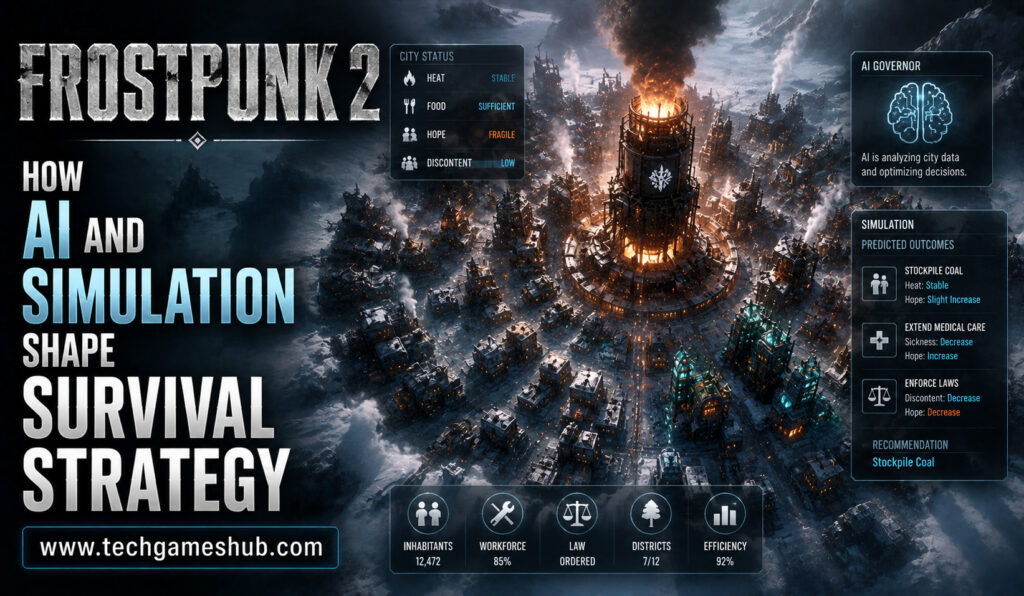
Survival strategy games often focus on gathering resources, building shelters, and protecting people from dangerous environments. Frostpunk 2 takes the concept much further by combining city building, social simulation, political decision-making, resource management, and harsh environmental conditions. Instead of simply asking players to construct a successful settlement, the game challenges them to manage a society struggling to survive in an unforgiving frozen world.
Artificial intelligence and simulation technology are central to this experience. Citizens have needs, factions have different priorities, resources fluctuate, and environmental conditions can create new problems. Every major decision can affect multiple parts of the city.
This combination makes Frostpunk 2 an interesting example of how simulation technology can turn survival strategy into a complex decision-making experience.
A City Is More Than Buildings
Traditional city-building games often focus heavily on construction. Players place roads, buildings, production facilities, and services while watching their population grow.
Frostpunk 2 approaches city management differently.
The city is also a social and political environment.
People have different needs, beliefs, expectations, and priorities. Factions can disagree about how the settlement should develop, while laws and policies can influence public opinion.
This means that constructing a new district is not simply an economic decision.
The player must consider how the decision will affect resources, living conditions, political relationships, and the city’s ability to survive.
Simulation Creates Interconnected Problems
One of Frostpunk 2’s greatest strengths is the way its systems interact.
A shortage of one resource can create several secondary problems.
For example, insufficient heating can affect living conditions. Poor living conditions can contribute to social unrest, which can make political management more difficult.
Similarly, investing heavily in one type of production can improve the economy while creating new environmental or social challenges.
This interconnected design means that players rarely solve one problem permanently.
Instead, they often move from one difficult decision to another.
AI Simulates Citizens and Factions
Artificial intelligence helps represent the behavior of the city’s population.
Citizens are not simply numbers displayed in a population counter. The game’s simulation systems represent different groups with their own priorities and reactions.
Factions can support certain policies while opposing others.
This creates political pressure that changes as the city develops.
The player must therefore understand not only what a policy accomplishes but also how different groups are likely to react.
AI and simulation work together to make social management part of the strategy.
Political Decisions Become Gameplay Mechanics
One of the major differences between Frostpunk 2 and conventional city builders is the importance of politics.
Players can introduce laws and policies that shape how society operates.
These decisions can influence productivity, resource consumption, living conditions, social relationships, and political support.
There is rarely a universally perfect choice.
A policy that improves one area may create problems elsewhere.
This creates a constant balancing act.
The player must determine which problems are acceptable and which consequences are too dangerous.
Factions Create Competing Priorities
Factions make political management more complicated.
Different groups may have different visions for the future of the city.
Some may prioritize technological development, while others may focus on social stability, tradition, environmental adaptation, or economic growth.
These competing priorities create strategic tension.
The player cannot always satisfy everyone.
Instead, successful leadership requires negotiation, compromise, and sometimes difficult decisions that produce short-term conflict for long-term survival.
The Environment Is an Active Threat
The frozen environment is one of the most important systems in Frostpunk 2.
Extreme cold influences how the city functions and forces players to consider heating, resources, infrastructure, and expansion.
The environment is not simply a visual backdrop.
It actively shapes the strategy.
When conditions become more difficult, players may need to adjust production, improve heating systems, or reconsider expansion plans.
This creates a relationship between environmental simulation and city management.
Resource Management Under Pressure
Resources are essential to survival.
Players must manage materials, food, energy, fuel, workforce capacity, and other requirements while planning for future needs.
The challenge is that resource production and consumption are constantly changing.
A resource that appears plentiful early in the game can become scarce later.
This encourages players to think ahead.
Instead of asking only whether the city has enough resources today, players need to consider whether their production systems can support the city in the future.
Workforce Simulation
The population also functions as a workforce.
Buildings and districts require workers, which means population management becomes connected to economic production.
This creates difficult decisions when the city expands.
More infrastructure may improve long-term capacity, but it can also increase demands on the workforce.
The player needs to balance production requirements with the needs of citizens.
This is another example of how Frostpunk 2 connects multiple simulation systems.
Technology Changes the City’s Future
Research and technological development provide another strategic layer.
Players can invest in technologies that improve production, infrastructure, social systems, or environmental adaptation.
However, research requires resources and time.
Choosing one technological direction means delaying another.
This creates an important long-term decision.
The player must decide whether to solve immediate problems or invest in technologies that could provide greater benefits later.
AI and Emergent Social Behavior
The interaction between factions, citizens, resources, laws, and environmental conditions can produce situations that are difficult to predict.
A decision that seems harmless can create political opposition.
A resource shortage can change the priorities of a faction.
A major environmental challenge can force the city to adopt policies that would previously have been unacceptable.
These situations create emergent gameplay.
Developers establish the rules, but the interaction between systems produces unique stories.
Survival Is About Trade-Offs
Frostpunk 2 rarely presents survival as a simple checklist.
Instead, players are constantly choosing between competing priorities.
Should the city expand quickly or remain stable?
Should resources be invested in immediate survival or future technology?
Should the player support one faction to pass an important law even if another group becomes unhappy?
Should production increase at the cost of greater resource consumption?
These decisions are difficult because there is often no perfect answer.
The Psychology of Leadership
The game’s simulation also creates an interesting psychological challenge.
Players are effectively placed in the role of a leader responsible for a large population.
Every decision can feel significant because the consequences affect citizens, factions, and the city’s future.
This makes Frostpunk 2 different from strategy games where losing a unit simply means producing another one.
The population represents a society rather than disposable pieces on a board.
As a result, strategic decisions can feel more emotionally meaningful.
AI Makes the City Feel Alive
A city becomes more convincing when its inhabitants appear to respond to circumstances.
AI-driven behavior helps create this impression.
Factions can support or oppose policies, citizens can be affected by living conditions, and political relationships can change over time.
These systems give the city a sense of internal activity.
The player is not simply managing buildings.
They are managing a population with competing expectations.
Simulation Creates Long-Term Consequences
One of Frostpunk 2’s most important design principles is that decisions can have consequences beyond the immediate moment.
A policy may provide an early benefit but create future problems.
A technological investment may take time to become useful.
An expansion decision can increase the city’s resource requirements.
This forces players to think in terms of long-term strategy.
Good decision-making requires understanding how today’s actions could shape tomorrow’s problems.
Difficulty Comes From Complexity
The game does not need enemies constantly attacking the city to create pressure.
The complexity of the simulation itself is enough.
Players must manage resources, people, politics, infrastructure, technology, and environmental conditions simultaneously.
Each system creates opportunities and problems.
The challenge comes from maintaining balance while the city continues to change.
This is an important lesson in strategy-game design: difficulty can emerge from interconnected systems rather than simply from stronger opponents.
How Frostpunk 2 Uses AI Differently
AI in Frostpunk 2 is not primarily about creating an enemy commander.
Instead, it helps simulate a society.
This is a different application of artificial intelligence.
The challenge is to represent groups with different priorities and reactions so that political decisions feel meaningful.
The result is a strategy game where the player is challenged by the behavior of the system itself.
The city becomes a constantly changing strategic environment.
The Future of Simulation-Based Strategy
Frostpunk 2 points toward a future where strategy games increasingly focus on complex simulations.
Improved AI could allow citizens to have more detailed behaviors, factions to respond more dynamically, and economies to react to player decisions in more sophisticated ways.
Environmental simulations could also become more detailed, allowing weather, resources, migration, and infrastructure to interact in increasingly complex ways.
Such systems could create worlds where no two campaigns develop in exactly the same way.
Conclusion
Frostpunk 2 demonstrates how AI and simulation technology can transform survival strategy. Instead of focusing solely on construction and resource gathering, the game combines environmental pressure with social behavior, politics, technology, workforce management, and long-term planning.
AI helps represent citizens and factions, while simulation systems connect their behavior to the larger city.
The result is a strategy experience built around difficult choices and competing priorities.
Frostpunk 2’s greatest strength is that survival is never simply about having enough resources. It is about deciding what kind of society can survive, which sacrifices are acceptable, and how today’s decisions will shape tomorrow’s challenges.
As artificial intelligence and simulation technology continue to improve, games may create increasingly detailed societies where players manage not just cities, but living systems filled with competing needs, unpredictable consequences, and evolving social relationships.