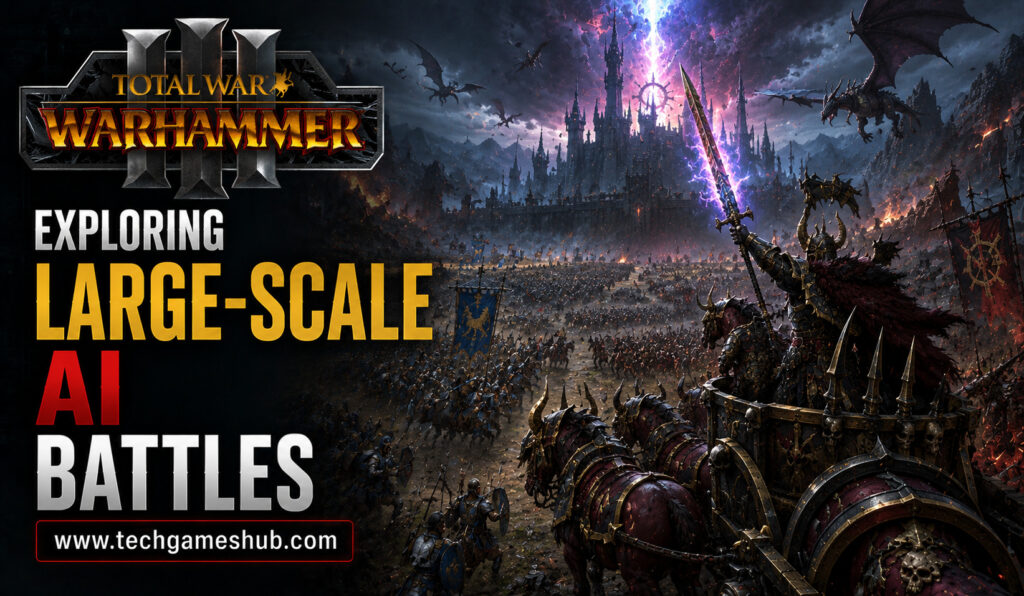
Large-scale strategy games are designed to make players think beyond individual units. Instead of controlling a handful of characters, players command armies, manage territories, develop economies, and make decisions that can influence an entire campaign. Total War: Warhammer III takes this concept to an enormous scale by combining turn-based grand strategy with real-time battles involving hundreds or even thousands of units.
One of the most important technologies supporting this experience is artificial intelligence. AI controls enemy armies, manages campaign factions, moves units across battlefields, and responds to player decisions. In large battles, AI becomes especially important because controlling so many units manually would be impossible for computer opponents.
Total War: Warhammer III demonstrates how AI can transform massive battles from collections of individual units into dynamic tactical encounters.
The Scale of Total War: Warhammer III
The defining feature of Total War: Warhammer III is its combination of two different strategic systems.
The campaign map operates through turns. Players move armies, manage settlements, recruit units, conduct diplomacy, research technologies, and make economic decisions.
When armies meet, the game can transition into a real-time battle.
This structure creates a unique relationship between strategic AI and battlefield AI. A computer-controlled faction needs to make decisions on the campaign map before its armies even reach the battlefield.
It must decide where to move, which territories to attack, how to develop its settlements, and when to engage enemy forces.
Once combat begins, another layer of AI takes over to manage individual units and battlefield tactics.
AI on the Campaign Map
Campaign AI is responsible for making the world feel active even when the player is not directly involved.
AI-controlled factions can expand their territories, recruit armies, attack settlements, defend important locations, and interact with other factions.
This creates an environment where the player is only one participant in a larger strategic system.
A faction may become stronger while the player is focused on another part of the map. An enemy army can appear near a vulnerable settlement, forcing the player to change plans.
This creates strategic uncertainty.
Players must think about not only what they want to accomplish but also what other factions might do while they are pursuing their own objectives.
Managing Huge Armies With AI
Large battles create a major technical challenge.
A battlefield can contain a huge number of individual soldiers divided into different units. Each unit has its own movement, attack range, morale, abilities, and formation.
Controlling all of these units simultaneously would be difficult for a human player and extremely demanding for a computer system.
AI helps organize this complexity.
Computer-controlled armies can determine which units should move, which targets should be attacked, where formations should be positioned, and when abilities should be used.
The goal is not necessarily to make every unit behave like an independent genius. Instead, AI creates coordinated group behavior that allows large armies to function as tactical forces.
Unit Roles Influence AI Decisions
Total War: Warhammer III includes a wide variety of unit types.
Infantry can hold positions, cavalry can maneuver around enemy formations, ranged units can attack from a distance, artillery can target large groups, and monstrous units can create powerful pressure.
Each type requires different battlefield behavior.
AI therefore needs to understand the general purpose of units and how they can interact with opposing forces.
A cavalry unit may be more useful attacking an exposed flank than charging directly into heavily protected infantry.
Similarly, ranged units can become vulnerable if enemy cavalry reaches their position.
These relationships create a tactical system where AI decisions can influence the outcome of battles dramatically.
Positioning Becomes a Major Strategic Tool
Large-scale battles are not simply about having more units.
Positioning can determine whether an army succeeds or fails.
High ground, narrow passages, defensive locations, flanks, and open spaces can all affect combat.
AI-controlled armies need to navigate these environments while responding to player movements.
This makes battlefield geography important.
A player who understands terrain can potentially defeat a larger army by forcing opponents into unfavorable positions.
AI helps create these opportunities because computer-controlled forces must make decisions about where to move and how to engage.
Flanking and Formation Management
Flanking is one of the most important tactics in Total War-style battles.
A formation attacked from the front may hold successfully, while the same formation attacked from the side or rear can suffer severe pressure.
AI therefore needs to manage formations and respond to threats from multiple directions.
This becomes increasingly difficult as battle sizes grow.
A commander may need to protect ranged units, maintain infantry lines, respond to cavalry movements, and deal with powerful monsters simultaneously.
AI allows the computer opponent to manage these tasks while the player focuses on making broader tactical decisions.
Morale Adds Another Layer of AI Complexity
Military units are not simply health bars.
Morale plays an important role in determining whether units continue fighting effectively or begin to retreat.
AI needs to consider morale because a weakened unit may be close to breaking even if it still has significant health.
Players can exploit this by attacking vulnerable units or creating pressure from multiple directions.
A successful AI-controlled army therefore needs to manage not only physical damage but also battlefield psychology represented through morale mechanics.
This adds another dimension to large-scale combat.
Legendary Lords and Powerful Characters
Total War: Warhammer III includes powerful characters and legendary lords who can dramatically influence battles.
These characters have unique abilities, spells, combat capabilities, and strategic importance.
AI must account for these powerful units when controlling armies.
A legendary lord may need to attack an important enemy unit, protect vulnerable troops, use special abilities, or avoid being surrounded.
For players, these characters create additional tactical opportunities because their abilities can change the battlefield.
Fantasy Powers Increase AI Complexity
The Warhammer universe introduces magical abilities, monsters, flying units, unusual creatures, and other mechanics that are not common in historical strategy games.
This significantly increases the number of possible battlefield interactions.
AI must operate within a system where units can behave in very different ways.
A flying unit can ignore certain terrain limitations. A spell can damage multiple units. A monster can disrupt formations. A ranged attack can punish tightly packed troops.
The larger the variety of mechanics, the harder it becomes to design AI that always responds perfectly.
AI Creates Emergent Battles
One of the most entertaining aspects of large strategy battles is that unexpected situations can develop.
A flank might succeed unexpectedly. A powerful unit could become trapped. A defensive line might collapse at the wrong moment. A small group of units could hold a critical position long enough to change the battle.
These situations emerge from the interaction between AI behavior, terrain, unit abilities, player decisions, and battlefield conditions.
The result is that no two battles need to unfold exactly the same way.
AI contributes to this unpredictability by creating opponents that react to the player’s actions.
Difficulty and Strategic Pressure
AI difficulty is particularly important in a game with large battles.
An opponent that is too passive can make massive battles feel meaningless. An opponent that is excessively aggressive or receives unfair advantages can become frustrating.
The ideal balance is an AI opponent that creates pressure while allowing the player to understand why a battle was won or lost.
Players should feel that better decisions can improve their performance.
This balance is especially important in Total War: Warhammer III because battles can involve many interconnected systems.
AI and Siege Warfare
Sieges create another major challenge for AI.
Attacking a fortified settlement requires different tactics from fighting in an open field.
Attackers need to manage multiple entry points, siege equipment, troops, and objectives. Defenders must protect walls, gates, towers, and important locations.
The AI needs to understand these different priorities.
Siege battles therefore provide an excellent example of how complex tactical systems can create difficulties for computer-controlled armies.
Campaign Strategy and AI Adaptation
Battlefield AI is only part of the challenge.
On the campaign map, players must consider alliances, enemies, resources, settlements, recruitment, and expansion.
AI-controlled factions operate within the same broader strategic environment.
This creates a long-term relationship between player and AI.
An opponent that survives several battles can become a major regional power. Another faction might collapse and leave a power vacuum.
These changes can reshape the campaign and force players to adapt their strategies.
Why AI Is Essential to Large-Scale Battles
Without AI, a game like Total War: Warhammer III could not provide the same experience.
Managing hundreds of units requires systems capable of organizing movement, attacks, formations, and responses.
More importantly, AI helps create the feeling of fighting against a living opponent rather than solving a fixed puzzle.
The technology allows massive battles to remain playable because the computer handles many low-level decisions while the player focuses on high-level command.
The Future of Large-Scale Strategy AI
Future strategy games could use more advanced AI to coordinate larger armies and make battlefield decisions more responsive.
Machine learning techniques, improved pathfinding, better tactical planning, and more sophisticated decision systems could potentially allow AI armies to recognize patterns in player behavior and adapt more effectively.
Future AI could also make campaign factions more convincing by giving them clearer strategic personalities and long-term objectives.
However, smarter AI should still remain understandable. Strategy games are most satisfying when players can learn from their opponents rather than simply being overwhelmed by unpredictable behavior.
Conclusion
Total War: Warhammer III demonstrates the importance of AI in creating large-scale strategy battles. From campaign decisions to battlefield formations, artificial intelligence helps manage the enormous complexity of armies, units, terrain, abilities, morale, and objectives.
The game’s combination of turn-based strategy and real-time combat creates a unique environment where AI operates at multiple levels.
On the campaign map, AI factions compete for territory and resources. On the battlefield, computer-controlled armies manage large numbers of units and respond to player tactics.
This combination makes every campaign and battle capable of producing unexpected situations.
As AI technology continues to improve, future strategy games may create even larger and more responsive battlefields. Total War: Warhammer III already shows how artificial intelligence can turn massive armies into dynamic tactical challenges where planning, adaptation, and battlefield awareness matter just as much as military strength.