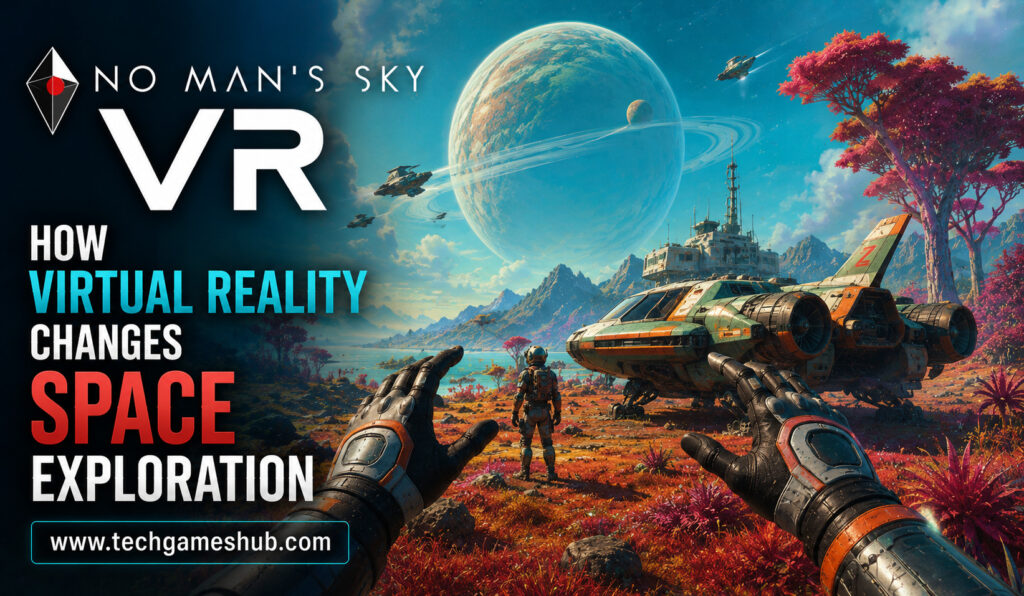
Space exploration has always been one of the most exciting concepts in gaming. Traditional space games allow players to pilot spacecraft, visit distant planets, and discover unfamiliar environments, but virtual reality can change how those experiences feel. No Man’s Sky VR takes the enormous procedural universe of No Man’s Sky and places players inside it, creating a more physical and immersive approach to exploration.
Instead of viewing a spacecraft or alien planet through a conventional screen, VR allows players to look around environments naturally, interact with objects using motion controls, and experience the scale of the universe from a first-person perspective. This combination of procedural generation and virtual reality creates a unique example of how technology can transform exploration-based gameplay.
What Makes No Man’s Sky VR Different?
No Man’s Sky is already known for its enormous procedurally generated universe. Players can explore planets, discover wildlife, collect resources, build bases, trade, fight enemies, and travel between star systems.
Virtual reality changes the relationship between the player and these activities.
On a traditional display, the player controls a character or spacecraft while looking at a screen. In VR, the player is placed inside the game environment. Looking around a cockpit becomes a physical action, while interacting with tools and objects can feel more direct.
This makes ordinary exploration activities more immersive because the player experiences them from inside the virtual world.
Virtual Reality Creates a Stronger Sense of Presence
One of the most important advantages of VR is presence.
When players wear a VR headset, the game world surrounds their field of view. Looking left or right reveals different parts of the environment, while looking upward can reveal mountains, spacecraft, buildings, creatures, or a huge alien sky.
This changes how players perceive virtual environments.
A planet that might look impressive on a flat monitor can feel significantly larger when the player is standing directly inside the landscape. The scale of mountains, structures, creatures, and spacecraft becomes easier to appreciate.
For a game focused on exploration, this sense of presence can make discovery more memorable.
Exploring Procedurally Generated Planets
Procedural generation is one of No Man’s Sky’s defining technologies. The game uses algorithms to create planets, landscapes, creatures, vegetation, resources, and other environmental elements.
Instead of manually designing every world, developers establish systems that generate content across an enormous universe.
VR gives these generated environments another dimension of immersion. Players can physically look around and examine details from different angles.
Walking through an alien forest, standing beside an unusual creature, or looking across a strange planetary landscape becomes more than simply moving a character through a level.
The procedural technology provides the variety, while VR provides the sense of being present inside that variety.
Cockpit Interaction and Spaceflight
One of the most enjoyable aspects of No Man’s Sky VR is interacting with spacecraft from a first-person perspective.
Instead of treating the ship as an external vehicle, VR can make the cockpit feel like an actual space.
Players can look around the cockpit, observe instruments, and use motion-based interactions to control aspects of the spacecraft.
This approach makes spaceflight feel more physical. The player is not simply pressing buttons to move a ship; they are sitting inside a virtual cockpit and observing the surrounding environment.
When a spacecraft launches from a planet and enters space, the transition can create a strong feeling of scale.
The Experience of Taking Off
Takeoff is an excellent example of how VR can change familiar gameplay.
On a conventional screen, leaving a planet involves controlling the spacecraft while watching the environment through a display.
In VR, the player can look around during the ascent. The planetary surface changes beneath the spacecraft, the horizon expands, and the surrounding environment gradually becomes smaller.
The experience emphasizes vertical scale and distance.
These visual changes are especially effective in exploration games because they reinforce the idea that the player is traveling through a real three-dimensional environment.
Discovering Alien Creatures in VR
No Man’s Sky features a wide variety of procedurally generated creatures.
VR makes interactions with these creatures feel more personal because their size and movement can be experienced from the player’s physical perspective.
A small creature can appear surprisingly close, while a large alien animal can feel enormous when viewed from ground level.
Players can look directly at creatures, observe their movements, and explore their surroundings without the limitations of a fixed camera.
This creates a stronger emotional connection to the game’s wildlife and environments.
Walking Through Alien Landscapes
Traditional games often communicate environmental scale through camera movement and graphics. VR adds physical perspective to the equation.
Walking across an alien landscape can feel different when players can freely look around while moving through the environment.
The player can examine rocks, plants, structures, creatures, and distant scenery from almost any direction.
This encourages slower exploration.
Instead of rushing from one objective to another, players may stop to observe a landscape or investigate an unusual object simply because the environment feels interesting.
VR Makes Building More Interactive
No Man’s Sky also includes base building, and VR can make construction feel more hands-on.
Players can examine their surroundings from a first-person perspective while placing structures and objects.
The ability to interact with the environment through motion controls can make construction feel more physical than traditional menu-driven building systems.
This is especially useful when creating detailed bases because players can move around their structures and evaluate them from different angles.
The result is a closer relationship between the player and the spaces they create.
Resource Gathering Feels More Physical
Resource collection is an important part of No Man’s Sky’s gameplay. Players gather materials for crafting, construction, upgrades, and survival.
VR can make these activities feel more direct because tools and objects exist within the player’s field of view.
Using a mining tool while physically looking toward a resource deposit creates a more immersive connection between the player’s action and the game’s response.
Although the underlying gameplay systems remain similar, the physical interface changes how those systems are experienced.
Space Combat in Virtual Reality
Space combat can also benefit from VR.
Players can look around the cockpit while tracking other spacecraft. Being able to move the head independently from the spacecraft’s direction provides a stronger sense of situational awareness.
Enemies can appear from different directions, encouraging players to visually scan the environment.
The cockpit itself also becomes part of the experience. Displays, controls, and surrounding structures can help communicate the position of the player within the spacecraft.
This makes combat feel more immersive than simply watching a ship from a third-person camera.
A More Personal Scale of Exploration
One of the biggest changes introduced by VR is the perception of scale.
A galaxy may be enormous, but players experience it through individual moments. VR makes those moments feel closer to the player’s physical space.
A spacecraft can feel like a machine surrounding the player. A large creature can appear imposing. A mountain can dominate the horizon. A space station can seem enormous when approached from a cockpit.
These experiences demonstrate why VR is particularly suitable for exploration games.
The Technology Behind the Experience
No Man’s Sky VR depends on several technologies working together.
Virtual reality headsets provide stereoscopic visuals and head tracking. Motion controllers allow players to interact with virtual objects. The game engine renders procedurally generated environments while maintaining the performance needed for immersive VR.
Performance is especially important because VR generally requires smooth and responsive visuals. Any significant delay or unstable frame rate can reduce immersion and make the experience uncomfortable.
This means VR versions of large open-world games require careful optimization.
Challenges of VR Space Exploration
VR also introduces challenges.
Players need to become comfortable with movement, controls, menus, and camera behavior. Long play sessions can be demanding for some users, particularly when virtual movement does not perfectly match physical movement.
Developers therefore need to design interfaces and movement systems that minimize discomfort while preserving gameplay freedom.
No Man’s Sky’s enormous environments also create technical demands because the game must render complex worlds while maintaining the performance expected from VR.
These challenges demonstrate that VR is not simply a matter of adding a headset mode to an existing game. It can require different approaches to interaction, movement, and interface design.
Why No Man’s Sky VR Matters for Gaming
No Man’s Sky VR demonstrates how virtual reality can complement procedural generation.
Procedural generation creates enormous amounts of variety, while VR makes individual discoveries feel more immediate and personal.
Together, these technologies can create a powerful exploration experience. Players are not simply visiting a collection of handcrafted locations. They are traveling through a universe that can continually produce new environments and experiencing those environments from inside the world.
This combination could influence future exploration games, especially as VR hardware becomes more accessible and comfortable.
The Future of VR Space Exploration
The future of VR space games could involve even more advanced interaction.
Improved motion tracking, lighter headsets, better displays, more realistic haptic feedback, and smarter AI could make virtual spacecraft and planets feel increasingly responsive.
Future games may allow players to physically manipulate more complex cockpit systems, communicate naturally with AI characters, and explore environments with greater freedom.
Procedural generation could also become more sophisticated, producing environments that are not only visually diverse but also more responsive to player actions.
Conclusion
No Man’s Sky VR shows how virtual reality can change the meaning of space exploration. The game’s enormous procedural universe provides scale and variety, while VR adds presence, physical interaction, and a stronger sense of immersion.
Flying a spacecraft, walking across an alien planet, discovering creatures, collecting resources, building a base, and exploring distant environments can feel more personal when experienced from inside the virtual world.
The technology does not simply make No Man’s Sky look more impressive. It changes how players interact with its universe.
As VR technology continues to improve, experiences like No Man’s Sky VR demonstrate the potential of combining procedural worlds with immersive interfaces. The future of space exploration in gaming may not just be about creating bigger galaxies—it may be about making players feel as though they are truly standing inside them.