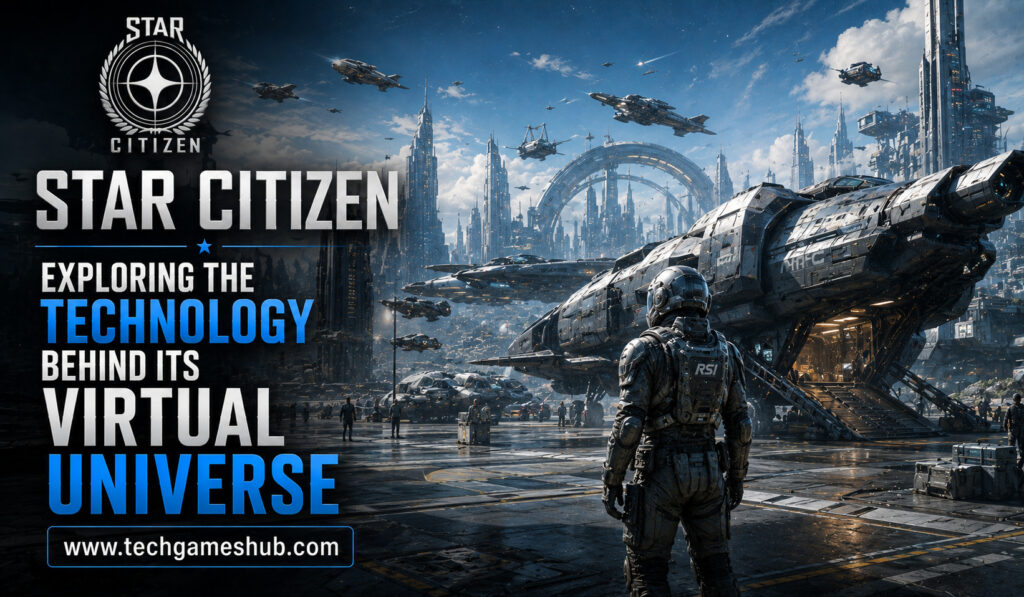
Creating a virtual universe is one of the most ambitious challenges in modern gaming. Instead of building a world around a single map, developers need to create interconnected environments, spacecraft, planets, cities, economies, characters, and online systems that can operate together. Star Citizen is one of the most ambitious projects to pursue this idea, combining space simulation with persistent online technology and detailed virtual environments.
The game aims to create an interconnected universe where players can travel between planets, operate spacecraft, explore locations, trade resources, participate in combat, and interact with other players. Its development has also attracted attention because of its focus on technological detail and the scale of its proposed virtual world.
Building a Virtual Universe Instead of a Traditional Map
Traditional games generally divide their worlds into levels, zones, or maps. Star Citizen takes a different approach by attempting to connect many different environments into a larger universe.
Players can potentially move from a planetary surface into a city, board a spacecraft, leave the atmosphere, travel through space, and interact with orbital locations.
This creates a complicated technical problem. Each environment needs to work independently while also connecting smoothly with the others.
The technology behind Star Citizen is therefore focused not only on visual quality but also on maintaining continuity between different parts of the game world.
Seamless Transitions and Immersion
One of Star Citizen’s most recognizable technological goals is seamless movement between locations.
Instead of constantly relying on traditional loading screens, the game attempts to make transitions between spacecraft interiors, stations, planets, and other environments feel continuous.
This approach can dramatically increase immersion. A spacecraft becomes more than a vehicle used to move between menus or levels. Players can walk inside their ships, interact with different areas, prepare equipment, and then use the vessel to travel into space.
The idea is to make the spacecraft itself part of the player’s physical environment.
Detailed Spacecraft Technology
Spacecraft are central to Star Citizen’s gameplay and technology. Ships are designed with detailed interiors, functional components, displays, weapons, engines, cargo areas, and other systems.
Different ships can serve different purposes. Some are designed for combat, while others focus on transportation, exploration, mining, cargo operations, or support.
This approach creates a more sophisticated relationship between player and vehicle. Instead of simply selecting a ship from a menu, players interact with it as a physical space.
The level of detail also supports cooperative gameplay. Different players can potentially perform different roles aboard larger spacecraft, turning a vessel into a small multiplayer environment.
Advanced Character and First-Person Technology
Star Citizen combines space simulation with first-person gameplay. Players can leave their ships and explore stations, cities, planets, and other locations on foot.
This requires the game to support both spacecraft-based movement and traditional character-based interaction.
The transition between these modes is important because it allows the player to experience the universe at multiple scales. A character can walk through a spacecraft, enter a station, travel through space, land on a planet, and continue exploring without completely changing the nature of the game.
This combination creates a more immersive concept of scale than traditional space games that keep the player permanently inside a cockpit.
Planetary Environments and Procedural Technology
A massive universe requires technology capable of generating and managing large environments efficiently.
Star Citizen uses procedural techniques to support the creation of planetary landscapes and large-scale environments. Procedural generation allows software systems to help produce terrain and environmental details rather than requiring every element to be manually placed.
This becomes particularly useful when a game includes large planets and multiple locations.
However, procedural technology is combined with handcrafted design. Important cities, stations, interiors, and other locations can receive detailed artistic attention while larger natural environments benefit from automated generation techniques.
The combination helps create both scale and visual variety.
Streaming Large Game Worlds
One of the biggest technical challenges in a large online universe is delivering world data to players efficiently.
A traditional game can load a level and focus on the content contained within it. A persistent space simulation has a much more complicated problem because players can move between very different environments.
World-streaming technology helps manage this complexity by loading and unloading relevant data as the player moves through the environment.
This allows developers to build much larger experiences without requiring the entire universe to remain loaded in memory at the same time.
Server Technology and Persistent Online Gameplay
Star Citizen is designed around a persistent online universe, which means networking technology is essential.
A multiplayer game must track players, spacecraft, objects, locations, inventories, missions, and other information while keeping different users synchronized.
Persistent online systems make the game world feel more like a continuing environment than a temporary multiplayer match.
Players can develop careers, acquire equipment, explore locations, and interact with other participants within a larger shared universe.
Maintaining this type of environment requires complex server architecture and careful management of data.
Artificial Intelligence and NPC Behavior
Non-player characters are another important component of the virtual universe.
A convincing space universe cannot consist entirely of player-controlled characters. NPC pilots, workers, civilians, security personnel, and other characters can make locations feel populated.
Artificial intelligence helps control these characters and allows them to perform tasks within the game world.
NPC behavior can support activities such as transportation, commerce, security, missions, and other simulated interactions.
The more responsive these characters become, the more dynamic the virtual universe can feel.
Physics and Object Interaction
Star Citizen also places considerable emphasis on physics and physical interaction.
Objects can occupy physical space, spacecraft respond to movement and thrust, and characters interact with environments rather than simply passing through them.
Physics becomes especially important in spacecraft combat. Speed, maneuvering, positioning, and acceleration can influence encounters.
It also matters inside environments, where physical objects and player movement contribute to immersion.
A strong physics system helps make the universe feel like a collection of connected spaces rather than a series of decorative backgrounds.
Economy and Player-Driven Activities
A virtual universe becomes more interesting when players have reasons to interact with it.
Star Citizen incorporates systems for activities such as trading, mining, transportation, exploration, combat, and other forms of gameplay.
These systems are designed to encourage different types of careers. One player might focus on transporting cargo, while another may explore distant areas or operate a mining spacecraft.
An interconnected economy can make these activities influence one another. Resources extracted through one activity can become valuable to another, while transportation creates connections between locations.
This type of systemic gameplay can create experiences that are not completely predetermined by developers.
Graphics Technology and Environmental Detail
Visual technology is another major component of Star Citizen’s appeal.
Detailed spacecraft interiors, character models, planetary environments, cities, space stations, lighting, particle effects, and cockpit displays contribute to the game’s visual identity.
The emphasis on detail becomes particularly noticeable because players can move close to objects. A spacecraft is not merely visible from the outside; players can walk through its interior and interact with its environment.
This requires high-quality assets and rendering technology capable of displaying detailed environments without destroying performance.
Virtual Reality and Immersive Possibilities
Space simulation naturally works well with immersive hardware. A cockpit-centered game can benefit from head tracking, advanced flight controls, and potentially virtual reality technologies.
Although hardware support and implementation can evolve over time, the underlying design of Star Citizen makes immersive interfaces an interesting possibility.
Being able to look around a cockpit, physically interact with controls, and observe a massive planetary environment could make the experience feel closer to operating a virtual spacecraft.
Why Technology Is Central to Star Citizen
Technology is not simply a tool for improving Star Citizen’s graphics. It is fundamental to the game’s entire concept.
A traditional game could create a beautiful spaceship or a detailed city as an isolated location. Star Citizen attempts to connect spacecraft, characters, cities, planets, space stations, economies, and multiplayer systems into a larger environment.
That ambition creates significant technical challenges.
The game’s development illustrates how modern game engines and online infrastructure are being pushed beyond conventional level-based design toward persistent simulated worlds.
Challenges of Creating Such a Large Universe
Building a virtual universe at this scale is extremely difficult. Developers must deal with performance, networking, artificial intelligence, physics, world streaming, server capacity, graphical detail, and data management simultaneously.
Every additional system can interact with other systems, increasing development complexity.
This is one reason large-scale online simulations can take many years to develop. Creating individual features is only one part of the challenge; making them work together reliably is considerably harder.
The Future of Virtual Universe Technology
The technology being explored by large space simulations could influence the broader gaming industry.
Improved procedural generation could create larger environments. Better AI could produce more believable NPCs. Faster hardware could support richer worlds, while improved networking could make persistent online environments more responsive.
Cloud infrastructure and advanced server architectures may also allow future games to simulate increasingly complex worlds.
Star Citizen represents one vision of where these technologies could lead: a game where the boundaries between individual levels, maps, and systems become less noticeable.
Conclusion
Star Citizen demonstrates how modern game technology can be used to pursue the idea of a persistent virtual universe. Its combination of detailed spacecraft, planetary environments, first-person exploration, procedural generation, physics, artificial intelligence, networking, and economic systems creates an unusually ambitious approach to space simulation.
The most interesting aspect is not any single technological feature. It is the attempt to connect many systems into one continuous experience.
As gaming technology continues to evolve, virtual worlds are becoming increasingly capable of supporting complex interactions and enormous environments. Star Citizen’s development reflects this broader shift toward games that aim to simulate entire worlds rather than simply provide players with a collection of levels.
Whether experienced as a pilot, explorer, trader, miner, or traveler, the game’s central technological idea remains compelling: create a virtual universe where the world itself becomes the foundation for gameplay.