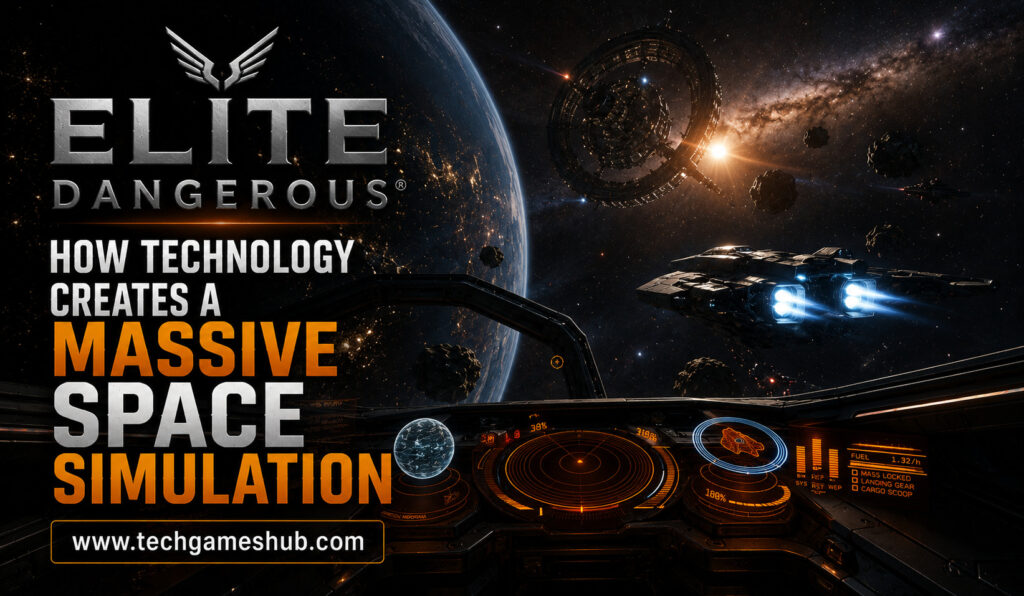
Space simulation games have always promised players the freedom to explore the universe, but few have attempted to create a galaxy on the scale of Elite Dangerous. Developed by Frontier Developments, the game combines space exploration, trading, combat, mining, exploration, and player-driven activities within an enormous simulated Milky Way galaxy.
What makes Elite Dangerous particularly impressive is not simply its size. The technology behind the game allows a vast digital universe to function as a connected simulation where stars, planets, spacecraft, economies, and players interact. Instead of placing players inside a small collection of handcrafted locations, the game creates the feeling of operating within a much larger and constantly evolving space environment.
A Galaxy Built on Simulation Technology
The defining feature of Elite Dangerous is its representation of the Milky Way. The game uses astronomical data, procedural generation, and simulation technology to create an enormous number of star systems.
Rather than requiring developers to manually design every planet and star, procedural generation allows the software to produce environments based on defined rules and astronomical characteristics.
This approach makes it possible to create a universe far larger than what traditional level-design techniques could support. Players can travel between star systems, discover distant planets, and encounter locations that may never have been visited by another player.
The technology behind procedural generation is therefore central to the game’s identity. It allows Elite Dangerous to provide scale while maintaining enough variation to make exploration meaningful.
Procedural Generation and the Milky Way
Procedural generation is one of the most important technologies used in large-scale games. Instead of storing every environmental detail as individually handcrafted content, algorithms can generate elements according to predetermined systems.
In Elite Dangerous, this technology helps create stars, planets, planetary systems, and other astronomical environments.
The result is a galaxy that feels enormous without requiring every location to be manually designed. Players can travel through familiar-looking regions or venture into remote areas where exploration becomes the primary objective.
This creates an unusual relationship between technology and gameplay. The game’s enormous scale is not simply a visual feature; it directly influences what players do.
Exploration becomes meaningful because there is always the possibility of reaching another system, scanning another world, or traveling farther than before.
Realistic Space Environments
Elite Dangerous places significant emphasis on creating believable space environments. Stars differ in appearance and characteristics, while planets can have different compositions, atmospheres, temperatures, and surfaces.
The game also uses lighting and astronomical positioning to create convincing visual environments.
Flying close to a star, approaching a planet, or traveling through an asteroid field can produce very different experiences. These environments are not simply background scenery. They influence navigation, exploration, mining, and other gameplay activities.
Modern graphics technology helps transform astronomical data and procedural systems into visually convincing locations.
Physics and Spaceflight
Space simulation depends heavily on physics. Elite Dangerous attempts to create a flight model that makes spacecraft feel different from conventional aircraft-based games.
Ships have different sizes, masses, capabilities, and handling characteristics. Acceleration, maneuvering, and speed management become important parts of piloting.
The experience also reflects the three-dimensional nature of space. Players can move in multiple directions rather than being restricted to a traditional horizontal game world.
This makes navigation more complex and creates opportunities for different approaches to travel and combat.
The game’s flight technology gives players the impression that they are controlling an actual spacecraft rather than simply moving a character through a three-dimensional level.
A Persistent Online Universe
Another major technological achievement is Elite Dangerous’ connected online structure. Thousands of players can participate in the same broad galaxy while following their own objectives.
The online infrastructure allows players to explore independently, meet other commanders, participate in community activities, or compete and cooperate in different ways.
A persistent universe also creates a stronger sense of place. A star system is not merely a temporary level that disappears when the player leaves. It exists as part of the larger game world.
This persistent structure is especially important for exploration because players can contribute discoveries and interact with a universe that other players also recognize.
Simulation of Economy and Trading
Elite Dangerous goes beyond space travel by incorporating economic systems. Players can buy and sell commodities, transport goods, mine resources, and search for profitable routes.
Technology allows markets and supply-and-demand systems to contribute to the game’s wider simulation.
For players who enjoy trading, space becomes a network of economic opportunities rather than simply a collection of destinations.
This also demonstrates how simulation technology can create gameplay without requiring developers to manually script every possible player decision. Systems and rules can generate different opportunities based on the player’s activities.
Mining Technology and Resource Extraction
Mining is another activity that demonstrates how different simulation systems can interact.
Players can locate resource-rich areas, operate specialized equipment, collect materials, and transport resources. Different environments can provide different opportunities, encouraging players to explore beyond conventional trade routes.
Mining transforms otherwise empty sections of space into useful locations. Asteroids and planetary environments become part of an interconnected resource system.
This is a good example of how procedural environments become more valuable when combined with gameplay systems.
Combat and Artificial Intelligence
Space combat is another major part of Elite Dangerous. Different ships have different strengths, weapons, defenses, and maneuvering characteristics.
Artificial intelligence controls many non-player spacecraft, allowing players to encounter hostile or neutral ships while traveling through the galaxy.
AI opponents can provide combat challenges without requiring another human player to be present. This makes the galaxy feel more active and unpredictable.
The combination of flight physics, weapons systems, AI behavior, and multiplayer networking creates combat encounters that can vary considerably depending on the situation.
Exploration as a Technological Experience
Exploration is arguably where Elite Dangerous’ technology becomes most visible.
A player can leave populated regions and travel toward remote parts of the galaxy. During these journeys, the player may scan systems, examine planets, gather information, and document discoveries.
The sheer scale of the galaxy changes the meaning of exploration. In a smaller game, reaching the edge of the map might take hours. In Elite Dangerous, players can spend enormous amounts of time traveling through space and still encounter unexplored areas.
This creates a unique sense of distance and discovery that few traditional games can reproduce.
Graphics and Immersion
Visual technology plays an important role in making the game’s enormous universe convincing.
Detailed spacecraft models, planetary surfaces, star fields, lighting effects, cockpit displays, and atmospheric environments help establish a sense of scale.
The cockpit interface is particularly important because it places the player inside the spacecraft. Instead of controlling a ship from an external camera, players interact with instruments and displays while surrounded by the visual environment of space.
Virtual reality and specialized flight controls can further enhance this experience for players with compatible hardware.
Sound Design and Spatial Awareness
Technology is not limited to graphics and physics. Audio also contributes significantly to immersion.
Engine sounds, cockpit alerts, communications, weapon effects, and environmental audio cues help players understand what is happening around them.
In a simulation-focused game, sound can provide useful information. Alerts may indicate system changes or approaching threats, while engine and weapon sounds help create a sense of physical activity.
Together, visual and audio technologies make the spacecraft feel like an interactive machine rather than a simple game object.
Technology Creates Player Freedom
One of Elite Dangerous’ greatest strengths is the freedom created by its underlying systems.
Players are not required to follow a single career path. Someone can focus on exploration, while another player may prefer trading, mining, combat, passenger transportation, or other activities.
This flexibility exists because the game is built around interconnected systems rather than a single linear progression structure.
The technology effectively provides a framework in which players can create their own objectives.
The Challenges of Building a Massive Simulation
Creating a universe on this scale also presents significant technical challenges. Developers need to balance enormous amounts of generated content with performance, networking requirements, graphical quality, and gameplay consistency.
A huge universe would not be useful if players could not navigate it efficiently or if the simulation constantly overwhelmed their hardware.
Procedural generation, optimized data systems, server technology, and carefully designed game mechanics help make the scale manageable.
This balance between ambition and technical limitations is one of the most interesting aspects of Elite Dangerous.
The Future of Space Simulation Technology
Space simulation technology continues to evolve as graphics hardware, artificial intelligence, procedural generation, and online infrastructure improve.
Future games could potentially create even more detailed planets, smarter AI characters, richer economies, and more dynamic galaxies.
Elite Dangerous has already demonstrated that a game can use technology to make astronomical scale part of the gameplay itself. Its approach shows how procedural systems and persistent online worlds can turn an enormous virtual environment into an interactive experience.
Conclusion
Elite Dangerous is more than a game about flying spaceships. It is an example of how modern technology can create a massive simulated universe where exploration, economics, combat, mining, physics, and multiplayer interaction work together.
Procedural generation provides the galaxy’s scale, simulation systems give it structure, physics creates believable spacecraft behavior, and online technology connects players to a persistent universe.
The result is a space simulation that gives players an unusual level of freedom. Instead of simply completing a predefined adventure, players can decide what kind of commander they want to become and create their own experiences among the stars.
As technology continues to improve, Elite Dangerous remains an important example of how ambitious simulation design can transform the concept of an open-world game from a large map into an entire virtual galaxy.