Plenty of action RPGs chase the Souls formula, yet Phantom Blade Zero swings in another direction. S-Game’s game launches on October 29, 2026, for PlayStation 5 and PC, so the comparison is no longer theoretical. Because many previews are now public, we can say what sets this Phantom Blade Zero action RPG apart. Still, a few points rest on short demos, so I will flag them.
This post covers the setting, the combat, the map, the quests, and the difficulty options. Beyond that, it looks at the studio and the cast behind the game. Along the way, I will compare it with common genre habits, so the differences stay concrete. That way, you can decide whether the game fits your taste.
A wuxia world instead of familiar fantasy
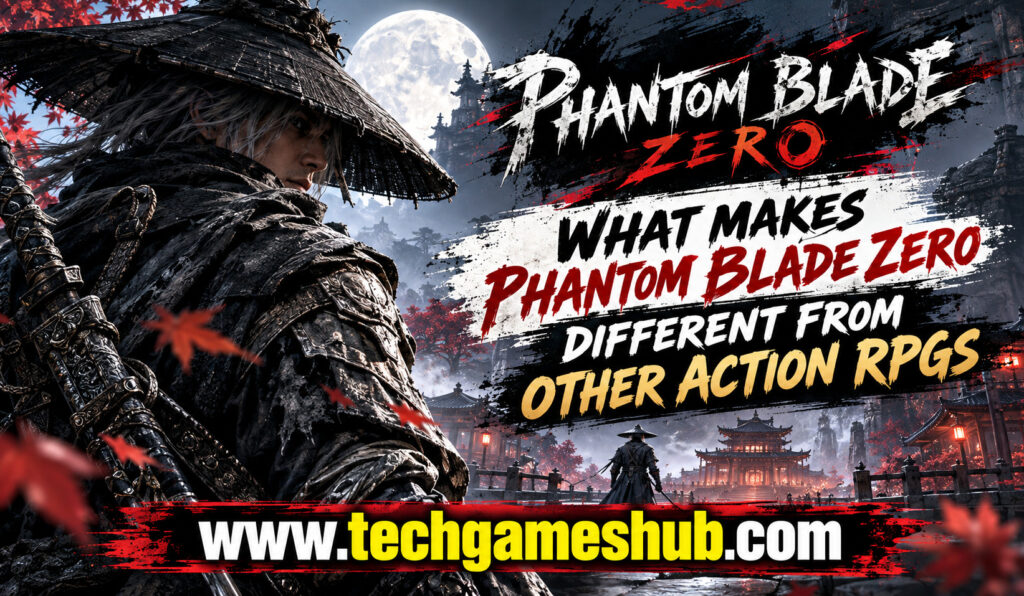
Most action RPGs borrow from European fantasy, yet Phantom Blade Zero draws on wuxia. The setting, called the Phantom World, is based loosely on Ming dynasty China. It also adds dark fantasy and horror, so the tone leans grim. The hero, Soul, is a xiake, which means a heroic wandering swordsman.
The developers call the style kungfupunk, a blend of kung fu, steampunk, and cyberpunk. Beebom describes it as traditional kung fu meeting steampunk machinery with body modification. As a result, the weapons look unusual, since many draw on Chinese folklore. For instance, one weapon shoots fire from a giant mask, and another is a Tiger Cannon.
That said, the setting is not just decoration. Each weapon carries folklore and its own attack patterns, so the culture shapes how you fight. I find that more convincing than a cosmetic theme, since the world and the combat support each other.
Wuxia also shapes the hero. Soul is a xiake, so his story follows the genre’s old ideas about loyalty and justice. Because he is framed and hunted, he fits the role of an outsider with a mission. Meanwhile, the horror touches keep the tone from feeling like a standard hero tale.
Combat that is aggressive, not a Souls clone
Previews keep returning to one point: the combat is fast and aggressive. One reviewer said it feels closer to Ninja Gaiden than Dark Souls. Another reviewer said it rewards both proactive and reactive play more than Wo-Long did. Meanwhile, a third preview called it more accessible than typical Souls-likes while still tough for veterans.
The structure explains why. You carry two primary and two secondary weapons and swap between them mid-fight. Because swapping restores stamina and triggers a flourish, switching feels like part of the combo. Heavy weapons such as axes and hammers feel weighty, while twin blades feel faster.
Defense also differs from the usual stamina routine. Sha-chi acts as a stamina bar for you and your enemies, so pressure flows both ways. A well-timed parry or dodge triggers a ghostep, which places you behind the enemy. From there, a backstab drains their sha-chi, and a drained enemy can be finished.
Previews also praised the loadout flexibility. Because axes, hammers, twin blades, and Phantom Edges all play differently, players can express different styles. As a result, two people could finish the game with very different habits. Even so, not every weapon works against every enemy, so smart swapping still matters.
A semi-open map with eight regions
Many action RPGs choose between linear levels and one huge open world. Phantom Blade Zero picks a middle road. The game has eight interconnected regions, and some open later through non-linear routes. It is not open world, but it is not fully linear either.
Levels are handcrafted and hide secret bosses and weapons. Bells let you fast travel between regions, while an ink-drawn map helps with direction. Lakes add variety, since you can ride a speedboat-like vessel across the water. Because the regions connect, you can return to places with new tools and new tricks.
I like this approach, since a handcrafted map avoids the filler that giant worlds often carry. Of course, a smaller world must stay interesting for dozens of hours. That test will come at launch, and no demo can answer it yet.
Because the regions connect, the game can hide shortcuts and later routes. Even so, the semi-open design keeps the story focused, since players are not buried under endless side markers. That said, I cannot confirm how many side activities the map holds, so that question stays open.
Side quests that change the ending
Side content in many games is optional and forgettable. S-Game says side quests here are more than filler. Some open new story paths, and some change the main plot. Because choices carry weight, the game can end in one of eight endings.
Quest outcomes also appear to influence the final ending, according to the State of Play coverage. As a result, ignoring side content may close doors you never saw. Even so, that is a design choice, and some players will love it while others will resent it.
The main story adds its own pressure. Soul has 66 days to live after a healer restores him with a tainted heart. That clock gives the quests a sense of urgency, since every detour costs time inside the story. Whether the game enforces it strictly depends on your difficulty mode.
Difficulty that adapts to you
Four difficulty modes cover very different players. Wayfarer is the story-focused option, built to make you feel like a kung fu god. Hellwalker, however, makes enemy AI smarter and adaptive. On that setting, bosses react to your attack patterns instead of following fixed scripts.
The fourth mode, 66 Days, uses Hellwalker rules and adds a life timer. Each death costs one day, so the countdown from the story becomes a real rule. Pathbreaker sits between the first two. New Game Plus also unlocks after a first playthrough, so veterans have another reason to return.
Beyond the modes, checkpoints and progression are forgiving, and dying does not cost useful resources, according to one preview. Because failure is cheap in resources, you can experiment with weapons freely. That mix of cheap failure and smart enemies is rare, and I think it is the game’s best idea.
Adjustable difficulty also matters for a game this stylish, since many players want the spectacle without the frustration. Because Wayfarer exists, those players are covered, while Hellwalker covers the rest. As a result, the same game can serve a casual evening and a brutal weekend.
A studio and cast with a clear point of view
S-Game is based in Beijing, with a motion capture team in Shanghai, an art team in Hong Kong, and a publishing team in Los Angeles. Soulframe Liang serves as director and producer, and the game runs on Unreal Engine 5. The studio is self-publishing the game, which gives it more control over the release.
Donnie Yen is also involved. He is the creative consultant and plays Mó Yuan, with English voice, facial capture, and motion capture. Because a martial arts star shaped the fights, the choreography carries real credibility. Strong animation and motion capture also stood out in one hands-on.
The hype is real as well. The game won Most Anticipated Game at the UCG Game Awards 2024 and the Ultra Game Awards 2025. It also passed one million wishlists within 15 days of its December 2025 store listing. Still, hype is not quality, so reviews will matter once the game launches.
The delay also deserves a mention. The game was first dated for September 9, 2026, and S-Game later moved it to October 29 to improve quality. Because the studio chose polish over speed, I read the move as a good sign. Still, a delay never guarantees a better game.
Phantom Blade Zero compared at a glance
The table below sums up the main differences. Keep in mind that the right column describes common habits, not every game. Even so, the contrast shows where this Phantom Blade Zero action RPG aims to be different.
| Area | Phantom Blade Zero | Common genre habit |
| Setting | Wuxia-inspired Phantom World | European-style fantasy |
| Map | Eight connected regions | Linear levels or one huge map |
| Combat | Aggressive, combo-driven, four weapons | Heavy focus on stamina and counters |
| Side quests | Can change the main plot | Optional extras |
| Difficulty | Four modes, including a death countdown | Fewer options |
Also Read, Into the Breach: How Smart Enemy Design Creates Tactical Challenges
Key Takeaways
- Setting: Wuxia-inspired Phantom World with a kungfupunk style
- Combat: Fast and aggressive, with four swappable weapons
- Map: Eight connected regions that are not fully open world
- Quests: Side content can change the story and endings
- Difficulty: Four modes, including 66 Days
- Launch: October 29, 2026, on PlayStation 5 and PC
Frequently Asked Questions
Is Phantom Blade Zero an open-world game?
No, because it uses eight connected regions instead of one huge open map.
Is Phantom Blade Zero like Dark Souls?
Although it has tough fights, previewers say it feels faster and more aggressive than Dark Souls.
Does Phantom Blade Zero have multiple endings?
Yes, since side quests and choices can lead to one of eight endings.
Who is Donnie Yen in Phantom Blade Zero?
He is the creative consultant, and he also plays Mó Yuan through facial and motion capture.
When can you play Phantom Blade Zero?
While Xbox players wait, the game launches on October 29, 2026, on PlayStation 5 and PC.
Conclusion
Phantom Blade Zero stands apart from other action RPGs through its wuxia setting, its aggressive combat, and its connected map. Because side quests can change the story, the game asks for attention beyond the main path. Even so, the real test is the full release, since previews only show small slices. If it delivers, this Phantom Blade Zero action RPG will offer something the genre rarely does.