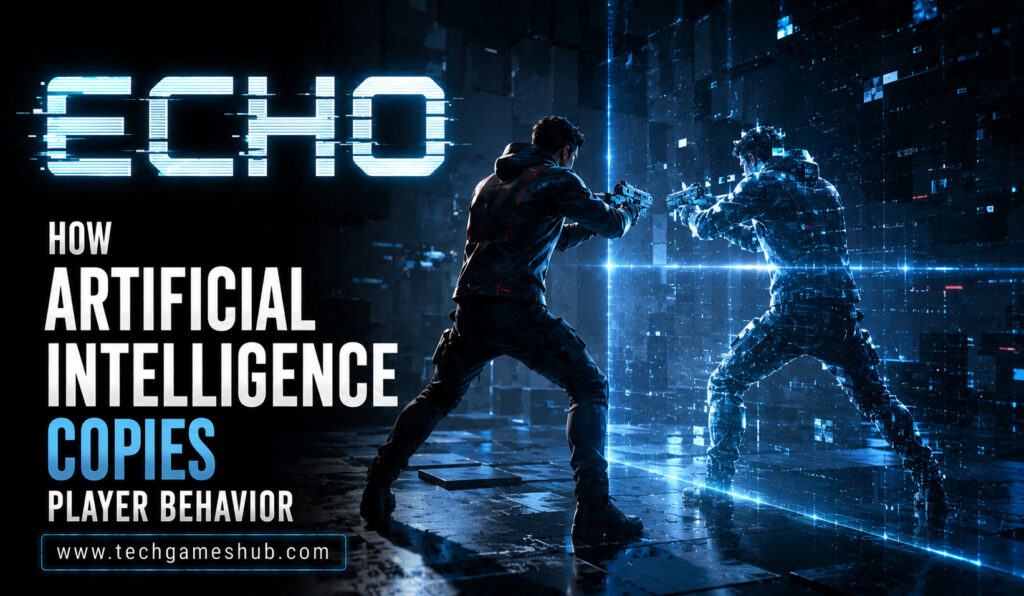
ECHO is a fascinating science-fiction game built around one unsettling idea: what if the enemy could learn from the way you play?
Developed by Ultra Ultra, ECHO places players in the role of En, a mysterious protagonist exploring an ancient and technologically advanced structure. The game combines stealth, exploration, and action, but its most memorable feature is the artificial intelligence system controlling the enemies known as Echoes.
These enemies do not simply follow fixed patrol routes. Instead, the game creates copies of the player’s recent behavior and uses those patterns to influence what the enemies can do.
The result is a gameplay system where the player’s own habits can eventually become a threat.
A Game Where Your Actions Teach the Enemy
Traditional stealth games often rely on predictable enemy behaviors.
Guards may patrol predefined routes, investigate suspicious sounds, or chase the player after detection. Although these systems can be sophisticated, players can often learn their patterns and develop reliable strategies.
ECHO introduces a different challenge.
The Echoes can reproduce actions that the player has performed.
If the player spends time sneaking, the enemies can eventually become capable of sneaking. If the player uses certain attacks or movement techniques, those behaviors can become part of the enemies’ capabilities.
This creates an unusual relationship between player behavior and enemy behavior.
The more players rely on certain tactics, the more they risk teaching those tactics to the opposition.
The Core Idea Behind the Echoes
The Echoes are essentially copies of En.
They look similar to the protagonist and are designed to reflect the player’s actions.
However, they do not immediately possess every ability that the player can use.
Their capabilities are influenced by the game’s cycles.
This creates a strategic rhythm.
Players can perform certain actions during one phase, knowing that those actions may become available to the Echoes during a later phase.
The player therefore has to think beyond the immediate moment.
A decision that seems useful now could create a much more dangerous situation later.
Player Behavior Becomes a Gameplay Resource
One of the most interesting ideas in ECHO is that player behavior itself becomes part of the game’s resource system.
Normally, players think about ammunition, health, equipment, or energy.
In ECHO, players also need to think about what they are teaching the enemy.
This changes the way players approach familiar mechanics.
Running may be useful, but will teaching the enemies how to run make future encounters harder?
Using a particular attack may solve an immediate problem, but could that same ability become a threat later?
These questions create strategic depth without requiring a huge inventory system.
The Game Punishes Repetitive Habits
Most games reward players for finding an effective strategy and repeating it.
If a particular tactic works, players naturally continue using it.
ECHO challenges that habit.
When players repeatedly rely on the same behavior, they risk giving the Echoes access to the same type of behavior.
This encourages adaptation.
A player who always uses one approach may eventually find that approach turned against them.
The game therefore asks players to remain flexible.
Success is not only about finding an effective strategy. It is about knowing when to change it.
Stealth Becomes More Complicated
Stealth is especially interesting because the Echoes can learn movement-related behaviors.
Players need to think carefully about how they navigate spaces.
Sneaking can help avoid enemies, but stealth is not completely isolated from the enemy’s learning system.
The player must constantly consider whether a particular approach is worth using.
This creates a psychological layer that is uncommon in conventional stealth games.
Instead of simply asking, “Can the enemy see me?” the player begins asking, “What will the enemy learn from me?”
Combat Has Consequences Beyond the Present
Combat decisions can also affect future encounters.
If the player uses certain offensive actions, the enemies may eventually gain access to similar capabilities.
This means combat is not limited to the current encounter.
The player is effectively influencing the future rules of the game.
That creates a powerful form of strategic planning.
A player might deliberately avoid using a particular ability even when it would be effective because they do not want the Echoes to gain the same advantage.
The enemy’s future strength is therefore partly shaped by the player’s own behavior.
Cycles Create a Learning Loop
The game’s structure is closely connected to this AI system.
The world operates through cycles in which the Echoes change their capabilities.
This creates a repeating gameplay loop:
Act → Observe → Enemy Learns → Adapt → Act Again
The player gradually discovers how the system works and begins making decisions with future cycles in mind.
This is different from a traditional enemy that becomes stronger because the game has increased its statistics.
The Echoes become more threatening because the player has given them more possibilities.
The Enemy Feels Personal
Because the Echoes are based on player behavior, they can feel more personal than conventional enemies.
They are not simply powerful opponents designed by the developers.
They are reflections of the player’s own actions.
If a player has a particular play style, the enemies eventually begin to resemble aspects of that style.
This creates an unsettling effect.
The player is effectively fighting against a distorted version of their own behavior.
The technology supports the game’s science-fiction themes while also strengthening its psychological atmosphere.
Artificial Intelligence Without Machine Learning
It is important to distinguish ECHO’s AI system from modern machine-learning systems.
The game does not necessarily need a neural network that independently learns everything the player does.
Instead, its behavior can be achieved through carefully designed game rules, tracking systems, and predefined actions.
The game monitors relevant player behaviors and determines which abilities or behaviors should become available to the Echoes.
From the player’s perspective, however, the effect is powerful.
The enemy appears to learn.
This demonstrates an important game-design principle: the perception of intelligence can be created through carefully controlled systems.
The Environment Supports the AI
The architecture of ECHO is also important.
The environments provide spaces where movement, stealth, combat, and observation matter.
Because the player needs to understand how the Echoes behave, environmental awareness becomes essential.
A corridor may provide an opportunity to hide.
An open room may create a dangerous combat situation.
A particular route may be safe during one cycle but risky after the enemies acquire additional abilities.
The environment therefore becomes part of the learning system.
Players Must Think About the Future
One of the biggest changes ECHO makes to traditional gameplay is its emphasis on future consequences.
Most action games encourage players to optimize the current situation.
ECHO asks players to consider how their current behavior could affect later encounters.
This creates a form of delayed consequence.
A tactic may be highly effective now but dangerous later.
Another strategy may seem inefficient in the short term but keep the enemy’s capabilities limited.
Players therefore need to balance immediate survival against long-term risk.
The Psychological Effect of Being Copied
The game’s AI concept also works because it creates psychological tension.
Players know that the enemy is connected to their own actions.
That knowledge changes how they perceive their decisions.
A simple movement or attack can suddenly feel important.
The player becomes conscious of their own habits.
If they discover that the Echoes can reproduce a particular action, they may begin deliberately changing their behavior.
This creates a fascinating feedback loop between player psychology and game mechanics.
Replayability Comes From Different Play Styles
Because the system is connected to player behavior, different players can experience different challenges.
A player who focuses heavily on stealth may create enemies that are better suited to stealth-related behaviors.
Someone who prefers aggressive combat may create a different set of future threats.
This gives the game an additional layer of replayability.
The basic environments may remain recognizable, but the player’s own habits influence how future encounters develop.
The enemy therefore becomes partly shaped by the person playing the game.
A Unique Approach to Enemy Design
ECHO demonstrates that enemy AI does not always need to become more complicated in order to become more interesting.
Instead of giving enemies hundreds of independent behaviors, developers can connect enemy capabilities directly to player behavior.
That relationship creates meaningful consequences.
The game effectively turns the player into part of the enemy-design process.
Every tactic becomes a potential lesson for the opposition.
Lessons for Future AI-Driven Games
The concept explored by ECHO has significant potential for future game design.
Imagine stealth games where enemies gradually recognize a player’s preferred routes, strategy games where opponents adapt to recurring tactics, or survival games where creatures become better at responding to individual players.
These systems could make enemies feel more personalized without requiring unlimited procedural content.
The challenge would be preventing adaptation from becoming unfair.
Enemies need to learn enough to create interesting challenges without making players feel punished simply for playing effectively.
ECHO provides an early and memorable example of how that balance can be explored.
Conclusion
ECHO turns artificial intelligence into a reflection of the player.
Its Echo enemies can gain access to behaviors based on what the player does, creating a gameplay loop where today’s tactics can become tomorrow’s threats.
This makes every action more meaningful.
Players are not simply trying to survive the current encounter. They are also shaping the capabilities of the enemies they will face later.
The result is a distinctive form of stealth and action gameplay built around adaptation.
Ultimately, ECHO demonstrates that one of the most interesting ways to make artificial intelligence feel intelligent is to connect it directly to the player’s behavior. When the enemy can imitate the way you play, your own habits become part of the challenge—and the safest strategy is often to keep changing.