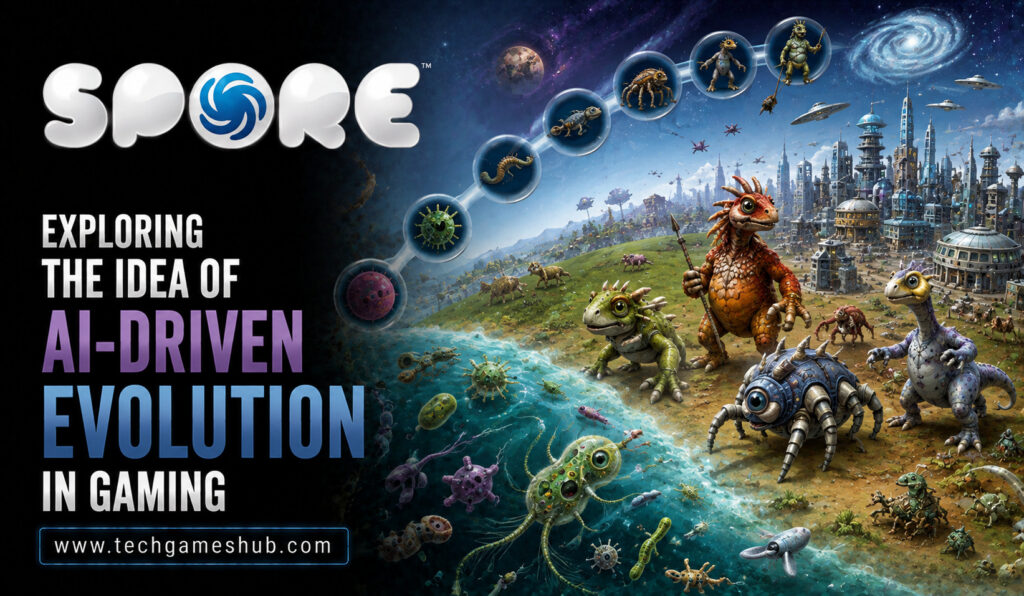
Spore is one of the most ambitious examples of evolutionary game design. Released by Maxis, the game allows players to begin with a microscopic organism and gradually guide it through multiple stages of development until it becomes part of a civilization capable of exploring space.
What makes Spore particularly interesting from a technology perspective is its attempt to combine procedural generation, simulation, artificial intelligence, and player creativity into one connected experience.
The game does not use artificial intelligence to create biological evolution in the same way that real organisms evolve. Instead, it creates the illusion of evolution through systems that respond to player choices, generate creatures and environments, and determine how different creations behave.
This makes Spore an important example of how AI-like systems can be used to simulate the idea of evolution in an interactive world.
Starting With a Simple Organism
The journey in Spore begins at the cellular stage.
Players control a small organism in a microscopic environment and must survive while finding food and avoiding threats. As the organism develops, players can modify its body and eventually influence how it evolves.
The experience introduces a basic evolutionary concept: survival depends on adapting to the environment.
Although the player’s decisions directly control much of this development, the game presents the process as a gradual transformation.
A simple creature can eventually become a complex organism with different abilities and physical characteristics.
This creates a strong sense of progression.
Creature Creation Becomes Part of the Simulation
One of Spore’s most innovative features is its creature creator.
Players can design organisms using a flexible collection of body parts and structures. They can change proportions, limbs, mouths, eyes, movement features, and other characteristics.
The important part is that these creations are not merely cosmetic.
The game can use the creature’s structure to influence how it behaves.
A creature designed with certain limbs may move differently from another creation. Changes to its body can influence its abilities and interactions.
This connection between creativity and behavior is what makes the creature creator more than a character customization tool.
Procedural Technology Expands the Possibilities
It would be impossible for developers to manually create every creature, animation, and variation that players might design.
Instead, Spore relies heavily on procedural technology.
The system can take player-created structures and generate animations and behaviors that fit those creations.
This is a major technical achievement.
Players can build strange or unusual creatures without developers having to manually animate every possible body shape.
The technology essentially converts player creativity into functional game assets.
That idea remains influential because it shows how procedural systems can dramatically expand the number of possibilities available in a game.
AI-Like Behavior Makes Creatures Feel Alive
Creature behavior is another important part of the experience.
Once players create an organism, it does not simply remain a static model.
Creatures can move, interact, communicate, compete, and respond to their surroundings.
These behaviors are controlled by game systems that make the creatures appear to have basic forms of intelligence.
They may react differently depending on their environment or relationship with other creatures.
The underlying systems are not equivalent to real biological intelligence, but they create a convincing simulation at the scale of the game.
Evolution Is Influenced by Player Decisions
One of the most interesting aspects of Spore is that evolution is partly controlled by the player.
Players decide which characteristics their creature develops and what kind of lifestyle it follows.
They can make an organism more aggressive, social, fast, defensive, or adaptable.
This means the game turns evolution into a form of interactive design.
Instead of simply observing a creature evolve, the player becomes an active participant in its development.
That makes biological change feel like gameplay rather than a passive simulation.
From Creature to Tribe
The game’s evolutionary structure continues beyond the microscopic stage.
After developing as a creature, the player eventually enters a tribal phase.
At this point, the focus shifts from individual survival to group behavior.
The player’s species becomes part of a larger social environment.
This transition demonstrates how the game’s systems expand in complexity.
The player is no longer concerned only with keeping one organism alive.
They are now managing relationships and interactions between groups.
Civilization Adds Another Layer of Simulation
The civilization stage expands the concept even further.
Players begin interacting with cities, resources, vehicles, buildings, and other societies.
The game uses the player’s earlier creature design as the foundation for this civilization.
This creates a sense of continuity across the different stages.
The species that began as a tiny organism eventually becomes a society with its own visual identity.
The underlying simulation therefore connects individual design decisions with much larger systems.
AI and Social Interaction
As the game progresses, artificial intelligence becomes more important for interactions between different groups.
Other civilizations can behave differently depending on their characteristics and relationship with the player’s society.
Players may encounter friendly groups, competitors, or potential enemies.
These interactions contribute to the feeling that the player’s species exists within a larger world.
Again, this is not a realistic simulation of civilization.
It is a simplified game system designed to make the world respond to the player’s choices.
The Space Stage Expands the Idea of Evolution
The final major stage takes the player into space.
At this point, the game moves beyond individual creatures and civilizations and presents a much larger universe.
Players can explore planets, interact with alien species, establish colonies, and encounter other forms of life.
This creates a dramatic progression from microscopic life to galactic exploration.
The concept of evolution therefore becomes more than biological transformation.
It becomes a framework for exploring increasing levels of complexity.
Procedural Generation Makes the Universe Vast
The space stage would be extremely difficult to build using only manually created content.
Procedural generation allows the game to create a huge variety of planets, creatures, and environmental details.
This gives the universe a sense of scale.
The player can encounter unusual worlds and life forms that may not have been individually designed by developers.
The technology supports the game’s central fantasy: exploring a universe filled with diverse forms of life.
Player Creativity and AI Work Together
One of Spore’s most interesting ideas is the relationship between human creativity and automated systems.
The player creates something.
The game’s procedural technology makes that creation functional.
AI-like systems determine how it behaves.
The game then places that creation into a larger simulated world.
This creates a loop in which human decisions and computational systems constantly influence each other.
It is a relatively early example of a design philosophy that has become increasingly relevant in modern games: giving players tools to create content while letting software determine how that content behaves.
The Illusion of Natural Evolution
It is important to understand that Spore does not simulate real-world evolution with scientific accuracy.
Real evolution is influenced by complex genetic processes, environmental pressures, reproduction, mutation, natural selection, and enormous timescales.
Spore simplifies these concepts to make them accessible and entertaining.
The player directly chooses many evolutionary changes, which is very different from natural selection.
Nevertheless, the game successfully captures the idea of evolutionary progression.
Players begin with something extremely simple and gradually transform it into something much more complex.
That fantasy is the game’s real focus.
Why Spore Was Technologically Important
Spore was ambitious because it attempted to connect several different types of game systems.
Procedural generation helped create content.
Simulation gave creations functional behavior.
AI-like systems controlled interactions.
Player customization determined the appearance and characteristics of life forms.
Together, these systems produced an experience that could generate an enormous number of unique combinations.
The game’s technology therefore became part of its identity.
Lessons for Modern AI Game Design
The ideas explored by Spore remain relevant today.
Modern developers have access to more powerful hardware, advanced procedural generation techniques, machine learning tools, and increasingly sophisticated simulation systems.
These technologies could make future evolutionary games much more dynamic.
Creatures might develop more complex behaviors, ecosystems could react to environmental changes, and player-created organisms could interact through deeper biological systems.
The challenge will be balancing complexity with accessibility.
Spore demonstrated that players are willing to engage with complicated systems when those systems are presented through intuitive creative tools.
Conclusion
Spore remains a fascinating experiment in AI-like evolution and procedural game design. Its greatest achievement is not perfectly simulating biological evolution but making the concept of evolution playable.
Players create organisms, influence their development, watch them become social groups, build civilizations, and eventually explore the galaxy.
Behind that journey are procedural systems, simulated behaviors, AI-driven interactions, and player-generated content working together.
The game shows how technology can transform a huge idea—evolution—into an interactive experience.
While modern games may be capable of building even more sophisticated simulations, Spore remains an important example of what happens when creativity, procedural technology, artificial intelligence, and evolutionary concepts are combined into one ambitious game world.